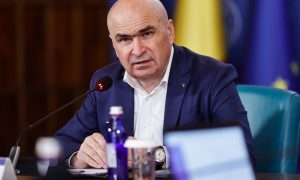
What follows in this material is the result of an investigation carried out over several months by Q Magazine into the contracts committed by the Romanian state under the SAFE Programme — an investigation that can at any moment serve as the basis for an in-depth inquiry by the state’s judicial bodies. If they were interested, of course.
- Măsura arestului la domiciliu pentru Horațiu Potra a fost ridicată
- Nota 10 se premiază: Guvernul acordă bani absolvenților de top
- Guvernul confirmă întâlnirea cu comisarul european pentru justiție pe legea ANI, dar infirmă categoric că a cerut tăierea banilor
- Patriarhul Daniel: Familia, conjugală, naturală, tradițională, se află în criză
- Muzica românească își premiază excelența. Gala UCMR ajunge la a 55-a ediție
First the supplier was chosen; then the law was written. Four weeks of November 2025 explain everything the Government has been refusing to explain for two months.
3 November: Prime Minister Ilie Bolojan and Armin Papperger, CEO of Rheinmetall, attend together the signing of the first partnership. 6 November: the draft SAFE emergency ordinance is registered. 12 November: the Government publicly announces “an understanding on industrial cooperation and the supply of military equipment” with Rheinmetall. 17 November: the CSAT (Supreme Council of National Defence) endorses the draft ordinance. 20 November: the ordinance is adopted. 24 November: the CSAT approves the €16.68 billion plan, borrowed by the Romanian state through the European Commission over a period of 45 years. 28 November: the application is sent to Brussels.
The rule and the partner were negotiated in parallel — and the partner was announced before the rule. Eight months later, the Chancellery admits in writing, at Q Magazine’s request, that for none of the fifteen projects of the Romanian Army was there ever a ranking between at least two eligible bidders: “the hypothesis is not applicable.” Of course it is not. A race with a single runner needs no stopwatch.
I. November: four weeks in which everything was decided

There are files that hide in safes, and files that sit defiantly in plain sight. This one belongs to the second category. Everything that follows comes from official documents of the Romanian state, published by the state itself — government press releases, CSAT decisions, the Official Gazette — and from institutionally signed replies in the possession of the Q Magazine editorial team. We broke into no archive. We simply read, in order. We have written about the SAFE Programme here, here, here and here.
3 November 2025. In Bucharest, the contract establishing Rheinmetall Victoria SA is signed — the partnership between Pirochim Victoria, Romarm’s subsidiary, and the German group. Prime Minister Ilie Bolojan and Rheinmetall’s chief executive, Armin Papperger, attend the event. From that moment on, the collaboration is publicly tied to the resources of the SAFE programme.
“Through this partnership, Romania is emerging as a player with potential in the defence industry of South-East Europe.” — Ilie Bolojan. Photo: Government of Romania
6 November 2025. The draft emergency ordinance that will organise the entire programme — the identification of suppliers, the evaluation, the selection — is registered under no. DSN1/1686. The document attesting to this is the CSAT decision itself, published on the Senate’s website.
12 November 2025. A Rheinmetall delegation led by Papperger returns to Victoria Palace — “a new meeting,” says the official press release, “following the discussions of recent weeks.” At its close, the Government publishes on its official website, in black and white:
“The Government and the Rheinmetall Company have reached an understanding on industrial cooperation and the supply of military equipment, which addresses Romania’s immediate needs. This concerns equipping the Army with state-of-the-art equipment to be financed from the SAFE programme…”
— Press release of the Government of Romania, gov.ro, 12 November 2025

Mihai Jurca, to the Prime Minister’s left. Photo: Government of Romania
The same press release also announces the route: the details will be clarified “in the coming days,” so that “the possible cooperation can be approved by the Supreme Council of National Defence at its first meeting in November, so that Romania’s package for accessing the more than €16.5 billion allocated through SAFE can be finalised.” In closing, the Prime Minister thanks by name the head of the Chancellery, Mihai Jurca — the man who would go on to lead the body tasked by law with “identifying” the suppliers.
17 November 2025. The CSAT endorses the draft ordinance.
20 November: the Government adopts it and publishes it the same day — Emergency Ordinance (GEO) no. 62/2025, Official Gazette no. 1071. Only now do the rules formally exist: requests for information sent to operators on a list approved by the head of the Chancellery; evaluation on two criteria, price (60%) and delivery time (40%); a descending ranking whenever several bidders meet the requirements; analysis documents endorsed by the Prime Minister; approval by the CSAT.
24 November 2025. By Decision no. 138, the CSAT approves the Investment Plan: €16,680,055,394. The official press release of the meeting contains a sentence that deserves framing: “Romania’s most substantial programmes carry a domestic production requirement of at least 50%, in some cases this share to reach 100%.” Remember those figures. We shall return to them.
28 November: Romania’s application is officially dispatched to the European Commission.
We can, however, state something serious enough, because it is fully documented: the selection rule and the relationship with the supplier were built in parallel, within the same three weeks, by the same people — and the “supply understanding” was publicly announced before the rule existed. In a state governed by the rule of law, the rule selects the partner. Here, the public chronology shows the reverse.
3 November — the partnership. 6 November — the draft law. 12 November — the understanding. 20 November — the law. 24 November — the plan. In that order.
II. The July confession
Eight months later, on 16 June 2026, Q Magazine filed fifteen questions with the Prime Minister’s Chancellery under Law 544/2001 on free access to public information — each with its legal basis indicated and with three mandatory response options: disclose the document; declare in writing that it does not exist; or refuse with reasons, citing the exact article of the law. There was no fourth option. The first question was both the simplest and the hardest: where is the ranking? (The full Q Magazine correspondence with the state institutions can be found at the end of this article.)
The reply, which arrived in July, chooses none of the three options — for none of the fifteen questions. It recites the law, mechanism by mechanism, for an entire paragraph. It explains, impeccably, what should have happened. And then, at the end of the sentence, it adds:
“The hypothesis provided for by the aforementioned legal provisions is not applicable in the case of the 15 projects covered by the analysis document comprising the MApN’s projects.”
— Prime Minister’s Chancellery, reply to request no. 257/DCRP/16.06.2026
Read it once more. Slowly. The “hypothesis” the sentence refers to is one and one only: several bidders respond and meet the requirements — the situation that makes a ranking mandatory. The Chancellery declares, under institutional signature, that this situation never arose. Not on one project. On all fifteen.
Armoured vehicles, ships, ammunition, air defence, communications — markets in which dozens of companies operate — and never, anywhere, two eligible bidders to compare. Consequently: no ranking. And the two legal criteria — price and delivery time — invoked for months as proof of rigour, never had anything to evaluate.
The same reply tells us two more things. That the Prime Minister’s endorsement — the only personal political filter the law places between the technical analysis and the CSAT — consisted of “signing the transmittal page,” “and not the issuing of a distinct administrative act”: no registration number disclosed, no list of the documents covered by that signature. And that the minutes of the Working Group which proposed the suppliers were drawn up “where appropriate” and are of an “internal character” — an exception that appears nowhere in Law 544/2001. The Prime Minister’s Chancellery is therefore invoking a subjective framework with no basis in law.
We then asked for the absolute minimum: three figures for each project. How many operators were invited. How many responded. How many met the requirements. Forty-five figures in total. We received none. Not even a refusal to disclose them. The Government of Romania is, in effect, “classifying” even arithmetic.
For two months we wrote that the state was refusing to show the documents of the competition under the SAFE programme. We were wrong. The state has politely informed us that there was no need for them to exist.

Prime Minister Ilie Bolojan with Rheinmetall AG CEO Armin Papperger.
III. Four possible explanations. All of them demand documents
How does a state end up in a situation where, for fifteen different military projects, there are not even two eligible responses to compare?
There are exactly four explanations, and each carries a different degree of gravity.
The first: a single operator was invited for each project — competition was excluded by design.
The second: several were invited, but only one responded — in which case it must be explained why an entire market ignored contracts worth billions.
The third: several responded, but all except one were declared non-compliant — in which case the grounds for elimination must be made public, for every rejected bidder.
The fourth: the requirements were drawn so narrowly that only one product, known in advance, could pass the filter — the gravest of all, and precisely the one that only documents can disprove.
There is, however, a fifth explanation as well — and it is not one we deduced. You have already read it above: the Government itself published it, on its own website, in November.
Placed side by side — the supply understanding announced before the law, and the admission that the hypothesis of competition never materialised on any project — the state’s own two documents lead, by themselves, to the conclusion that risks becoming the lasting one: the spring procedure was not an open selection, but the administrative formalisation of a political choice announced beforehand.
We do not assert this as established fact. We state it as the conclusion the Government can overturn at any moment — with documents. To this day, it has published none.
And one more thing, because we hold to rigour: the partner chosen without any documented comparison is not just any partner. Following the investigation by German prosecutors in Bremen into arms contracts with Greece, the subsidiary Rheinmetall Defence Electronics accepted a total penalty of more than €37 million, after it was established that Greek officials had been bribed; chief executive Armin Papperger — the same man received at Victoria Palace — told the Süddeutsche Zeitung at the time: “Mistakes were made at Rheinmetall and we take responsibility for them.”
We do not claim, nor do we suggest, that anything similar took place in Romania. We claim only this: it is precisely for such situations that modern legislation invented rankings, minutes, and endorsements bearing registration numbers. In the SAFE file, all three are missing.
The question built specifically to distinguish between these explanations — the three figures per project — went unanswered. Even though — and here the circle closes — the reply had already given us all of them, in a single sentence: the hypothesis of several eligible bidders “is not applicable.”
We also place on record an April press report according to which, in the fighting-vehicle programme, the request for information was allegedly sent to a single operator: Rheinmetall. We do not treat it as proven fact — the institutions have not confirmed it. But as long as the Government withholds the figures that could disprove it within a minute, it remains — through the Government’s own refusal — impossible to disprove publicly. Whoever stays silent in the face of such a report does not deny it. He confirms it.

IV. The winner before the race
Here, now, is the chronology, day by day, drawn exclusively from official sources and public statements.
30 March 2026: GEO 21/2026 is published, amending the mechanism of the SAFE ordinance — and on the same day, according to the official chronology on the MApN’s (Ministry of National Defence) webpage, the ministry transmits to the Chancellery the analysis documents on the fulfilment of the operational requirements for its projects. The calendar coincidence is not, by itself, proof of any manipulation. It is, however, a mandatory audit point: were the analyses drawn up under the old rules or under the new ones — and who checked?
15 April: the Prime Minister “endorses” the analysis documents, by signature, without a distinct act.
22 April: the CSAT approves the projects and the operators, by Decision no. 71 — an unpublished document.
27–28 April: the selection becomes public; the official document transmitted to Parliament records, for the fighting-vehicle programme, that “the selected economic operator is Rheinmetall Automecanica SRL,” the procedure being “negotiation without prior publication of a contract notice under art. 4 para. (2) of GEO 62/2025.” Parliament endorses the amounts and the companies on 28 April. (No hearings, no request for supporting documents, no…, no…)
30 April: only now does the public learn, from the Minister of Defence, how much is actually produced in Romania — “Half the value of the Lynx is the turret… Overall it is a minimum of 40%” — and that the price had already risen by more than 12% against the initial estimate, through “additions to the equipment fit.”
11 May: Rheinmetall informs the Government that it no longer agrees to the negotiated terms and demands a reduction of the localisation level — government sources quoted by DeFapt.ro call the manoeuvre, verbatim, “blackmail”; MApN sources sum it up: “They are trying to give as little as possible and take as much as possible.”
That same day, the MApN issues an official statement: “the procedures for awarding the public procurement contracts are ongoing” — two weeks after the selection had been announced — and “the MApN will not sign public procurement contracts on disadvantageous terms.”
14 May: the head of the Chancellery, Mihai Jurca, publicly explains the concentration of contracts through a new logic — the German group could deliver ships, armoured vehicles, air defence and ammunition, and placing several products “in a single basket” would have yielded a discount, from roughly €6.4 billion down to €5.69 billion. The explanation may describe a legitimate commercial strategy. But it overturns the architecture of the law, which requires an analysis and a proposal for each project individually: was each operator chosen for each project — or was the group chosen first, with the projects placed into the basket afterwards? The discount calculation, the reference prices per project and the mandate for the “package” negotiation have never been published.
In those same days, at the BSDA defence exhibition, the configuration of the armoured vehicle for Romania was still being defined in public — which systems would be removed, which Romanian equipment would be integrated, how localisation might be raised from the “initial threshold of 40%.”
At the end of May: the signatures, at night — €5.69 billion to Rheinmetall entities, 68.3% of the Army’s package, under the signature of a government dismissed on 5 May.
Put this sequence before anyone who has ever organised a procurement, however small: the operator is declared selected at the end of April; the price, the product configuration and the Romanian production share are negotiated in May; the contracts are signed on deadline, under the pressure of the European calendar. The question is not rhetorical, and we address it formally to the Government: if the product, the final price and the industrial conditions were finalised AFTER the selection, on what exactly was the operator selected — and what purpose did the legal criteria of price and delivery time serve? An evaluation that discovers its object after having chosen its winner is not an evaluation. It is a confirmed reservation.
Selected in April. Negotiated in May. Evaluated — when?
V. The Prime Minister who endorsed — and found out from the press
On 4 June 2026, asked about the SAFE contract worth nearly €200 million between the SRI (Romanian Intelligence Service) and Digi, Prime Minister Ilie Bolojan declared on Euronews Romania: “this working group had no involvement whatsoever in the negotiations, which were conducted directly,” and then: “I found out from the press who signed this contract.” On the same day — the very same day — the Romanian Intelligence Service published an official statement saying exactly the opposite:
“The entire SAFE programme is conducted under the coordination of the Prime Minister’s Chancellery. The identification and selection of suppliers for the projects financed through SAFE is carried out within the inter-institutional Working Group coordinated by the Head of the Prime Minister’s Chancellery… The list of selected suppliers is approved by the Supreme Council of National Defence.”
— SRI, “Clarifications…”, official statement, 4 June 2026, sri.ro
Let us be precise, because precision here cuts harder than any adjective. The Prime Minister was under no obligation to endorse a ranking — a ranking exists only where there are at least two eligible bidders. He was, however, obliged, under art. 6 para. (2) of his own ordinance, to endorse the analysis documents — those proposing the economic operator, the estimated value and the cooperation requirements. The Chancellery confirmed to Q Magazine that the endorsement was given on 15 April, by the signing of the transmittal page. Formally, that may pass as a method of endorsement. Substantively, it does not answer the only question that matters: what did the documents contain, and what did the man who signed them actually verify?
From here, a dilemma with no elegant way out. Either the documents endorsed on 15 April contained the names of the operators — in which case the statement “I found out from the press” is incompatible with the documentary trail described by his own Chancellery. Or they did not — in which case the Prime Minister endorsed, for €8.33 billion, documents from which the very legal object of the endorsement was missing: that is, he failed to exercise the very power his own ordinance confers upon him. We do not assert which branch is the true one. We assert that one of them is — and that each, in its own way, describes a failure: of truth, or of office. The document that settles the matter exists; it bears a date and a signature. It is not being shown to us.

VI. The 60% that does not exist on paper
Let us return to the sentence in the CSAT press release of 24 November: domestic production “of at least 50%, in some cases… 100%.”
On 17 May, the Minister of Defence declared on TVR Info that the programmes “carry an obligation for 60% of total production to take place in Romania” — an “obligation” that appears nowhere among the legal criteria. In the flagship contract, the publicly recorded share is “a minimum of 40%.” On 11 May, the supplier was officially demanding that even that be reduced. And when we asked the Chancellery for the document setting firm thresholds for each project, the answer was that the cooperation indicators “may include, where appropriate,” components made in Romania. “May include, where appropriate” — on a debt stretching towards the year 2071.
And there is one more confusion that must be dispelled, because official rhetoric rests upon it. The European SAFE Regulation requires that at least 65 per cent of the cost of the components of the final product originate in eligible participating states. That is a European eligibility condition — not an obligation for anything in particular to be produced in Romania. A product can satisfy the European condition perfectly without a single significant part being manufactured in Romania. The two percentages are not interchangeable. And as long as the Government does not show the contractual percentage, the calculation base, the investment schedule and the penalty clauses, “production in Romania” is not a demonstrated achievement. It is a press-conference promise.
Meanwhile, the arithmetic of prices has flowed in one direction only. The increases accepted against the initial estimates, as documented by the investigative press: +12% on the fighting vehicles, roughly +20% on the patrol ships, +47% on the divers’ intervention boats. Within the same window, the only project with full production in Romania — the Piranha 5, at Uzina Mecanică București — was rejected. The reason invoked: the price increase.
The same state, the same weeks: the German price that rises gets signed; the Romanian price that rises gets rejected.
VII. The lawyer from Frankfurt
One practical question remains: if the firm percentages do not exist on paper, who wrote the clauses that were supposed to protect Romania?
Between 22 and 30 April 2026 — precisely the window in which the CSAT was approving the projects, on 22 April, and Parliament’s joint committees were endorsing them, on 28 April — the Prime Minister’s Chancellery received legal assistance from the German law firm CMS. The invoice, issued on 13 May 2026: 95,257 lei — over €19,000 for nine days. The total contract: 306,000 lei plus VAT. The object of the services, according to the invoice: assistance in negotiating the industrial cooperation agreements under the SAFE programme. That is, precisely the mechanisms that were supposed to guarantee production in Romania — the ones for which, today, not a single document with a firm percentage can be produced.

Working on defence matters at CMS is Cristian Băcanu — a former PNL deputy, PNL member, honorary adviser to Deputy Prime Minister Oana Gheorghiu. And CMS, according to the public accusation made by the PSD, has acted as legal representative of the Rheinmetall group “in many other legal matters.” Deputy Prime Minister Tánczos Barna, a member of the same government, stated publicly: “These things are thoroughly unhealthy.” The Prime Minister stated: “I see no form of conflict of interest.”
We do not claim that a conflict of interest existed — that is a legal qualification, and the press cannot make it. We note only this: the Romanian state paid, in order to defend itself against a supplier, a law firm that works with that supplier. And the only man who sees no problem here is the one who signed.
The state paid a lawyer to defend it from the supplier. The lawyer works with the supplier. The Prime Minister sees no problem.
VIII. Mangalia: the promise, and the auction no one came to
While this file was being closed, reality itself delivered the proof that the withheld documents should have contained.
On 28 April 2026, in the press conference in which he defended the SAFE contracts, Defence Minister Radu Miruță said (min. 2:26 and min. 2:39–3:06, repeated at min. 6:52): “When I was at the Ministry of the Economy, I promised the people at the Mangalia 2 Mai Shipyard that they would continue to have work there and that the shipyard would be saved.” And he publicly explained the architecture: the four ships — a €920 million contract — were included in SAFE “on the condition, recorded and approved in the Romanian Parliament, that they be built at the Mangalia 2 Mai Shipyard, which is to be modernised and managed by Rheinmetall.” That, then, was the public justification of the naval contract: saving Mangalia. The ship pulls the shipyard. The shipyard pulls the town.
On 27 June 2026, at 1 p.m., the registration deadline expired for the first auction for the sale of the bankrupt shipyard. Starting price: €184 million. Not a single offer arrived at the liquidator’s address. Not one investor. And the great absentee was precisely the company the Romanian authorities had repeatedly claimed would take over and modernise the shipyard. The company to which the Romanian state had committed, by contract, €920 million for ships that were supposed to be built there did not even register for the auction — and officially stated that “the total size of the Mangalia assets exceeds its current needs.”
Rheinmetall’s public communications had, in fact, always been more cautious than the authorities’ enthusiasm: the company was “analysing,” together with a partner, the possibility of a takeover. That was all.

Meanwhile, the shipyard’s 1,011 employees were laid off in waves; the last 271 entered their notice period, and their contracts ended around 16 July. The second auction is scheduled for 29 July, at the same price. The Minister of Defence passes the questions on to the Ministry of the Economy. The Minister of the Economy admits the state cannot intervene in the bankruptcy proceedings. We do not know the exact content of the contractual obligation concerning the shipyard — and that is precisely why the contract must be published in its unclassified part.
Remember this sequence, because it is the entire file in miniature: a contract of nearly one billion euros, awarded without any documented ranking, publicly justified by an industrial condition — and at the first moment that condition could be tested with money on the table, the beneficiary of the contract did not show up. The state delivered the contract. The counterparty did not deliver even its presence.
€920 million for ships “at Mangalia.” At the auction for Mangalia: not one bidder. Not even the one under contract.
If the CSAT and Parliament approved the contracts with Rheinmetall on the condition that it save and produce at the Mangalia shipyard, and Rheinmetall did not even show up at the auction for the shipyard’s sale, does that not mean the commitments have not been honoured — and that the contracts must be terminated?
IX. What justice can do — and what the press cannot say
The public evidence does not, at this moment, establish the theft of seven billion euros, bribery, or a criminal group — and we will not assert what we cannot prove, because press exaggeration is the cheapest defence available to those concerned.
What does emerge, fully documented, is everything an investigation needs in order to be opened: a supply understanding announced before the rules; no ranking between two eligible operators, on any project — admitted in writing; the refusal to provide elementary figures; an eight-billion-euro endorsement without an act and without a disclosed registration number; minutes drawn up “where appropriate”; prices and industrial obligations negotiated after the approval of the operators; a “basket” that replaced the project-by-project evaluation required by the very law they themselves enacted; localisation promises melted down from 100% to “where appropriate.”
Abuse of office requires a breached duty under primary legislation, concrete conduct, a benefit and a damage. Negligence requires fault and harm. Intellectual forgery requires the knowing recording of untrue facts. Which of these is present here — or none — is not something Q Magazine can say. Only the documents can — if seized in time.
And there is something else, which the institutions in Bucharest seem to have forgotten: SAFE money is not Romanian money. It is an instrument of the European Union, and the protection of the Union’s financial interests has its own prosecution office — the European Public Prosecutor’s Office. The verification of this file no longer depends, therefore, exclusively on the prosecutors who keep silent.
In the meantime, the proportions of national justice remain these: for 20 state-funded places at a sports faculty, the Romanian state found military prosecutors, an official press release and hearings for the Chief of the Defence Staff — who enjoys the presumption of innocence and publicly remarked on “the at least curious character of the chosen moment.” For €7.5 billion contracted without any ranking, the same state has not found, to this day, even a single question.
And the Constitutional Court, asked whether a dismissed government had the right to legislate, postponed on 10 June, on 18 June and on 15 July — until 23 September. The explanatory memorandum in which the Government admits its own race against its own dismissal likewise awaits autumn, in the case file.
A justice system that sees perfectly well when looking down and goes blind when it must look up is no longer equal justice.
X. The list prosecutors could seize tomorrow morning
This article does not call for convictions. It calls for ten categories of documents, all identifiable, all dated, all held in the state’s archives: all versions of the draft GEO 62/2025, with endorsements and amendments, between 3 and 20 November 2025; the documents arising from the Bolojan–Papperger meetings of 3 and 12 November — mandates, minutes, memoranda, correspondence; the individual orders on industrial cooperation, for each project; the list of recipients of each request for information, the responses and the compliance reports; the successive versions of the technical requirements, with author and date; the analysis documents and the page endorsed by the Prime Minister on 15 April; the calculation of the “basket” discount and the mandate for the package negotiation; the minutes and registers of the Working Group; the contracts and industrial cooperation agreements, with thresholds, penalties and certification mechanism; the correspondence concerning the price increases and the reduction of localisation.
The Court of Accounts can audit.
The Competition Council can analyse.
Parliament can hold hearings.
The Prosecutor General’s Office, the DNA (National Anticorruption Directorate) and the European Public Prosecutor’s Office can seize the documents before they go “astray.” Each of these institutions has the legal competence to begin tomorrow morning.
If everything is legal, verification will strengthen Romanians’ trust in the institutions of the state. If it is not, every day of silence enlarges the damage.
XI. The right to an explanation
Perhaps all the equipment is necessary — we live next door to a war, and a Russian drone struck an apartment block in Galați on the very night contracts under the SAFE programme were being signed. Perhaps Rheinmetall was, in every single case, the only operator capable of delivering on time. Perhaps the package secured a better price and genuine localisation.
Sincerely, we would like that to be true — because the debt is collective, and the equipment protects us all.
The Government can demonstrate all of this in a single day: by publishing the unclassified documents and indicating the exact legal basis of every refusal. Not press releases. Documents.
Until then, the last word does not belong to the institutions. It belongs to you, the ones who pay. A child born this summer will be forty-five years old when Romania settles the final instalment of this loan. That child voted for no one and was asked nothing — yet already carries the debt signed in his name, in the night, by a dismissed government.
In Mangalia, people who spent a lifetime building ships emptied their lockers this week — in the town that was promised, with a hand resting on a €920 million contract, that it would be saved.
At Cugir and at Sadu, factories that have been making armaments for a century learn from press releases what share falls to them — or rather, does not fall to them.
This country took to the streets, in the hundreds of thousands, over an ordinance passed in the night. Today it stands before an understanding announced before the law, a selection announced before the conditions, a debt running until 2071 — and an official reply politely informing it that its questions “are not applicable.”
The suspicion is not the press’s. It is yours. And it is legitimate: they have committed your future with your own money, and they refuse to show you the receipt. You have the right to demand an account — and the power not to stop until you receive one.
Almost a century after the Škoda affair — in which the Romanian state could pin down not a single name and acquitted them all, and history passed judgment in the courts’ stead, with no right of appeal — the Government of Romania has one path left to halt the comparison: the documents.
All of them!!!
If it is right, we will write so. If it is not — history will write it; and history, unlike the institutions of the Romanian state, never postpones anything until… September.
First the supplier. Then the law. And at the end of it all: “the hypothesis is not applicable” — and not a single person held to answer. WE HAVE PUT IT IN WRITING!
Note of rigour: this article describes facts, contradictions and hypotheses that warrant verification. It does not assert the criminal guilt of any person or company. The report concerning the transmission of the RFI to a single operator is marked as institutionally unconfirmed. Q Magazine requested the right of reply from the institutions and entities mentioned, prior to publication.
Q Magazine’s correspondence with the institutions:
Correspondence Q MAGAZINE — STATE INSTITUTIONS — THE SAFE PROGRAMME