When I first met her, she appeared gentle, gracious, warm, modest and of a calm simplicity contrasting with a society trying too hard to appear sophisticated.
Citește AICI varianta în limba română
“I have no time to buy her some flowers”, I say to myself upset whilst I am rushing down London streets, on a Thursday evening, to get to White Bear Theatre. I cannot wait to see her play. She was nervous and fearful when I talked to her, before she started to be in this play. She was going to be in this play for a month, every evening – except on Sundays and Mondays –, even twice on Saturdays.
The day we spoke, it was after rehearsals and she was exhausted. She was anxiously wondering how it was going to be once they started the live performances. I finally get to the theatre. I see a big poster – The Gift of the Gab – in which a familiar face, amazingly beautiful, looks back at me: Mădălina Bellariu. The only female actor in the play.
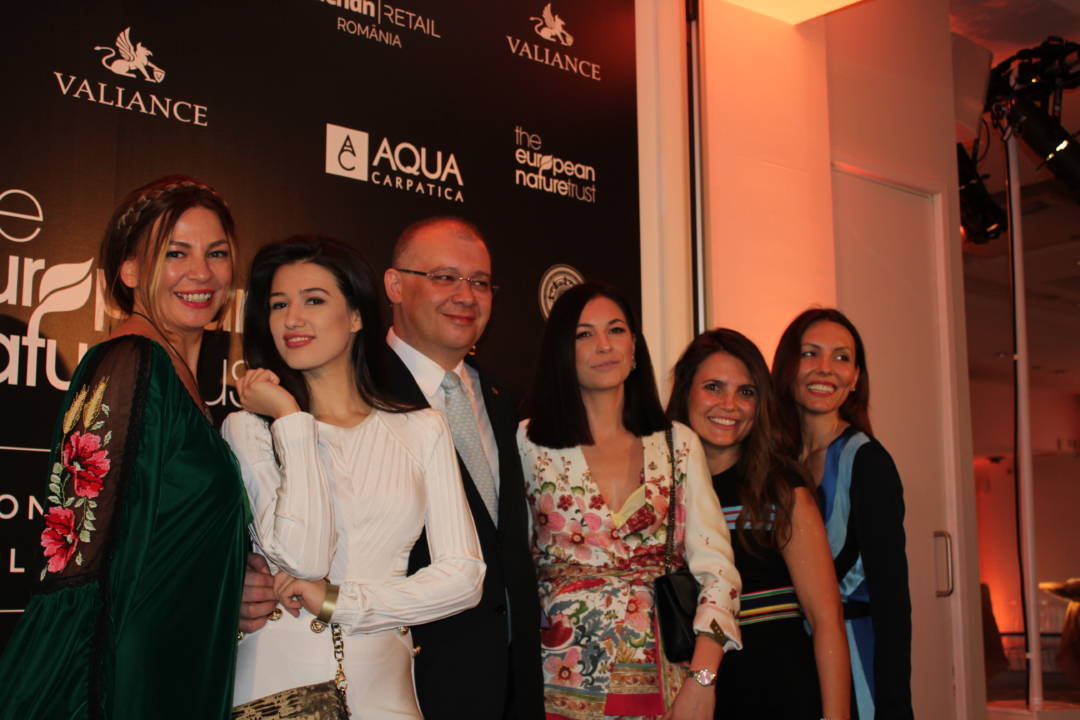

I had previously read about her role in The Young Pope, I knew about her amazing beauty and talent, so I was pleasantly surprised when, upon meeting her at a film premiere during BAFTA, I found her to be free of a big ego, of a “star in the making”.
She has a gentle handshake to go with the sweetest smile in the world. Yet, behind this grace, you can sense a strong willpower. Behind the fragility, you can find, if you were paying enough attention, the discipline, determination and professionalism of a soldier.
Behind the genuine innocence, there is also the head-spinning sensuality. Her smile, as natural as that of a child, makes her instantly pleasant. And looking at her, you start to understand why it would have been very hard, if not impossible, for the film director of The Young Pope to find a better “temptation” for the young pope.
You can rarely find such a natural mix of innocence, tenderness and mind-blowing sensuality, lacking any vulgarity.
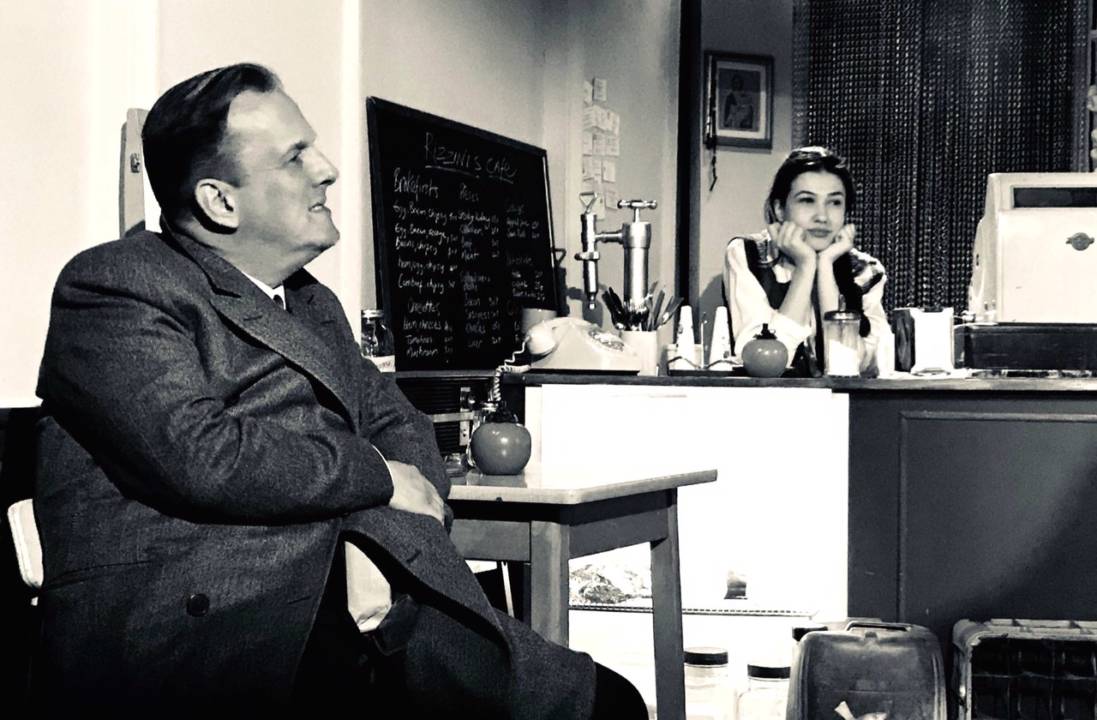
Concetta
We are inside the theatre; the stage is so close… I was never so close to the actors. I am nervous as if I were in the play. The Gift of the Gab is set in Brighton, in 1979, in Rizzini’s, a cheap coffee shop managed by hot-blooded Ric and his beautiful daughter, Concetta.
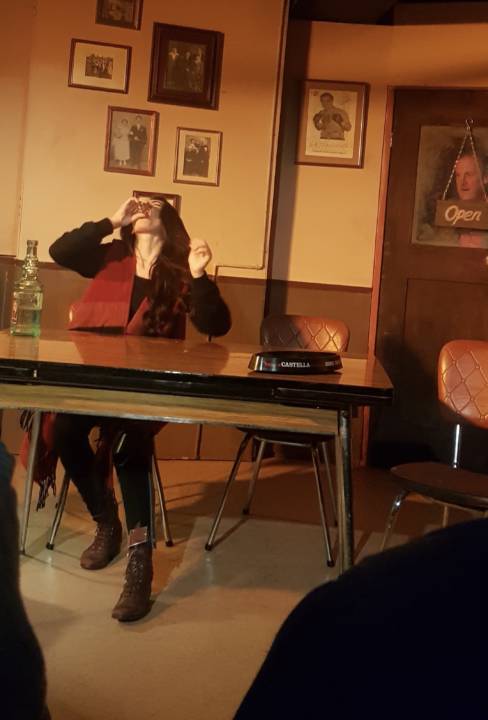
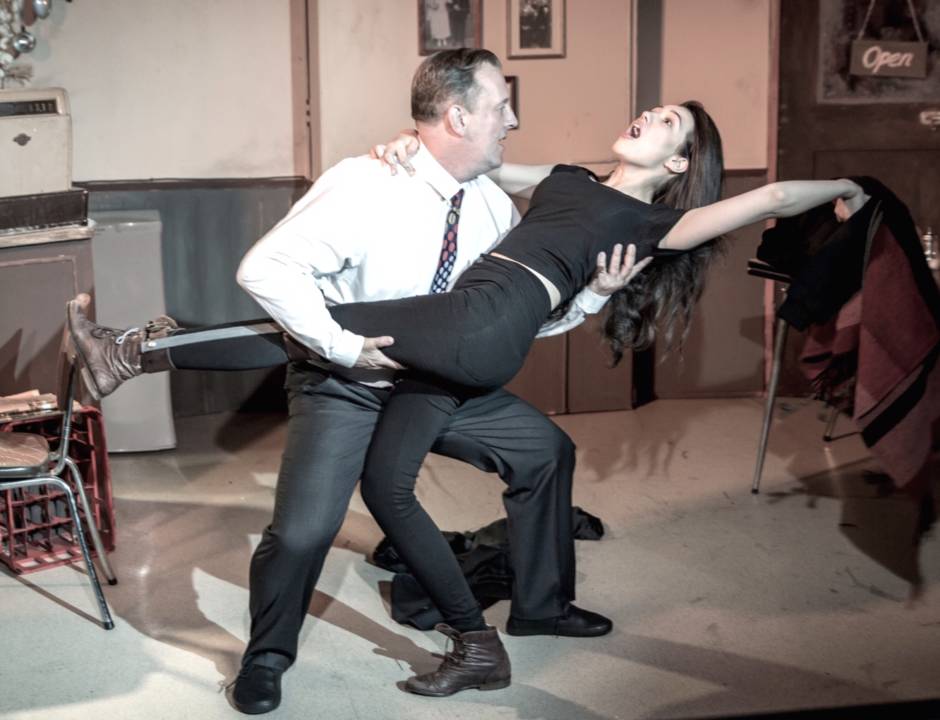
Innocent at times, seductive at others, with a frothy Italian accent, Mădălina is wonderful. She shows childlike joy when receiving a musical score as a present. Now she vibrates listening to a melody, now she is bored to death. She is being seductive, she is dreaming, she is arguing with her father, crying, suffering, struggling to escape the setting which makes her feel like a prisoner, even if only through the piano lessons she’s diligently taking. She is hungry for love and to be free, she fights to fill her empty and boring life.
She is in love or rather deluding herself that she’s in love – a skilful interpretation in Mădălina’s play.
Read here: From the Bible to space – How jews changed the world.
Concetta is challenging for the actor in every scene.
I asked Mădălina what this role meant for her and what was the most special moment whilst performing.
“Concetta Rizzini has a limp because of polio and this is representative, metaphorically, of the character’s state of mind: a soul running with a limp towards being free, a bird yearning to fly, but whose wings are broken. Even though she starts as just a funny character, she is a symbol of the mentality and morality of the middle class caught in the struggle between an imperfect reality and the dream of a perfect world.
The hope of such characters is the force pushing the world ahead. I enjoyed playing the role of Concetta, because she is challenging for the actor in every scene. Her unassuming outlook on life, her joy for life, the way she enjoys the simplest things… she’s, in many ways, an inspiration for me.
The happiest moment for me, whilst playing this character, was actually not a specific moment, but a state of mind that extended over two months. The joy in preparing for this role and in discovering this character, embodying Concetta and discovering a new facet of hers with every performance made every
moment be, in effect, the most memorable moment”.
I was curious to find out if she would have liked to do something differently: “I wouldn’t do anything differently because every day was actually different, in space and time. I lived as this character for 2 months and every performance was for me a new day, not yet discovered by Concetta Rissini. Besides, we, the actors, evolved every day under the guidance from our director”.
Read here The interview with former minister Yossi Beilin
“Is her talent matching her beauty?”
I will share with you a lovely letter about Mădălina that I received from director Simon David Eden, hoping it will bring you as much joy and pride as it did to me:
“Dear Alexandra,
Thank you for the nice words about our play, I am pleased that you enjoyed it. This play means a lot to me because it’s inspired by my personal experience whilst growing up in Brighton on the Southern coast of England, in the 1970s and by the people that I have met during my youth, which was spent in such a “wrong”, yet valuable manner. It is also because it took me almost eight years from writing the first draft to having the play into production, so I’m very pleased to be able to finally show it to people.
It is quite rare for a writer/director to bring together his first choices when casting for a play, but this happened for this production. As for Mădălina – she was the only woman in a cast of seven people –, as soon as she auditioned, I simply could not imagine somebody else playing Concetta.
Although I have seen four other actresses before her – actresses which were wonderful and talented and all of them speaking Italian – Mădălina surprised everyone in the room – me, as the writer/ director, but also the producer and the casting director.
And it’s not only because she is so beautiful; she is in fact so beautiful that we asked ourselves if her talent would match her beauty. But even before she finished the scenes she had prepared for this audition it was clear that she has that rare and shiny mix of physical beauty and a wonderful acting instinct and sense of humour. Timing is something that can’t be taught in comedy, but Mădălina has it in her DNA.
Another thing that I do when casting for a role is paying attention to the actors’ connection. How will each actor adapt to the whole ensemble? How are they working together? This involves a lot of guessing many times, of course, but my instinct regarding Mădălina was that she is taking her roles very seriously, that she really wanted this role and that she asked very smart questions during the audition.
This proved to be true during the three weeks of rehearsals. It was a joy working with all the actors and particularly with Mădălina, who was dedicated, disciplined and very professional.
As far as the play goes, she brought an irresistible magic and a lot of authenticity on the stage every evening and she even contributed with one of the lines in the play that makes everyone burst into laughter. Again, it’s about following your natural instincts, and I was smart enough to keep that line on the remaining shows.
I am thankful to Mădălina! She is now in the final draft of the play, which will be forever in the Modern Playscripts collection held by the British Library.
I am on my way to the last show for this play when writing this letter. There’s talk about a potential transfer and also a comedy sitcom inspired by this play, a series which I would write and which I would co-produce, with Matt Lipsey as a director (BAFTA/EMMY winner for hits like Little Britain, Psychoville and Man Down). He liked how Mădălina played this character and we’re both excited about how we could build on this, together, for a play in a lengthier format.
Film producer Christopher Simon (Miss You Already) also came to see the show and he is also convinced that Mădălina is a star in the making. I fully agree and I really hope to have the chance of working again with her in the near future”.
I’ll stop here about Mădălina, for now. I had no time to get her flowers, but I wish for these words to stay alive in her soul forever, like a bouquet made of happy thoughts, of thanks and admiration, of gratitude that, on a May evening in London, “My Romania abroad” was so beautiful, hardworking, disciplined, talented, cherished and loved.