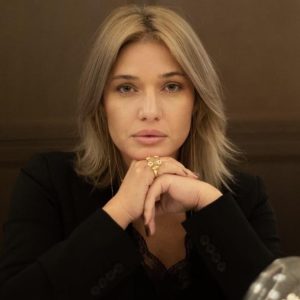
In a world where information can hurt as precisely as a weapon, DONA TUDOR takes on a dual role: witness in the field and researcher of the mechanisms that shape our minds. Beyond bibliographies and concepts, behind this voice lie years of front lines, people, fears, decisions, the achievement of becoming the first female doctor of military sciences in Romania, but also a personal life lived with discretion and dignity. She spoke about all this for Q Magazine.
- Acordul Mercosur a intrat în vigoare
- Bolojan: Pensia specială nu va mai putea fi cumulată cu salariul în sectorul public. CSM arată că proiectul adoptat de Guvern e neconstituțional
- Topul libertății presei: România, locul 49 mondial. Ce state africane o depășesc
- Q Magazine face-to-face with Alexandru Balan. Pawn. Spy. Traitor.
- Din fabrica Philip Morris România de la Otopeni spre 54 de țări, pe 5 continente

Dona Tudor made her debut at the age of 15, in ninth grade, at the radio station in the commune of Vida, which became the town of Videle in 1968. Since then, she has been working in the media. She has 38 years, 6 months, and 5 days of service at Romanian Radio and Television. The rest of her 45 years of service have been in university education. She is currently a permanent contributor to the cultural magazine Leviathan.

PAYMENT FOR REWARD
Q Magazine: “What should remain after the end of the world? A reporter.” Why did you choose this motto—attributed to Nicolae Iorga—and how much or what did it cost you to carry it as a profession and as an identity?
Dona Tudor: From so many fronts, I understood that not only does the world need a reporter, but the reporter also needs a place, within himself, where the truth can remain intact. When order breaks down, when people are pushed to the margins of their own lives, that simple need arises: for someone to see and tell. Not as a form of heroism, but as a duty of witness.
The cost was a loneliness that never goes away. Today, however, I would not let it go, because it is mine and, paradoxically, it protects me. You learn to carry your fears quietly, not to place them on anyone else’s shoulders.
Over time, you pay with pieces of yourself: your sleep, your trust, your naivety in believing that the truth, once spoken, automatically heals.
You were an accredited journalist in theaters of operations for 10 years, on missions ranging from the breakup of Yugoslavia to Kandahar, Afghanistan. When was the moment you felt, very clearly, that “something is changing in me here”?
It was early on, at the train station in Sežana, on the border with Italy, when I found myself lined up in a row of refugees. A year later, in the camps near Belgrade, at the beginning of the conflict in the former Yugoslavia, the feeling was confirmed.
There I understood that “news” is never just news: it is a room you enter with your shoes full of moral mud. And that every sentence you write or say into the microphone can lift a person up or crush them once again.
Over time, I understood that I am not just a mind. I am also a body. And my body is not a journalist. It is made of flesh and blood and remembers, no matter how much I want to forget: the pulse, the tension, the smells, the sounds, the fear, the adrenaline, the exhaustion, the sleeplessness.
In Sarajevo, I slept fully clothed, with grenades at the window. In Angola, I didn’t put on my boots until a soldier checked them for scorpions. In Somalia, I learned not to crush mosquitoes, but to blow them away gently. In Kandahar, I washed with water only once in a week; the rest of the time, I learned to wash with sand. In Iraq, in Nassiriya, I took shelter from a sandstorm in the small church in the camp—soothing, protective.
Trifles. Fragments. Not years of life, but life from years.
Later, on the way to Kandahar, the change deepened. I began to feel not only what was happening, but also how the perception of what was happening was being constructed.
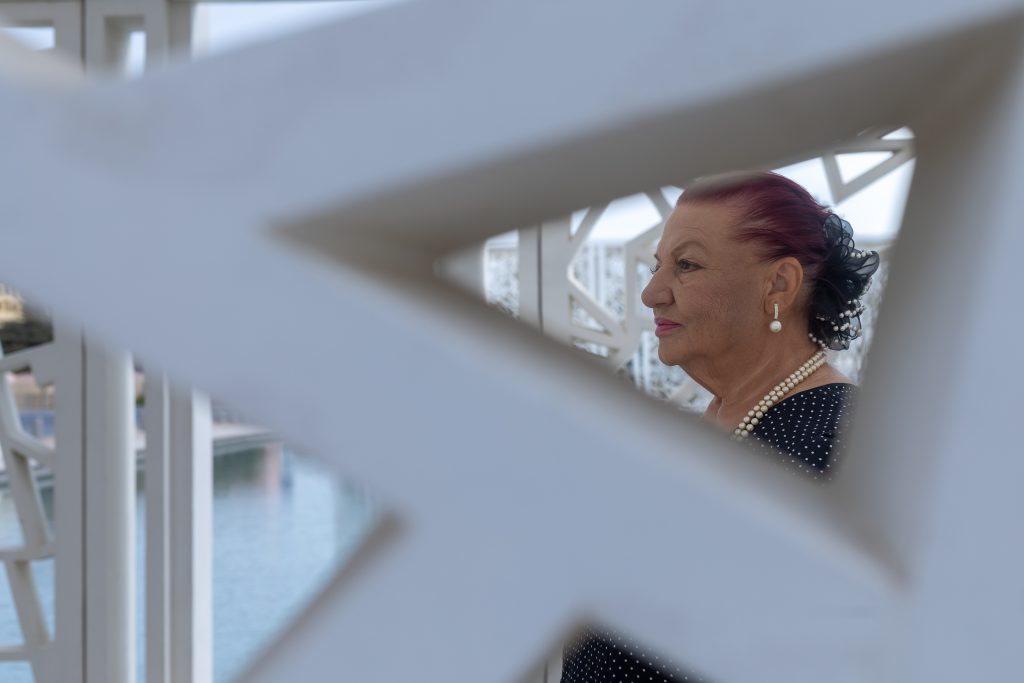
Dona Tudor was the first woman in Romania to be a war correspondent for TVR in Bosnia in 1994.
UNTRAVELLABLE SUFFERING
And when you close your eyes, what is the first image that comes to mind: a gesture, a glance, a sentence heard in passing?
In a field near Belgrade, in a refugee camp, a five- or six-year-old boy sat next to a small bundle. He was waiting. He wasn’t crying. He was just looking. And his gaze was too mature—like a wound that had dried too quickly.
In places like this, tears are a luxury. Energy is reserved for survival.
I can also remember the sounds: the rustling of aid bags, hurried footsteps, a language you don’t fully understand, but whose pain you recognize immediately.
That has always stayed with me: the fact that suffering needs no translation.
Today, with the passage of time, if you were to symbolically unpack that “frontline backpack,” what would you find inside: fear, lucidity, guilt, courage, prayers, rules, protocols, security, ethics?
First and foremost, I would find discipline. I am still not perfect in this regard—I still lose my rhythm, but I realize it and correct myself. Journalists, even if they are civilians and accredited in a conflict or war zone, live in that space according to rules and protocols in order to stay alive and not endanger others.
I would also find a form of prayer without words: not to become cynical, not to get used to evil.
And yes, I would also find fear. Not the fear of death—if I thought that way, I would never have left the television studio, where it is warm and safe—but the fear of making a mistake: that my reporting should correspond to reality, that I should not convey something that could fuel hatred or manipulate without my realizing it.
Because the truth of a reality is not only what you say, but also when you say it and what consequences you leave behind.
THE MOST IMPORTANT 15 CM IN WAR
In your recent book, “Information Aggression and Media Structures,” you investigate whether the evolution of media structures can induce insecurity and create new situations for military organizations. When did you first feel, intuitively, not theoretically, that information can become “aggression”?
In Sarajevo, after the attack in Markale Square. I was in the Ilijaš area, a kind of Otopeni of ours.
I don’t get carried away by emotion; emotion is the preferred fuel of manipulation.
Bullets have a brutal sincerity: you know where they come from and you know what they do. Narratives, words, stories are more treacherous. They can colonize your thinking without you even noticing.
An American general, James Mattis, former Secretary of Defense of the United States, stubbornly repeated: “The most important 15 centimeters on the battlefield are those between your ears.”
When I understood that, in war, the media can become militarized and manipulation becomes a weapon—not metaphorically, but functionally, for support, justification, and influence—something essential clicked for me: there are battles in which not only your body is attacked, but your perception. And if you lose your perception, you can be led anywhere.
Today, armies have a new space for confrontation: virtual space. It makes me wonder how people with intellectual and cultural pretensions end up living in parallel realities, constantly fed by screens, in a comfortable screenosphere.
In this way, the invisible war becomes longer, stickier, harder to end. It is dangerous when the fabric of trust between institutions and the public slowly breaks down, when information is no longer just reporting but part of the “operation,” when a curve of disbelief appears between the army and the media, and when the logic of television ends up being dictated by the logic of the market.
When I returned from the front to my desk, with my scientific apparatus anchored in the reality I had experienced as a reporter, I analyzed informational aggression because it attacks not only the facts—the raw material of journalism—but also the procedures through which facts become knowledge: time, language, trust.
The production of media images is a force in motion. The media, in all its forms, is no longer a simple channel of communication, but a constituent factor of social existence. Media structures not only transmit reality, but also produce and reconstruct it.
The lived world is no longer just the sum of events, but the sum of events that are visible and significant in the media.
In this tension, the reporter-researcher finds himself between two visions: information as a mirror of reality and information as the infrastructure of the social world.
In my analysis, information is not decoration. It is force.
In my study, I identify a new situation for military organizations, political decision-makers, and people in the media, and I consider the management of social information in the media to be a dimension of collective security.
The aim of this book is to recover lucidity as a form of sovereignty—a sovereignty of the mind, without which no state can remain intact, no matter how solid its borders may be.
How do you recover from the trauma of the front line as a reporter? (What the military calls post-war syndrome.)
Returning from a conflict zone is not visible in your passport. It is visible in your body.
As a female reporter, I learned to be “strong” in a way that looks good on the outside but costs a lot on the inside. For me, strength was confused with not crying, with constant control, with not losing my temper. And post-war syndrome sets in exactly where you lose your temper, where the thread breaks, where you can no longer control anything.
In the field, I was a tool: two eyes, a microphone, a spine. I moved forward, because that’s how you do it in this profession—forward, even when people, smoke, and unanswered questions remain behind.
In the field, the woman in me becomes a survival mechanism. An extremely efficient mechanism that also works in everyday life: it closes certain doors so that I can move on, it closes off my crying, my trembling, my fragility. It closes off pleasure. And sometimes it closes off love too.
Healing was possible because, when I returned, “that” person was waiting for me at home. The man. My husband. The man in front of whom I was neither a heroine nor a reporter. Television did not cross the threshold with me. I was just his woman, who had seen too much and too many things. For 45 years, he was my cure for recovery, existence, and resilience.
He has been gone for two years now, and without him, I sometimes feel lost. Then there were the children, the house, the garden, the Labrador—because, in my free time, I was a wife and homemaker. The harmony of our home rubbed off on our two children, who are now successful, together with their families, both doctors of science in top fields, diplomacy and law.
THE TEMPERATURE OF SOCIETY
Can you describe the Romanian army with its pros and cons?
The army is beautiful for everyone, at parades, on television, in the theater, or at the cinema. In reality, however, it is not for everyone. Those who choose a military career must feel, in their destiny, that this is their path; otherwise, the army becomes a torment.
Today, the Romanian army looks like armor that has been worn for too long: polished in places, worn in places, still heavy in places. It has people who know their job, trained in multinational exercises, strengthened by the experience of missions.
On the Eastern Flank, the Romanian army is a guardian of NATO, with its gaze fixed where the map is no longer peaceful.
The positives are visible in its rigor, professionalism, alliances, and slow but sure progress toward modern technology. Romania’s ambition to modernize and its desire to count for more than yesterday are palpable.
The downsides lie in the old cracks: bureaucracy that still slows things down, tired infrastructure, and the loss of people that leaves gaps that are hard to fill.
Between ideal and reality, the army moves forward with dignity, but also with burdens that the public does not always see.
What did the elimination of compulsory military service generate in Romanian society?
It discreetly changed the temperature of society. It removed the barracks from the “natural” path of youth and shifted defense more into the care of those who consciously choose the military uniform.
For many young people, it meant freedom and continuity: school, work, and personal projects were no longer interrupted by that “imposed social parenthesis.”
The army was forced to professionalize, specialize, and build a different kind of prestige—not that of obligation, but of vocation.
There is also a qualitative gain in the relationship between the state and the citizen: the idea of not constraining, of not “taking” months or years of someone’s life just because tradition demands it.
Instead of the uniform worn by everyone, there is now a uniform worn by those who want to and can, which has gradually led to a culture of performance and more careful selection.
Of course, any change leaves gaps—not necessarily negative ones, but natural costs. Fewer people today have direct experience with military discipline, and the link between civilians and the military is built more through trust, education, and public contact than through personal experiences.
Romania has thus shifted the maturation of young people from the realm of social obligation to that of individual choice and transformed the army into a modern profession with a clearer and more assumed dignity.

Dona Tudor is the first woman in Romania to obtain a doctorate in military sciences, which she received from the Academy of Higher Military Studies in 1999 (now UNAp).
MENTAL BEAUTY RITUAL
How do you protect your mind when you feel that reality is becoming noise?
I am the harshest judge of my own existence, even when I have to “cut” into my own soul. I protect myself by slowing down and selecting.
As I write in my book, culture is increasingly becoming a continuous flow of fragmented information from the outside. If you let everything in, nothing remains yours.
I have a daily information ritual: I choose, I close, and I remain silent. I refuse to confuse knowledge with permanent connection.
I have never been in love with adrenaline. I prepared thoroughly for each foray. Before arriving at a location, before filming, I would look for former military attachés, people who had worked in the area years before. Because in a conflict or a war, the terrain is not a stage—it is a wound.
There are collective wounds, built from repeated images, carefully chosen words, deliberate omissions. There are PR agencies that specialise in this type of perception engineering. The public can be pushed towards consensus, even in the case of controversial decisions, if reality is served to them through the right filters.
Wars often end on the map faster than they end in people’s minds. And it must be said clearly: war does not always begin with the first bullet; sometimes it begins with the first sentence that takes away your compass.
Today, there is a lot of talk in journalism about courage.
I believe there is a quieter kind of courage, which begins after the courage to go to the front: it is the courage to stop. To no longer be a witness. To become, once again, an ordinary person.
It is the courage of my age – that of letting myself be touched by life, without armor

MISSIONS ON THE FRONT
It started with UNPROFOR, 1992, Yugoslavia; then the refugee camps near Belgrade and Sarajevo, 1994; UNOSOM II, Somalia, 1994; Vietnam – 20 years after the fall of Saigon; UNAVEM III, Angola, 1995; ALBA Mission, Albania, 1996; IFOR, Bosnia, 1997; SFOR I, Bosnia, 1998; SFOR II, Bosnia, 1999; Iraq, 2000 and 2002; Afghanistan, 2003. In the meantime, he was sent on special assignments to Lebanon, Israel, Iran, Egypt, and Libya – countries where the unrest of conflict smoldered beneath the surface.
In the Balkans, at first, he “saw how the air changes when a country breaks apart.” In Belgrade and Sežana, on the border with Italy, people no longer walked—they crept. They no longer greeted each other—they sized each other up. Sarajevo came as a wound that would not heal. The city was beautiful in that tragic way in which beauty remains standing, only to blame you. The broken windows made the light sharper, and the bullet holes in the walls looked like interrupted sentences.
In Somalia, he understood that the sun can be an interrogation. The light does not caress you, it weighs you down. Dust gets everywhere: in your eyes, in the water, in your voice, in your hair. You breathe heat into heat. There he understood that “poverty does not make you small – it makes you invisible.”
In Vietnam, twenty years after the fall of Saigon, he encountered another kind of silence: the silence that comes after history has taken its toll and left. “Life had found its course, but in the eyes of the elderly, a film that had not yet ended was still playing.”
Similarly, in Angola, Albania, and Bosnia—with IFOR and then SFOR I and II—she recognized the same image, changed in appearance: reconstruction. There she learned that “you can’t hammer nails as if you were hammering back the past” and that “silence is not always peace.”
Iraq taught her about “the warmth that enters your thoughts and makes them tremble.” From Afghanistan, she will never forget “the pink sunsets and their grandeur, which remain unchanged even when regimes change.” And she will never forget the eyes of children who know how to speak without their voices being heard. “Do you know what the children in Afghanistan asked for? A pen. A pencil. Something to write with.”
Military painter Valentin Tănase captured them like this. I saw his painting in the hallway of the Romanian Military Mission in Mons, where the Supreme Headquarters Allied Powers Europe (SHAPE), NATO’s operational center for Europe, is located.
THE MOST IMPORTANT MAN
Petre Morometescu, head of the radio station in the village of Vida. He paved the way—and gave him the microphone—to the world of broadcast journalism. In that makeshift studio, he learned to read the news, then to write it, to hold a microphone in his hand and to understand the responsibility of the voice. And the little girl who “had lived fifteen years by the light of a gas lamp, who had lost her boot in the mud of the alley on her way back from high school, later went on to travel the world, interview Jacques Chirac and General Võ Nguyên Giáp, and today sits among sheikhs and other important people.”