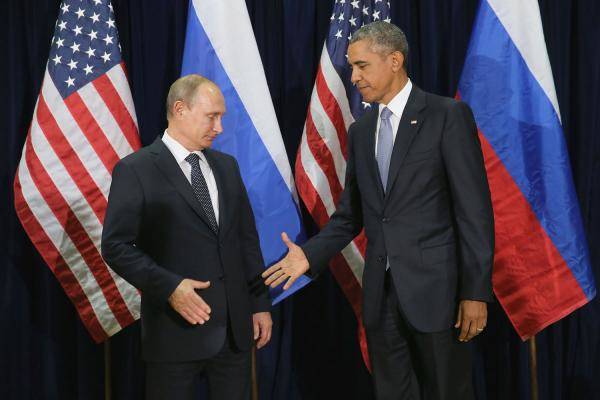

Following the latest revelations of email hacking that appear to be Russian-inspired (full disclosure: I was party to some of Colin Powell’s emails that were stolen and released), the media were reporting that the United States was increasing its espionage assets against Moscow. Despite the fragile agreement struck with Moscow over a Syrian cease-fire and the need for U.S.-Russian cooperation in the fight against the Islamic State, are both sides starting a new Cold War? And, if so, what would even greater spying inside Russia really achieve?
From its inception, the Soviet Union maintained a muscular spy service both domestically and internationally. The Cominform (Communist Information Bureau) and the Comintern (Communist International) it replaced in 1947 represented 30 years of combining external propaganda with recruiting fellow travelers and actual agents. After World War II, the United States and chiefly Britain turned their espionage assets onto the Soviet Union. John LeCarre and James Bond novels captured slices of this espionage world.
The United States and Soviet Union spent hundreds of billions of dollars and rubles on everything from very sophisticated and expensive space satellites to bribing officials to commit treason. The infamous Walker naval spy ring, Aldrich Ames and Robert Hanson were Americans turned traitors. Oleg Penkovsky, a disgruntled military intelligence colonel (GRU), was lesser known but a very important Soviet gone rogue.
Sometimes, spying became the theater of the absurd. A trip to Moscow was cancelled because of a fire in Spaso House, the home of the U.S. ambassador to Russia, started by a careless KGB agent. Surreptitiously checking surveillance equipment in Spaso House’s attic, the not-so-secret agent dropped a lit cigarette on a pile of old newspapers. No doubt we succumbed to similar incidents.
Russia has far greater access to American society due to our laws and constitutionally protected free speech and right of assembly than the United States has to the Russian public.

The questions that should be asked and answered first are: What would an increase in American espionage assets deployed against Russia look like? What are the benefits and gains? What would be the consequences, intended or otherwise, risks and possible Russian responses? And are there better alternatives than returning to what could become a replay of the spy versus spy Cold War days?
The weakest reason is retaliation for what appears to be increasing Russian attempts to manipulate American elections. Retaliation is only likely to provoke a counterresponse. In that regard, escalation may prove to be to Russia’s advantage.
A second reason is that as Russian actions, whether in cyberspace or in intimidating its neighbors, seem to be more bellicose, the relationship is headed on a nastier and darker course. One result is that the U.S. Defense Department is now planning to deter, and if war comes, to defeat Russia. If this unsettling priority persists, a new Cold War footing is setting in — hence the need for more espionage to gain intelligence on Russian military and other capabilities.
A third reason is political. By checking or matching Moscow’s more aggressive posture, the competition can be frozen or deadlocked. This is the equivalent of nuclear deterrence that was meant to prevent all-out conflict during the Cold War.
None of these reasons is compelling. As the Pentagon touts a “third offset” strategy to make transformational changes to military capability, an offset strategy to merely upping espionage is essential. Increasing numbers of NOC’s (CIA clandestine agents operating with non-official cover); more intrusive covert military activities largely with the nuclear submarine force; and other active means is probably a waste of money.
Open source intelligence has been a vital and viable alternative that has yet to reach its full potential in providing necessary insights on targets of interest. Questioning Russian officials in the course of normal diplomacy can yield treasure troves of intelligence. Dirty tricks such as identifying and releasing the hidden assets and wealth of Russian leaders or disclosing personal information such as the names of children studying in Western schools or embarrassing peccadilloes can mitigate bad behavior. Fourth, consulting with real experts on Russia from many different vantage points, especially business, is important.
During the Cold War, each of these techniques was tried. Today, in the 21st century, it is non-espionage techniques that are more important than traditional “spying.” Before falling prey to reflexive responses to heightened Russian aggressive policies with enhanced “espionage” examining alternatives beforehand is a much wiser course of action.