This year, a new Secretary General of the United Nations will be elected. Most likely, according to the principle of rotation, he will come from Eastern Europe. A chance that Romania is losing by opting out. Why don’t we have a candidate?
In the analysis of Q Magazine, we have asked this question starting with Romania’s President, Foreign Affairs Ministry and ending with a few career diplomats.
The simplest yet most honest answer is that Romania does not have a global vision, a clearly formulated strategy of foreign affairs policy and it does not have a coherent and strategic approach of promoting Romanians in international organizations. It has lost the ambition for big games; it does not have diplomats of international scale or, if it still has a few left, they are not supported in order not to enhance their figure; it thinks small and it does not have the capacity to explore opportunities.
Mircea Maliţa for Q Magazine: “Romania has lost its sovereignity”
It condemns itself to imprisonment in one strategic partnership where it gives everything and asks for nothing, it does not use the leverage that we have in the EU mechanisms and it is not making itself heard through its voice, but only through its geo-strategic position, for which it has no merit.

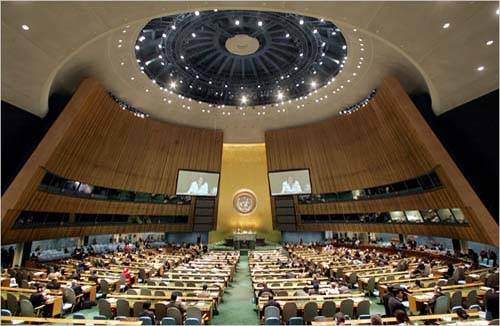
The UN is the largest international organization which includes 193 countries. Immediately after the Second World War, in 1945, 55 founding countries have signed the United Nations Charter, which would establish the UN. According to this document, the UN’s mission is to provide “world peace”, “human rights”, “international cooperation” and “respect for international law.” The UN Secretary General is appointed by the General Assembly on the recommendation of the UN Security Council and must be accepted by its five permanent members with veto powers. Over time, the position has been occupied by diplomats from Norway, Sweden, Burma, Austria, Peru, Egypt, Ghana and South Korea.
 At the end of this year, Ban Ki-Moon’s term expires and, because Eastern Europe has never given a secretary general, chances are high that the future SG will come from our region.
Romania held, between 2004 and 2005, the non-permanent, elected membership of the Security Council. It was when there still were global aspirations in Bucharest for our country. From this position I passed a draft resolution on UN cooperation with regional organizations in maintaining international peace and security, adopted on October 17, 2005 (RCS / 1631/2005). It is both the first Romanian resolution adopted in the Security Council, and also the first in the history of this UN body on cooperation between the UN and regional organizations.
On mae.ro, it states that “Romania, through its presence in various UN bodies, has the opportunity to participate in the decision-making process within the World Organisation, with influences on the international situation at a global level and in nearby geographical areas.” However, although it has been known that this year we can benefit from this opportunity, here we are with no candidate and without this objective.
Exercising all lucidity that the regional context and our difficult relationship with Russia urges us to, it does not mean that we have conquered this position, but it would have provided the framework for Romania, for one year, to launch important foreign policy issues such as combating terrorism and extreme violence, solving the problem of migration, promoting peacekeeping missions, conflict prevention at a global and regional level, supporting sustainable development and reduction of social inequality in different parts of the world. We could have negotiated, ultimately, our eventual support for another candidate, obtaining economic benefits and political assistance for causes we support, roles and influence in other important positions, but more, we would have proved that we are an important regional actor which has a strong opinion, an important voice and high aspirations.
Who does Romania fear?
While documenting the subject of the election of a new UN Secretary General, I have found with infinite sadness, disappointment and bewilderment that, many of those who make the country’s politics have had no idea of this moment in the lifecycle of the United Nations, and most of those whom we have consulted (of those involved in decision-making) could not give reasons WHY we have not entered in this race.
Off the record, everyone says that we have not had the chance to pass over Russia’s veto but no one has raised the issue of a nomination and negotiation.
All countries have received, since December 2015, a letter from the President of the General Assembly and the President, back then, of the Security Council through which they are invited to submit proposals for candidates. Some have already done so.
I have asked the Ministry of Foreign Affairs if Romania has such a proposal, if he has a timetable of actions for the success of this endeavour and how he will exploit this moment.
In an address sent to Q Magazine, the Communication Department of the MFA has not answered any of my questions and has camouflaged the absence of this subject on the agenda of foreign policy by listing who has led the UN over time and what is the procedure for electing the Secretary General, public elements which are found on the UN website and that are known by any journalist with minimal knowledge.
After my demands, MFA has stated that “so far, Romania has not proposed any candidate”. Most of the diplomats I have spoken with on the subject and – who wished to remain anonymous – have told me that we are missing a crucial moment, while in Bucharest the priority issues are related to increasing wages and mayor elections. Meanwhile, neighbouring countries have already established potential candidates and are assessing the best option.
Experts believe that the ideal Secretary General would have both diplomatic, cultural and linguistic skills and also those that make him acceptable to all countries with veto power in the Council, often with antagonistic vision.
Will the next UN SG be a woman?
There are few personalities who have the figure and international scale, and come from a friendly country with both the US and Russia, major players in the final choice. In turn, China will have a say, by pursuing their interests they will probably negotiate with one of the two superpowers.
France demands French – speaking diplomat as the next UN Secretary General, since French is the second work language in the UN system (after English) and taking into account the increasing role of the Francophone Organization in the world. In this context, let us remember that when Boutros Boutros-Ghali wanted to get a second term and the US opposed, France retrieved the Egyptian diplomat installing it as the President of the Francophone Organization.
More than that, another factor that seems to gain more and more high profile among UN countries, is the gender and there is a strong current that supports the election of a woman.
Diplomaticcourrier.com has made a comparative analysis of some of the rumoured candidates that are likely to fill this post.
Among the criteria taken into account are diplomatic experience at international level with proven leadership skills, managerial, communication skills and diplomacy, experience within the United Nations, diplomatic successes, acceptability from the 5 permanent members of the SC, regional support of all the countries in Eastern Europe, domestic support, the type and the ability to understand the sensitivity of issues related to cultural diversity.
From this perspective have been analysed: Irina Bokova, Bulgaria’s former Foreign Affairs minister and currently general director of UNESCO, the second term, Kristalina Georgieva, European Commissioner for Budget and Human Resources, from the same country; Macedonia’s former Foreign Affairs Minister and former President of the UN General Assembly, Srgjan Kerim; Foreign Affairs Minister of Slovakia Miroslav Lajcak; former Prime Minister and current Foreign Affairs Minister of Montenegro, Igor Luksic; Croatia’s Deputy Prime Minister and Minister of Foreign Affairs Vesna Pusic and Danilo Turk, former President of Slovenia. Experts believe that Bokova is the favourite, but Turk also has considerable chances.
Bulgaria, on the favorite’s short list
Irina Bokova’s name was spoken the most often for the position of UN Secretary General and in Davos, officials in Sofia already nominating her for the position of SG, claiming that “it might be one of the important candidates in the campaign for the election of the Secretary General “.
Her diplomatic abilities are recognized and, from the position of Director at UNESCO – under UN auspices – she has proven to be a consensual leader and, at the same time, radical when she has reduced revenues from the illegal use of copyright, targeted by terrorist organizations. A significant detail is that Bokova studied in Moscow, and the United States, has good relations with China and speaks fluent French.
“All of Irina Bokova’s rivals in the region will face serious obstacles,” writes Diplomatic Courrier. “There are numerous diplomats in Eastern Europe who may run successfully, but most of them are men. Dalia Grybauskaitė – who is not – will certainly be blocked by Russia’s veto, while the former Foreign Affairs Minister of Serbia, Vuk Jeremic will not be accepted by the US because of its tough position on Kosovo. In turn, Mircea Geoana, former Foreign Affairs Minister of Romania, has many of the qualities needed for a UN secretary-general, but in his case, the most important is that he will not receive government support in his country. ”
In all the discussions we have had with Romanian or foreign diplomats on the subject, the name of Mircea Geoana has been spoken most often but the name of Simona Miculescu is also heard, our former ambassador to the UN and currently representative of the UN Secretary General and director of the UN Office in Belgrade.


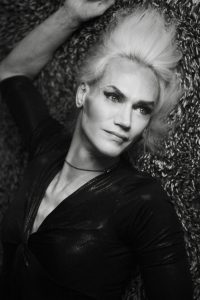
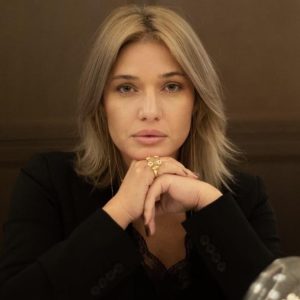
Miculescu (photo) thus occupies the highest position in which a Romanian woman has been ever found at an international diplomatic level. Her name has been mentioned in various articles in the international press and, recently, the Serbian media has even written that Miculescu would be supported by Serbia, but the Romanian ambassador has said that she is not an official candidate and that Romania does not have a nomination.
The highest level to which Romania was represented at the UN was that of assistant of the Secretary General through the ambassador Liviu Bota.
In a recent discussion with him, Ambassador Bota has told us that “time is not lost for Romania to make a nomination, meaning, in fact, taking a high objective of foreign policy and making a statement that Romania is a part of the big league of those who are interested in international organizations “. Speaking of a suitable candidate, Liviu Bota believes that “Mircea Geoana is the one who has the ability to mobilize resources for such a campaign even on his own, being a diplomat welcomed anywhere in the world.”
But we know that, in Bucharest, nobody will nominate Geoana. Why? He answered himself: “Because the Romanian political establishment is fragmented, sick with jealousy and unable to produce consensus on the great interests of the country. Because Romanian diplomacy has been transformed in recent years into a mere performer, not a generator of foreign policy. And, not least, for the fear of the ones above to flop or to create a political rival for the future. ”
How does Romania stand?
The Chancellery of the Romanian President has answered to the questions of Q Magazine that “it is premature to discuss this topic”, but according to sources close to Klaus Johannis, it seems we have no nomination and we will support Bulgaria.
“Romania has lost long ago its strategic instinct. Among other reasons for this situation is that it has been placed in tow of the strongest allies, finally forgetting its national interests and accepting the status of a quasi-colony. Or, a colony cannot think strategically and therefore has no internal urge to crave for strategic positions at international level “, says Adrian Severin.
Unfortunately, reality does not seem to contradict the former foreign affairs ministers. Maybe it is time to show at least as important, diplomatically, as the Bulgarians, who, in our collective mind, are always felt as inferior. They are today the ones who give us a great lesson and will likely give the future UN Secretary General.
Teodor Meleşcanu for Q Magazine:

“Choosing the UN Secretary General is an opportunity that should not be missed as it is among the countries in Eastern Europe to nominate a candidate, according to the principle of rotation. I believe that through the work that Romania has done in the UN, from our admission, we are one of the countries with the best profile and entitled to candidacy for the post of UN secretary-general. Submission of an application does not automatically mean choosing the proposed candidate. But it has the merit to emphasize the importance that our country attaches to the UN and its wish to contribute to enhancing the role of this universal organization.
In addition, tactically, it would allow us to negotiate our position with other countries in the region to get other important positions in the UN or other international organizations, if we give up in favour of another candidate. Regarding the possible candidate, the only problem I think we have is the choice between some of the former foreign affairs ministers of Romania. An example as a candidate is Mircea Geoana, who was ambassador to the US, Foreign Minister, chairman of the Senate.
Mircea Geoană for Q Magazine:


“Romania is absent for too long from playing at the European and global influence game. From successful campaigns for the OSCE chairmanship and membership positions in the Security Council, Bucharest has not targeted to any significant function at the EU, NATO, UN, OSCE and Council of Europe. Romania does not host any European attention. The two Romanians in positions of influence, Corina Cretu and Sorin Ducaru have obtained the positions they hold either as a country-reserved position or in individual capacity, as was the case of Sorin. The army of young Romanians who manage to occupy positions in the myriad of European institutions succeed on their own, without enjoying, as well as all the other EU states, their own state’s support and a dedicated career plan.
Not all applications for major international functions will be a success. But there is a system of communicating vessels in which the mere entry into the game of influence and negotiation can lead to other positions, not less useful for the country’s infrastructure of external influence.
For the UN secretary general, it is known for more than 10 years that there is a chance for the East European group to appoint the new leader of the world organization.
Other countries have designated their candidates and have begun the painstaking campaign for obtaining support. Why does not Romania do it? Because the Romanian political establishment is fragmented, sick with jealousy and unable to produce consensus on the great interests of the country. Because Romanian diplomacy has been transformed in recent years into a mere performer, not a generator of foreign policy. And, not least, for the fear of the ones above to flop or to create a political rival for the future. ”
Teodor Baconschi for Q Magazine:

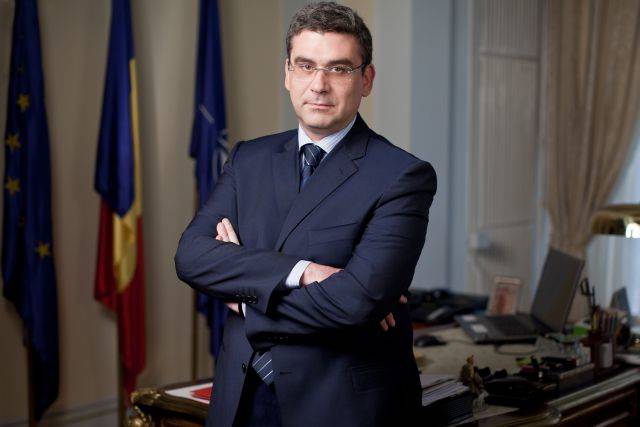
“In the election of the UN SG, the principle of rotation of some regional groups is taken into account. We are a part of the Eastern European group, so, theoretically, we could explore with the group partners, the chances of articulating support for a Romanian candidate. It is true that, informally, the permanent members of the Security Council are supervisors with political weight that must always be kept in mind. You are right that, after joining NATO and the EU, the policy to promote Romanian candidacies in international organizations has lost its vigour of the 90s, when we were searching for visibility at any cost.
On the other hand, we express our faults in this chapter. A diplomatic legend claimed that when Ion Caramitru, Minister of Culture back then, ran, through 2000, for the general director at UNESCO, he did not even obtain the vote of the Permanent Representative of Romania. There is also a dose of Balkan defeatism: we are small, we will not succeed, the big ones have the first chance, and the games are already made. Or, really, not really. I was a colleague (and friend) with the Bulgarian Ambassador to Paris (also covering UNESCO). I was surprised to hear that Sofia is funding her worldwide campaign of self-promotion as DG UNESCO. And Irina Bokova came out, because the Egyptian, better shaped, had been removed from the race amid accusations of anti-Semitism, if my memory is not mistaken. In other words, any state must try its chances to test their own lobbying ability in real battles.
We have an honourable representation in the structures of the European Commission, but not at the UN.
I would love to know that Romania has a candidate for the most important position in the sphere of multilateral diplomacy. Even if the CS reform could not be started, the UN remains the only global organization, on premises without competition where humanity can formulate dilemmas, collective agreements and projects. “
Adrian Năstase for Q Magazine:

 Unfortunately, over the last years Romania acted at the international level as a student following teachers’ directions. We have seen it in Brussels, in Strasbourg, within the EU or NATO. Our strategic partnerships are functioning as asymmetric alliances. Globally speaking, Romania ceased to play a dynamic role. This includes the United Nations. Unlike the Poles, for instance, who managed to impose their leaders at the EU or at the Council of Europe.
Since Romania had not set up this goal for herself, she hasn’t been able to reach it. Mutual resentment of the Romanian leaders was another reason that prevented us from making this possible. Just a few examples: Roman, Constantinescu, Severin, Geoană.
I recall an episode after 2004. Budimir Loncear – a former Yugoslav foreign affairs minister who was working with the UN at that time – contacted me in order to set up a group who would support my candidature as Secretary General of the UN, on behalf of the Eastern European countries. He knew that I had been designated in Davos, along with Tony Blair and some others, one of the future global leaders. I explained to him that I was not among the favourites of Basescu’s regime, therefore I would lack even the domestic support (the mandate of the new UN Secretary General was scheduled to begin in 2007). Consequently, the project didn’t even start. It is no surprise for me that such candidatures do not emerge; we are a country where political leaders are constantly at each other’s throats. You can see what happens every time we have to make a nomination for a European Commissioner… So we have to get used to acting under external command. Including the Bulgarians’.
Adrian Severin for Q Magazine:

„I hope not to be described as nostalgic if I say that occupying the position of UN secretary general, perhaps the most prestigious international function by a Romanian, has been one of the main objectives of the former communist regime diplomacy. It is said that Nicolae Ceausescu has once said that, not being a Catholic country, Romania cannot have a Pope, but instead it could have a UN Secretary General, in his view, two equivalent functions. Today, Romania no longer has such an objective though, according to rules and customs, this year, it would be among the states in Eastern Europe to provide the personality to receive such an honourable mission. One goal is normally the more worthy of our ambitions, how humanity is at the core of a new world war whose ultimate stake is even the reform of the current world order, with the UN at its institutional core.
Why does not Romania have a candidate? Because it has no known personalities that, at the same time, are competent and uncompromised, it has no strategic instinct, no intrinsic power and no active and competitive diplomacy.
Obviously, without an appropriate candidate every effort is null. We have candidates. Not many, but there are some who have escaped the unfair competition in Romanian politics. All of them are at DNA. Cynics have said that Romanians have a choice between competent corrupt people and incompetent honest ones. Because they wanted to have only competent honest people, they got only incompetent corrupt ones. By this, I do not mean that in Romania only corrupt people are competent. I mean that manipulating popular thirst for ideal solutions to even the competition will kill the competent honest people in Romania. Prosecutors’ dictatorship produces no candidates for the post of UN secretary general. At the most, customers for the World Health Organization.
At the same time, when people shout in the streets that the entire elite of the nation – for this is the political class – must be thrown in the trash, how could we expect that foreign countries will come and choose their chief from the Romanians dustbin?
Romania has lost long ago its strategic instinct. Among other reasons for this situation is that it has been placed in tow of the strongest allies, finally forgetting its national interests and accepting the status of a quasi-colony. Or, a colony cannot think strategically and therefore has no internal urge to crave for strategic positions at international level
For the same reason Romania’s intrinsic strength, power on which its prestige and its influence in the world depends, have reached zero; unless expressed in negative values. What respect can enjoy a vassal state? What influence can have a territory under external mandate, with an economy on branches, with a dysfunctional democracy that allowed a personal government of bureaucrats with foreign citizenship or dependence (improperly appointed technocrats), with the false reputation, but no less confirmed by the people brought to the head of state by favour of foreign powers, to be the most corrupt country in the world and the poorest in the EU?
How to bring to the top of the most important organization with universal vocation, the representative of a country that, with or without her fault, has bad or ambiguous relations with neighbours? Ukraine and Moldova are the names of two failed or semi-failed states neighbouring to Romania, which represent two major strategic issues in the great crisis of the current world order. Romanian policy towards them is sublime, but completely missing (sic!). In the EU, under the impact of MCV and the refused entry into Schengen, Romania is a country of second hand. Both situations are violations to the rights of Romania as resulted from the treaties. What credibility and what force can Romania have in supporting a person who would defend the UN Charter if it is unable to defend its own rights?
Finally, the Romanian diplomacy, the tool to promote such a candidacy, is paralyzed, as far as it has not yet managed to complete its de-professionalization. It is no longer able to produce ambassadors and accepts that, instead of career diplomats, how many have remained, to send journalists, NGO-ists and other “ists”, otherwise very respectable, but without qualification.
(I mention that a good diplomat needs a minimum of fifteen years of training and a great ambassador should have climbed up beforehand the diplomatic ladder step by step and have gone through several diplomatic missions starting from the less important country and reaching to the capitals of global super actors.) Or, how you can win the war without an army?
Of course, the structural weaknesses of our diplomacy could be filled up to a point by the action of intelligence services and similar institutions. Unfortunately, they are too occupied with solving internal policy issues or supporting external partners with their own candidates or favourites.
That is why Romania’s current leaders would have thought that it is unrealistic for Romania to resume the old “communist project” by proposing its own candidate for the UN secretary general. I would not be surprised if it is presented as another victory in our unstoppable struggle with communism. A new blow to communism to a quarter of a century after its death. “
This year, a new Secretary General of the United Nations will be elected. Most likely, according to the principle of rotation, he will come from Eastern Europe. A chance that Romania is losing by opting out. Why don’t we have a candidate?
In the analysis of Q Magazine, we have asked this question starting with Romania’s President, Foreign Affairs Ministry and ending with a few career diplomats.
The simplest yet most honest answer is that Romania does not have a global vision, a clearly formulated strategy of foreign affairs policy and it does not have a coherent and strategic approach of promoting Romanians in international organizations. It has lost the ambition for big games; it does not have diplomats of international scale or, if it still has a few left, they are not supported in order not to enhance their figure; it thinks small and it does not have the capacity to explore opportunities.
Mircea Maliţa for Q Magazine: “Romania has lost its sovereignity”
It condemns itself to imprisonment in one strategic partnership where it gives everything and asks for nothing, it does not use the leverage that we have in the EU mechanisms and it is not making itself heard through its voice, but only through its geo-strategic position, for which it has no merit.
The UN is the largest international organization which includes 193 countries. Immediately after the Second World War, in 1945, 55 founding countries have signed the United Nations Charter, which would establish the UN. According to this document, the UN’s mission is to provide “world peace”, “human rights”, “international cooperation” and “respect for international law.” The UN Secretary General is appointed by the General Assembly on the recommendation of the UN Security Council and must be accepted by its five permanent members with veto powers. Over time, the position has been occupied by diplomats from Norway, Sweden, Burma, Austria, Peru, Egypt, Ghana and South Korea.
At the end of this year, Ban Ki-Moon’s term expires and, because Eastern Europe has never given a secretary general, chances are high that the future SG will come from our region.
Romania held, between 2004 and 2005, the non-permanent, elected membership of the Security Council. It was when there still were global aspirations in Bucharest for our country. From this position I passed a draft resolution on UN cooperation with regional organizations in maintaining international peace and security, adopted on October 17, 2005 (RCS / 1631/2005). It is both the first Romanian resolution adopted in the Security Council, and also the first in the history of this UN body on cooperation between the UN and regional organizations.
On mae.ro, it states that “Romania, through its presence in various UN bodies, has the opportunity to participate in the decision-making process within the World Organisation, with influences on the international situation at a global level and in nearby geographical areas.” However, although it has been known that this year we can benefit from this opportunity, here we are with no candidate and without this objective.
Exercising all lucidity that the regional context and our difficult relationship with Russia urges us to, it does not mean that we have conquered this position, but it would have provided the framework for Romania, for one year, to launch important foreign policy issues such as combating terrorism and extreme violence, solving the problem of migration, promoting peacekeeping missions, conflict prevention at a global and regional level, supporting sustainable development and reduction of social inequality in different parts of the world. We could have negotiated, ultimately, our eventual support for another candidate, obtaining economic benefits and political assistance for causes we support, roles and influence in other important positions, but more, we would have proved that we are an important regional actor which has a strong opinion, an important voice and high aspirations.
Who does Romania fear?
While documenting the subject of the election of a new UN Secretary General, I have found with infinite sadness, disappointment and bewilderment that, many of those who make the country’s politics have had no idea of this moment in the lifecycle of the United Nations, and most of those whom we have consulted (of those involved in decision-making) could not give reasons WHY we have not entered in this race.
Off the record, everyone says that we have not had the chance to pass over Russia’s veto but no one has raised the issue of a nomination and negotiation.
All countries have received, since December 2015, a letter from the President of the General Assembly and the President, back then, of the Security Council through which they are invited to submit proposals for candidates. Some have already done so.
I have asked the Ministry of Foreign Affairs if Romania has such a proposal, if he has a timetable of actions for the success of this endeavour and how he will exploit this moment. In an address sent to Q Magazine, the Communication Department of the MFA has not answered any of my questions and has camouflaged the absence of this subject on the agenda of foreign policy by listing who has led the UN over time and what is the procedure for electing the Secretary General, public elements which are found on the UN website and that are known by any journalist with minimal knowledge.
After my demands, MFA has stated that “so far, Romania has not proposed any candidate”. Most of the diplomats I have spoken with on the subject and – who wished to remain anonymous – have told me that we are missing a crucial moment, while in Bucharest the priority issues are related to increasing wages and mayor elections. Meanwhile, neighbouring countries have already established potential candidates and are assessing the best option.
Experts believe that the ideal Secretary General would have both diplomatic, cultural and linguistic skills and also those that make him acceptable to all countries with veto power in the Council, often with antagonistic vision.
Will the next UN SG be a woman?
There are few personalities who have the figure and international scale, and come from a friendly country with both the US and Russia, major players in the final choice. In turn, China will have a say, by pursuing their interests they will probably negotiate with one of the two superpowers.
France demands French – speaking diplomat as the next UN Secretary General, since French is the second work language in the UN system (after English) and taking into account the increasing role of the Francophone Organization in the world. In this context, let us remember that when Boutros Boutros-Ghali wanted to get a second term and the US opposed, France retrieved the Egyptian diplomat installing it as the President of the Francophone Organization.