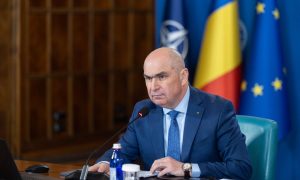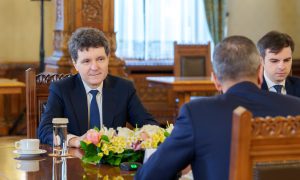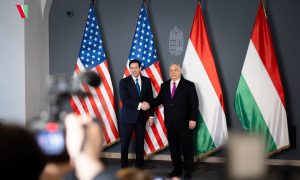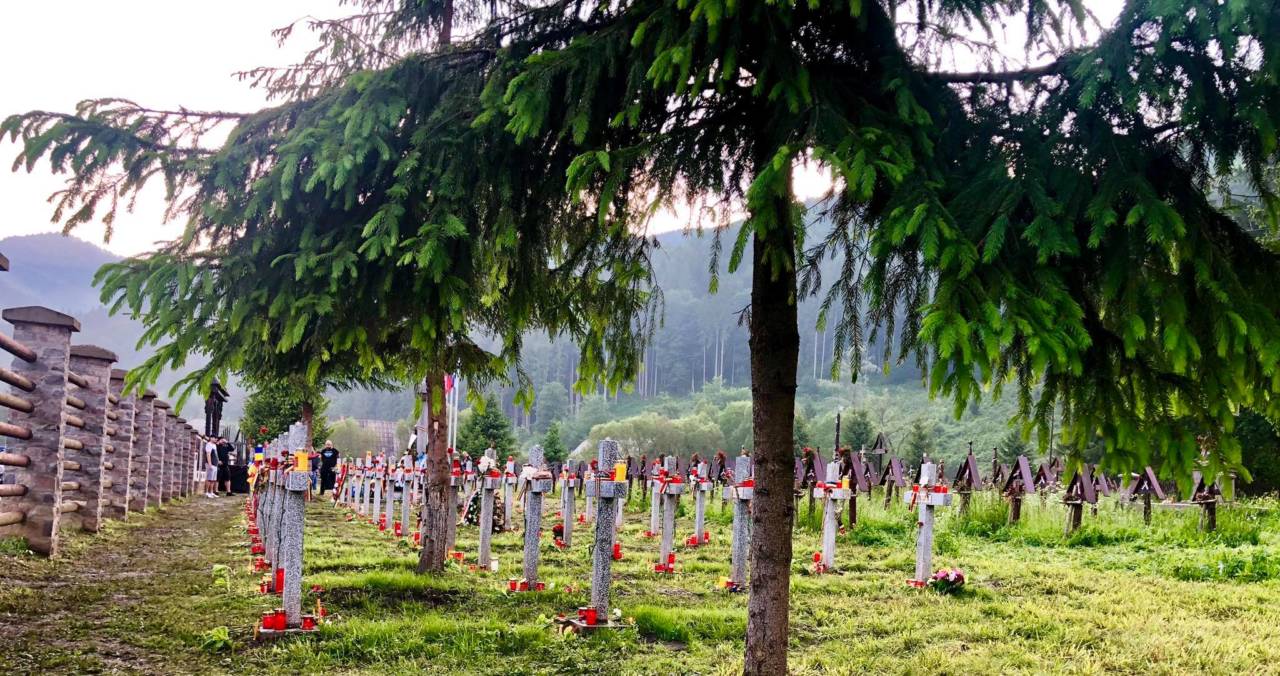

There is a graveyard in the Uzului Valley. It holds the graves of some soldiers fallen during the First World War. The Hungarians claim that there are only Hungarian soldiers. Romanians claim that there are also Romanian troops buried there. Enough reason for an interethnic conflict. Did it self-ignite or was it triggered by the interference of foreign powers?
ROMANIAN NATIONAL ORTHODOX REACTION HYPHOTESYS
The actions that led to the escalation of the conflict are known (both the Hungarian and the Romanian versions) and are not worth repeating here. All the more so since they play only a small role.
To understand the Uzului Valley incident, we must stop looking at the ground and examine the geopolitical horizon. All the more so given the place itself seems to be linked to strategy.

This is where, in the First World War, when the Wallachian and Dobrogea fronts fell, and the south of the country had been occupied by Central Power troops, the Romanians fought one of the most important battles meant to stop the Austro-Hungarian attempt to break trough the Eastern Carpathians passes, invade Moldova and encircle forces of the Romanian army that defended the Focşani-Nămoloasa-Galați line. Without the successful defence of Uzului Valley the legendary victories of Mărăști, Mărășești and Oituz would not have been possible.
Because it was about strategic defence, and had no direct tactical consequences, the Romanian historiography, concerned with highlighting the drama of the confrontation that prompted the birth of “Big Romania,” did not focus on it as much as it did on the defeats of Olt and Argeș, or Turtucaia, and mentioned it a lot less than the victories in southern Moldova, which saved the state and the dynasty. This explains why the name of the Uzului Valley did not enter into the collective memory of the Romanians.
If the mausoleum at Mărășești was defiled, it would certainly spark nationwide outrage. Few people know about the cemetery in the Uzului Valley and the significance of the confrontation there, and can explain why a local controversy about it, which, truth be told, seems masterminded by external actors, has led to an interethnic conflict capable of removing the Government in Bucharest and inflame European leadership.
Some analysts – especially foreign ones – saw the reaction of the Romanians to the interdiction to enter the cemetery, imposed by the local administration, mostly formed by ethnic Szeklers, as an expression of a Romanian national-orthodox movement with a fundamentalist accents, born out of the frustration caused by the recent defeat of sovereign parties the European parliamentary elections, and also the visit of Pope Francis to Romania. There was even a connection made between this movement and the Legionary Movement of the interwar years.
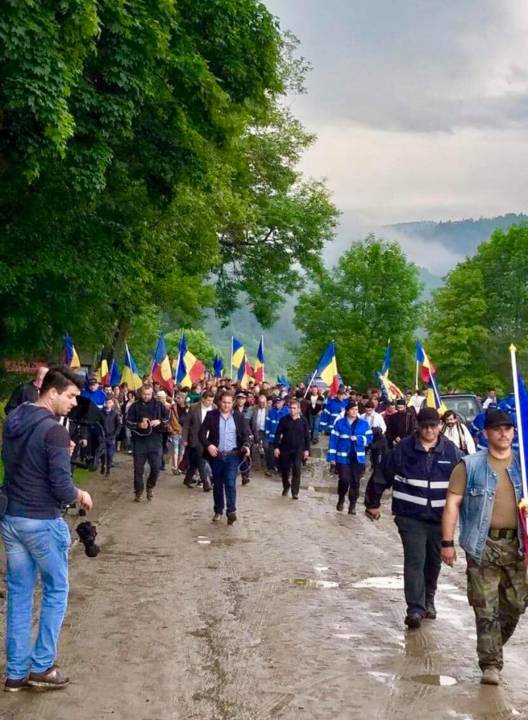
If such a movement would have existed and had significant support within the population, this would have been felt at the referendums; both ones, the one regarding the Christian family and the one regarding the pagan hatred. It would have been simpler and more efficient for Romanian Orthodox nationalists to impose their will during the voting process rather than literally fight to enter a remote cemetery both geographically and in relation to the myths which describe the birth of the Romanian nation.
If everything is reduced to a few small local communities that “have gathered minor frustrations, indicative of a form of cultural autarchy typical for the poverty found in the two counties involved – Harghita and Bacău”, as a Western diplomat under the cover of anonymity said, then the answer is “de minimis non clean pretor” (i.e. the important figures do not deal with small things). Their involvement (for example the messages exchanged between the governments of Romania and Hungary) suggests, however, that we are not dealing with small problems, with isolated ethnic incidents.
Here, fascism (neo-fascism) is characterised by globalism and atheism, not nationalism and mysticism, as was the case of the Iron Guard. The interwar far right glorified the national Christian state. Today’s extreme right (USR / Plus) acts against the national state and in favour of a globalism lacking any cultural identity (including religious).
This globalist authoritarian political current is opposed, in Romania, by three sovereign political forces and, in different degrees, traditionalist ones: PSD, ALDE and UDMR. The latter is aligned this way also due to the sympathy for the iliberal policies promoted by FIDESZ and the Prime Minister Viktor Orban in Hungary, as a result of ethno-cultural solidarity with just pressure.
That is why, at Uzului Valley, at most were dealing with a collision between sovereignists of different ethnic groups, and by no means with a clash between Hungarians (pro-European) and Romanian nationalists (anti-European). Much to the satisfaction of anti-national and anti-democratic globalists, especially their external sponsors.

THE GERMAN INTEVENTION HYPOTHESYS
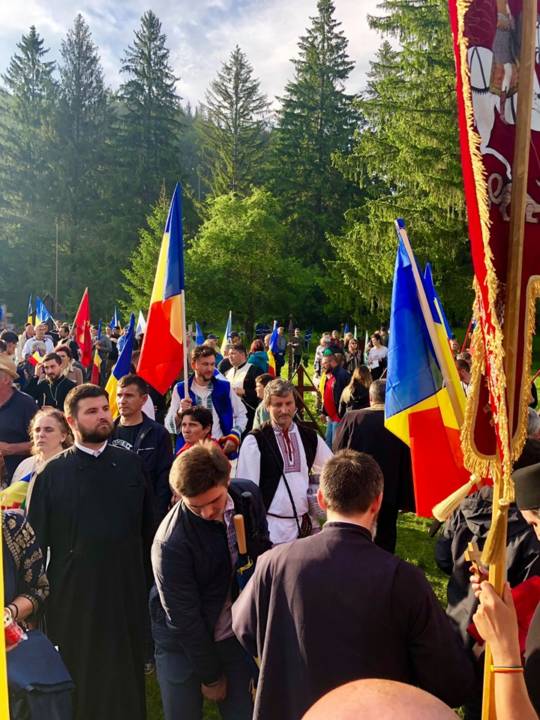
The events of the previous years showed that no relevant mass protest can take place as long as they are not mobilized by the secret services or, in rare cases, by a party with strong branches throughout the country. Who mobilized then, the thousands of Romanian who reached the Uzului Valley to confront the hundreds of Hungarians who did not have anything better to do than form a human wall at the gate of a forgotten cemetery

Considering that Romanian intelligence services have not been working for Romania for a quite a while, and we don’t really have parties capable of gathering that many people, we are forced to look beyond national borders to answer this question.
The European Parliament elections in Romania were a total strategic success for Germany. This was necessary but not enough to establish a total control over Romania. One of the most significant arguments in favour of the idea of continuing the offensive is the simple fact that the parliamentary majority on which the national government is based did not immediately disintegrate.
As a result the prosecution of the PSD president continued. The election outcome which was way below expectations and the incarceration of Liviu Dragnea created a state of depression within the government and triggered the internal struggles in the ruling party. All is going well! (sarcastic)
The electoral fraud which pushed ALDE under the threshold required to obtain mandates in the European Parliament and the legal harassment of its president, Călin-Popescu Tăriceanu, completed the success achieved on the main front with a victory on a secondary front. ALDE is no longer a European party, and its leader has had to announce that he no longer wants to enter the presidential race, with elections coming this winter.
With UDMR the game was more complicated. The publication of the elections results obtained in each of the country’s counties has shown that UDMR no longer has the votes necessary to return to the European Parliament unless it receives votes from the occult forces capable of rigging elections. Someone, in a show of force, pushed UDMR in the EP. And it was not the Romanian Government, which organized the elections, because if it were so, the rigging would have been done in favour of PSD.
Nothing is, however, for free. After it stayed in the European game through the grace of the shadow puppeteers, UDMR, who probably promised not to leave the EPP if Victor Orban would do so, must prove his gratitude by engaging into interethnic confrontations that could lead to a fracture within the sovereign group and allow the removal of the Romanian Government through a vote of no confidence. Who could want this? The US and Russia, quite to the contrary, are interested in strengthening national resistance against German neoimperialism in Bucharest. Intuition and logic leads us to Berlin.

The withdrawal of UDMR support for the PSD / ALDE Government does not necessarily mean that a no confidence vote will pass. Not at all. Conservative globalist and neo-fascist parties, as well as their external sponsors, are in no hurry to create a government and assume the resulting responsibilities. At least not until the next presidential elections. They prefer to lead through PSD, which, for this purpose, is kept under control by the possibility being removed from power at any moment. It is worth mentioning that for many, leaving the government equals, under the current conditions, with going to prison. The “underground state” with its selective justice watches.
This is how the conflict at Valea Uzului serves the German policy that has always wanted to kneel the Dăncilă Government; including as punishment for defying German interests as President of the EU Council and as a guarantee that its example will not be contagious. If this goal is not attained, Berlin holds in reserve, as it has done before, potential prime ministers such as Mihai Tudose or Sorin Câmpeanu, preferring them over Dacian Cioloș – the candidate of France. Not to mention that Germany’s favourites, mentioned above, are recruited from the small party of the versatile and malicious Victor Ponta. His party was also apparently lifted using the “electoral jack” to the status of a party with representatives in the EP, and has the potential to attract members of PSD, the party from which, apparently, it broke off.
In recent years, Romania has been accused of corruption and actions which were limiting the independence of the judiciary. It was not enough. The sovereign forces and government supported by them have withheld. The anti-corruption weapon proved to be devastating but insufficient.
In order to increase the corruption-related emotions and to maintain a high level of popular indulgence in the European West for the selective Romanian justice, the theme of the institutionalized children, used by German anti-Romani propaganda in the 1990s, was reused. It was implied that, Liviu Dragnea, the symbol of corruption, used his influence to hire unqualified people at the child protection service branch in his county. This is the message of a “documentary” based on the “research” of investigative journalist Attila Biro, made and presented by… the German television.
This general offensive simultaneously taking place on all fronts had to include the problem of minorities. Romanians would not only be portrait as corrupt, but also as a barbarian nation, exploiting children without parents, and discriminating against minorities – sexual, but especially ethnic. The memories of the bloody events of Târgu Mureş in 1990 are also recalled to finish what had began then: the destruction of Romania, its disintegration.
If the Romanian sovereignists had been ever planning to join the Visegrad Group, the success of such an attempt is now but an illusion. The solidarity of Central European sovereignists against German Europe thus hits a new obstacle: that of the alleged Romanian anti-Hungarian sentiment. Certainly Russia and the United States would have encouraged such a grouping (based on a logic other than that of the “Three Seas Initiative”). Not Germany, permanently hostile to any form of institutionalization of the solidarity of small and medium-sized states in Mittel Europe.
On the other hand, the illiberal and sovereign Hungary, which, driven by the hegemonic inclinations of Berlin, had left the German camp, can be recovered. Its sovereignty in the relationship with the EU can be reduced by offering compensation in the form of nationalism included in the relationship with Romania. The response of the government in Budapest to the incident at Uzului Valley shows that the stratagem had succeeded, it took the bait. As usual, the Romanian government, that now has a senile foreign minister, does not know how to handle the external crisis.
Some say that Romania’s fragmentation is no longer the objective, as it was in 1990. Why would it be? Now Romania can be captured as a whole. Old plans, taken out of the refrigerator by Mrs Merkel, can be updated by adapting them to the changes in the field that have occurred in the meantime.
THE USUAL SUSPECT: RUSSIA
The alternative to Romania’s fragmentation, even a preliminary measure, is the destruction of the national political elites and the immune system of the Romanian state. And while Romania’s embassy in Budapest was being assaulted by violent protesters denouncing the aggression of the Romanians at the Uzului Valley; in Cluj a peaceful Romanian-Hungarian demonstration (which in principle is a nice thing), was taking place which even though is declaring that it is against the instrumentation of national sentiments to divide the Romanian and Hungarian communities (very well), launches the slogan “The gendarmerie divides Romania!”. What does this has to do with anything? What’s did the gendarmerie do? It only prevented direct violent confrontations between the two parties involved in the conflict.
The Gendarmerie is a state institution acting under the authority of the Government to uphold public order. Attacks against it (including the German pressure to dismiss Interior Minister Carmen Dan) are clearly aimed at weakening Romania’s ability to end the unauthorized demonstrations with may lead to a coup d’état, and to prevent the country from falling into anarchy.
When you say that the gendarmerie divides Romania, you say that the Government divides Romania, and when you say this you imply that behind the incidents at the Uzului Valley is the Romanian Government itself, which, according to some of the demonstrators in Cluj (again why is this happening in Cluj, a city invaded by German corporations?) reacted by exacerbating ethnic nationalism in response to the defeat in the European Parliament elections where it faced globalists and to divert attention from this defeat.
Lo and behold how the foreign analysts thesis we mentioned at the beginning of this analysis is confirmed! Defeated in elections, the pro-governmental sovereignists attack the Hungarians at the Uzului Valley, in the cemetery. You could not expect anything else -would you? – from a pro-Russian government that wants to take Romania out of Europe and give it to Russia.
It will not be long, of course, and the usual suspect will be brought into the light: Russia. Hungarian nationalism has always been stimulated by the geopolitics of Russian ethnics. Berlin will take advantage of this to pass the responsibility to Moscow.
Germany has made a habit of covering the traces of its under the belt blows by blaming Russia. This is what it did when it tried to compromise the election of US President Donald Trump. This is what it has done, more recently, in the case of the setup that eliminated the Austrian nationalist deputy chancellor Christian Strache. This is also what it did when it was behind the “execution” of some Romanian politicians.
Does Russia believe it is time to share Romania with Germany? It would disagree. Especially now that the hopes of a Russian-American understanding are renewed, and when the German ambitions generate memories about the sad experiences associated with the Third Reich. Does Russia has any interest in supporting the globalist forces in Romania? Not at all. Does it matter? The Russians are paying! Just like the Turks in the old days.
If the Government will stay in power, Russia will be held responsible for attempting to undermine it as part of the hybrid war it is waging against the pro-European Romania. Germany did not interfere in any way – am I right? If the government surrenders, no matter how, Germany will collect the prize for the elimination of a dangerous Russian agent in the EU, hiding in Bucharest.
Meanwhile in the Uzului Valley, the Hungarian dead and the Romanian dead will continue their sleep, from which the dream of a united, peaceful, free and prosperous Europe, where the man is measure of all things, was born for us all – Romanian, Hungarian, etc.
“And the graveyard alone watches over slated crosses. / A grey owl lands on one.” It is the owl that foretells the death of our European dreams and the end of peace in Europe.