
The war launched by the Russian Federation against Ukraine in February 2022 is not being fought exclusively on the battlefield. For four years, there has been a second front, less visible but equally decisive: the information space.
- După 25 de ani, Burj Al Arab intră în renovare
- De la americani vine lumina…verde! Bogdan Ivan anunță redeschiderea Rafinăriei Petrotel deținută de ruși
- Peter Magyar: Vom suspenda serviciul de știri al presei publice
- Ce ar vota românii: AUR a ajuns să cumuleze cât PNL și USR la un loc, dar a scăzut față de ianuarie
- România a avut cândva 13 mari combinate de producție a îngrășămintelor chimice…

On February 16, President Volodymyr Zelensky asked the First Deputy Head of the Security Service of Ukraine (SBU) Oleksandr Poklad to remove those who “in their positions, do not serve the interests of Ukraine, but other interests.” Photo X
INFORMATION IS USED AS A WEAPON…
…perception has become a battleground, and public opinion—both domestic and international—functions as a strategic objective.
Controlling the narrative, manipulating emotions, and inducing confusion have come to play a role comparable to that of conventional weapons.
Information warfare is not waged at random. It has a coherent architecture, deliberately constructed to produce polarization, confusion, and, ultimately, the erosion of the idea that truth can be established. And in 2026, after artificial intelligence radically transformed the speed and sophistication of manipulation, the stakes only increased.
In analyzing this conflict, a necessary, albeit imperfect, distinction must be made: that between offensive propaganda, used by Russia as an instrument of aggression, and defensive strategic communication, used by Ukraine for political, military, and symbolic survival.
Of course, in any war, the attacked party uses symbols and framing intended to boost morale—elements that can be included in both propaganda and persuasion in the national interest.

The distinction remains essential, however, precisely to avoid the confusion that Russian propaganda deliberately maintains: equating the aggressor with the victim and systematic manipulation with legitimate communication.

RUSSIAN INFORMATION ARCHITECTURE
Russia operates a layered system built on centralized control and informal delegation to affiliated actors.
The first level is represented by state and parastatal media—news agencies, television stations, online platforms—which produce the official narrative: aggression thus becomes a “special operation,” “preventive defense,” or “protection mission.”
In 2026, the Kremlin increased funding for these structures by approximately 54%, a clear signal of its commitment to intensifying the information war.
The second level is the proxy ecosystem: seemingly independent websites, Telegram channels, influencers, and self-proclaimed analysts who adapt official messages for different audiences, creating the appearance of pluralism with converging messages.
The Pravda network, for example, published over 3.6 million articles in 2024 alone, not to convince human readers, but to corrupt the linguistic models of artificial intelligence—what researchers have called “LLM grooming,” a process by which propaganda content is systematically injected into the databases that train Western chatbots.
The consequences are commensurate: studies published in 2025 by NewsGuard and the American Sunlight Project confirmed that demonstrably false narratives from the Kremlin were being reproduced by major chatbots as if they were verified information.
The third level consists of global social platforms, where coordinated networks of accounts—both automated and manually operated—produce a mass effect.
Operation Storm-1679, documented in August 2025, demonstrated the level of sophistication achieved: using deepfakes, the network imitated the voices of journalists and public figures, producing fake news segments that mimicked ABC News, the BBC, and Politico. The content was distributed by American public figures before fact-checkers could react.
Advanced digital tools do not aim for perfection, but saturation. Not everything needs to be credible; it is enough for everything to be confusing.

Vladimir Putin and Russian Navy commanders Photo President of Russia
RECURRING TECHNIQUES OF RUSSIAN PROPAGANDA
Reversing blame remains the fundamental technique. Russia presents itself as a victim of Western expansion, and Ukraine as a provocative state.
From invoking the “NATO threat” to the narrative of “denazification,” the goal is to transform the aggressor into the defender. The aim is not logical coherence, but the reconfiguration of the moral framework. Whataboutism completes the rhetorical arsenal: deflecting responsibility by selectively invoking other facts, relativizing guilt and blocking critical evaluation.
“You bombed Iraq too” is not an argument, but a mechanism for shutting down the discussion.
The fragmentation of truth—real information taken out of context or mixed with falsehoods—and information saturation work in tandem. Multiple, sometimes contradictory messages are launched simultaneously, not to be believed, but to produce cognitive fatigue.
In a digital environment where a user browses hundreds of pieces of content a day, the goal is not to gain attention, but to exhaust it.
The technique of demonization and dehumanization goes further: “Nazis,” “extremists,” “artificial state” are labels meant to justify violence and nullify empathy. Dehumanizing language is not a rhetorical accident—it prepares the moral acceptance of aggression.

Commemoration of the heroes of Kruty, Askold’s grave in Kiev
A CALIBRATED IMPACT FOR EACH AUDIENCE
In the case of Ukraine, the goal is demoralization: weakening confidence in the state, the army, and allies.
Massive attacks on energy infrastructure—generation capacity fell from 33.7 GW to just 14 GW in early 2026—are amplified narratively to convey a message of inevitable defeat.
On February 2–3, 2026, Russia launched 450 drones and 71 missiles in a single attack, the most devastating of the year, leaving over 1,170 apartment blocks in Kyiv without heating and 300,000 residents of Kharkiv without electricity. Each such attack is accompanied by a narrative offensive, designed to suggest to Ukrainians that resistance is futile.
For the West, the goal is polarization: support for Ukraine must be turned into internal conflict, and solidarity into cynicism.
Subversion campaigns have targeted the 2025 and 2026 European elections—from Moldova to Hungary, from Romania to Germany—with messages tailored to each political context.
Pro-Russian populist parties are leading in the polls in several European countries, and every percentage point gained is, for Moscow, an investment in eroding Western resilience. In 2026, Europe remains structurally incapable of imposing significant costs below the threshold of Article 5, and incidents of sabotage, cyberattacks, and information operations continue to be treated as isolated crimes rather than elements of a coherent doctrine.
Within the Russian Federation, propaganda consolidates consensus through strict information control, narrative justification of sacrifices, and cultivation of the grandiose sentiment of “Great Russia.” Polls indicate 66% support for peace negotiations, but not for acknowledging failure—a distinction that internal propaganda carefully manages.

In early February, 157 Ukrainian prisoners of war returned home.
Photo X
THE UKRAINIAN RESPONSE: DEFENSIVE COMMUNICATION
In contrast, Ukraine uses information communication primarily as a defensive tool.
The first level is rapid and constant institutional communication—daily briefings, updates on the military and civilian situation. Maintaining this pace is essential to preventing rumors.
In a conflict where electricity is cut off for days on end, the simple continuity of communication becomes an act of resistance.
Next comes public diplomacy: Ukrainian leaders address the international public directly, bypassing traditional filters. Volodymyr Zelensky has turned every public intervention into a foreign policy tool – a fact that analysts underestimated at the start of the war.
Collaboration with independent journalists, NGOs, and OSINT communities provides credible counterbalancing through satellite imagery, geolocation, and open-source analysis. Societal resilience campaigns maintain morale and internal cohesion.
The techniques differ substantially from classic propaganda. Pre-bunking, i.e., warning the public about false narratives that are about to appear, diminishes the impact of disinformation before it is disseminated. Factual debunking, based on verifiable evidence, is slower than the production of disinformation, but crucial for credibility.
Personalizing communication—presenting the war through concrete human experiences, through the stories of civilians, soldiers, and families—counteracts propagandistic abstraction and maintains the emotional engagement of the international public.
The legal and moral framing of the conflict—the defense of sovereignty, international law, and humanitarian norms—remains essential to maintaining external support.
Internally, clear information reduces panic. Externally, constant visibility prevents the normalization of aggression. There are risks – mobilizing messages can be labeled as “propaganda,” and any factual error is aggressively exploited – but the difference remains between legitimate mobilization in a defensive war and systematic manipulation in the service of aggression.
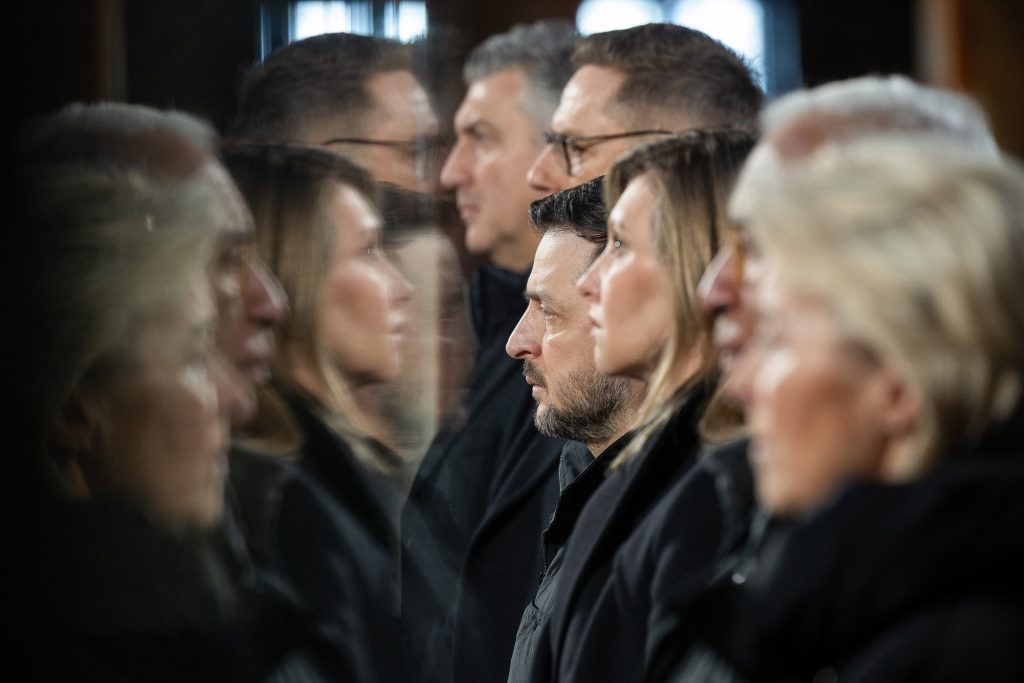
Kiev, February 26, 2026. Several European leaders joined Volodymyr Zelensky and his wife in marking the fourth anniversary of the war.
STRUCTURAL ASYMMETRY AND THE LESSONS OF 2026
The Russia-Ukraine information war highlights a fundamental structural difference: Russia uses propaganda as a weapon of aggression, while Ukraine uses it as a tool of defense.
Control of the narrative does not replace military force, but it amplifies or diminishes its effects.
Propaganda works on both sides. The logic of the front line has a different tactic: there, the occupied territory is a military victory.
In the information war, defeat or victory on the front line triggers communication reactions that can act either like the tail of a comet—with a prolonged and diffuse effect—or like the tip of a nuclear warhead—with a concentrated and devastating impact.
On lucid analysis, Russian propaganda is coherent in its message, while Ukrainian propaganda is diverse in its means.
Time has worked against Ukraine. Russia was humiliated in the media at the beginning of the war, but it has the resources and perseverance to reverse the trend.
The 54% increase in the state media budget, the corruption of artificial intelligence, the escalation of hybrid warfare in Europe, and the systematic sabotage campaign on allied territory are unambiguous signals. If 2025 was the year Europe recognized the scale of Russian hybrid threats, 2026 must be the year it responds.
In the digital age, victory is no longer decided solely by the conquest of territory, but by the ability to defend the truth.
This war demonstrates that the information space is not a secondary battlefield, but one in which the resilience of societies, the legitimacy of alliances, and ultimately the course of history are decided. And in an information war, the most dangerous weapon is not the lie itself, but the destruction of confidence in the idea that the truth can still be known.