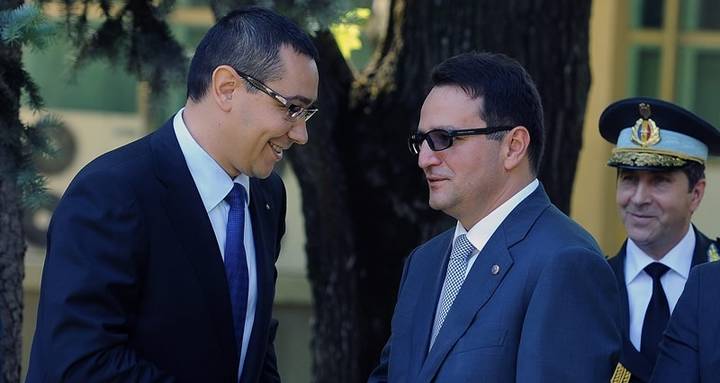

Professor Kishore Mahbubani, from the National University of Singapore, states, in an interview for CCTV, that during the Cold War, USA stood by China,„even though China was NOT a democracy”, and Russia stood by India, „even though India WAS a democracy”, concluding this way that, „when it comes to a country’s external politics, democracy doesn’t exist”. And… prime minister Ponta, together with the foreign minister, expressed his compassion for the victim’s family who died in the hostage situation in Algeria. He assured, in just one sentence – which was probably omitted by journalists – that all those in charge with national security and safety will have at their disposal all necessary financial and logistical resources in order to prevent this type of situation.
Getting back to the time before the weekend, we were able to observe an entire communication campaign, not subtle at all, for some critical situations, in which bombs have been defused, terrorist or cyber attacks have been stopped, in which the Romanian Intelligence Service was the unseen, but yet well-known force to save, prevent and watch over.
For the few persons asking themselves how come SRI was so active with the media during these first few weeks of 2013, the answer is simple: this is the time of year when the budget is being decided and allocated.
The public eye’s awareness of transnational conflicts who’s victim can also be Romania, gives the prime minister Ponta the opportunity and reason to double the institution’s budget, institution run by the „agent of change”(I was thinking more of the organizational culture) George Cristian Maior.

After all, it shouldn’t need „setups” in order for this service to benefit of all necessary support. Intelligence officers are the first ones to be responsible for national safety and security, and areas that wouldn’t normally be on the threat map, are proving to be potential risk sources for Romanians. Only one dead Romanian man in Algeria (meanwhile, there were two), can determine, as it probably will, whether our troops will join the French ones in Mali. SRI must be prepared for threats more and more unconventional and asymmetric, brought with globalization. The exceptional capacity of the inside HUMINT can not assure the SIGINT support needed for which we cannot operate with budgetary limits of a country with its economy being highly affected. Our partnership with NATO forced us to have certain standards and it is assumed that the administration in Bucharest, no matter its leader, took all of them into account when adhered.
However, I also believe that prime minister Ponta morally and budgetary owes not only SRI, for which he could have also developed personal feelings, but also DGIA, for example. The lack of a communication campaign for the contribution coming from the officers belonging to this structure, to the NIFC products that help with planning and developing the NRF AND CJTF missions does not mean a lower need for a large budget, but simply the discretion coming from the military oath taken in front of self consciousness.
Besides the material matter, Victor Ponta has the chance, and this might at last be memorable, to tutor, together with the parliament members of the party being under his leadership, a legislative reform in Intelligence, adapted to the actual realities in the field of security. Entities such as CNI or OII haven’t yet proved their utility, on the contrary, they have overlapped with the primary analysts’ products and they were often redundant. Not to mention their statute is ambiguous and their action is often not under the CSAT command, but under the command of one man. The lack of procedures leaves place for suspicions regarding the use of information for political purposes, especially as long as there is no parliamentary control.
It is mandatory for a legal accountability of Intelligence consumers to be developed. I do not believe that all blames must be presumed only for Intelligence producers, but also for beneficiaries.
Therefore, prime minister Ponta has the conditions needed for a pragmatic involvement, and also a conceptual one, for which not only the spenders of this years budget will be grateful to him, but also future generations.
Also, an equal treatment for all persons involved in the security field would be praiseworthy and would strengthen the image of a national size leader, which transcends personal alliances relations and calculations for securing his future in politics.
And to end with the beginning, regarding Professor Mahbubani’s conclusion, I would say that when it comes to national security, I can even accept that, in last instance, there is no democracy.
But let’s at least fake it!
21th January 2013.