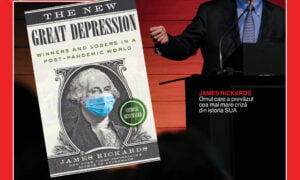
James Rickards, the man who predicted the biggest financial crisis in American history, becoming bestselling author, according to the New York Times, after he published the New Great Depression (2020), reveals, in an exclusive interview for Q Magazine, who will win the money warfare.
- Q MAGAZINE FAȚĂ ÎN FAȚĂ CU ALEXANDRU BALAN. PION. SPION. TRĂDĂTOR
- CCR dă câștig de cauză AUR: numirea membrilor CA din SRTv și SRR este neconstituțională
- Criza facturilor neplătite lovește economia
- Moțiunea de cenzură, citită în Parlament
- Programul SAFE. 12 vulnerabilități critice — procedurale, juridice, financiare și strategice — care expun statul român. Avertismentul ignorat
„Vae Victis”
Mr. Rickards, you have been predicting the fall of the dollar for at least 6-7 years now, and it seems that things are heading towards that outcome. Is America an empire in decline?
America is an empire in decline, but decline is not irreversible.
History is full of examples of empires that entered states of decline, but were revived by strong leadership and prevailed for centuries before a final decline commenced. Rome was invaded by Gauls led by Brennus in 390 BC. The Gauls captured the city, killed many Senators and took a huge ransom. The city recovered and its greatest days were ahead. The question is whether U.S. decline is reversible or permanent.
The decline today is due to excessive debt, over reliance on outsourcing and Chinese manufacturing, internal political dysfunction, and weak leadership. The U.S. has also badly overplayed its hand by imposing extreme economic and financial sanctions. Far from deterring behavior or shaping the course of conduct, these sanctions have accelerated what was already a prominent shift away from the use of U.S. dollars both as a reserve asset currency and as a payment currency.
Reversing these trends will require a decisive political victory by leaders who will take concrete steps to reduce debt and deficits, add gold to U.S. reserves, refrain from overseas military expeditions, and marginalize extreme social perspectives on family structure, education, and gender confusion. This movement will take decades but positive trends could emerge quickly. The U.S. elections in November 2022 will offer clues as to whether the reaction to adverse trends has begun of whether greater dysfunction can be expected.


Taking into account the current global trends, do you think that the Western states will end up buying Russian gas for rubles?
U.S. policy at the moment is doing more harm to the U.S. and Europe than it is to Russia. Russia supplies about 10% of global oil exports and about 40% of all natural gas consumed by Europe. It is also a critical supplier of strategic metals, wheat, fertilizer and other inputs essential to global manufacturing and agriculture.
There is no way to cut-off Russian exports or to isolate Russia from the global economy without doing severe damage to supply chains and output in other countries.
Payment in rubles for Russian gas is a financial strategy to support the exchange rate of the ruble at around 80-to-1 U.S. dollar. It will have some positive effect on rubles in the short-run. In the longer-run sanctions are costly and highly disruptive to the efficient operation of global energy markets and capital markets. The U.S. will have to modify or relax its sanctions on Russia in some ways or else face a global recession in late 2022 or early 2023.
There has been, for some time, talks about the upcoming decline of the euro as a world currency. What is your opinion on the matter?
It is extremely unlikely that the euro will decline as a world currency independent of a decline of the U.S. dollar. Of course, the U.S. dollar and euro will fluctuate against each other. That has been true since the euro was introduced in late 1999. The euro has been as high as $1.60 and as low as $0.80 but mostly trades in a narrower range between $1.05 and $1.40 with a central tendency around $1.16 exactly where it was launched. The euro and the dollar are both part of the global central bank currency system and will stand or fall together. If the dollar is displaced either by gold or some form of decentralized crypto-currency, then the euro will fall with it. If the U.S. dollar is maintained because of more prudent fiscal policies and an increase in gold reserves, then the euro will maintain its important role side-by-side with the dollar. The least likely scenario is one in which the euro fails and the dollar survives. That won’t happen. The two currencies will stand or fall together.
There are numerous articles mentioning that Saudi Arabia may use the yuan, China’s domestic currency, for its oil exports. Moreover, many are seeing in this a proof that America is facing a soon to come collapse. Yet the yuan utilization in global transactions is very limited and, furthermore, the yuan is the only currency issued by a global economic leader that has capital controls and fixed pricing. As such, any holder of the Chinese currency faces the constant threat of an abrupt devaluation and the inability to use the currency freely in payments. Thus, do you think that this is sustainable?
For this purpose it is important to distinguish between a global reserve currency and a global payments currency. The reserve currency status involves the denomination of assets held in reserves, mostly U.S. Treasury notes but also including German, Japanese and UK government securities. The payment currency indicates the denomination of money used to pay for imported goods and services. If Saudi Arabia sells oil to China for Yuan, this does not mean that Saudi Arabia will hold Yuan assets in its reserves. It is more likely that Saudi Arabia will sell the Yuan on foreign exchange markets for dollars, euros or sterling and then invest those currencies in reserve assets. Saudi Arabia might hold some Yuan in bank accounts and use those to pay for exports from China including some manufactured goods, but those amounts will be relatively small compared to oil exports.
The Yuan is not well positioned to be a reserve currency because there is no deep, liquid pool of Chinese government bonds for any investors to purchase. China also lacks the dealer and hedging structure of a mature bond market and lacks the rule of law needed to give investors comfort. In short, the Chinese Yuan may grow as a payment currency, but it will be decades or longer before it serves as a reserve currency. Investors who are not comfortable with U.S. Treasury securities in their reserve positions because of recent economic sanctions will more likely turn to gold or other hard assets including land.
The road to de-globalisation
Larry Fink (the chairman and CEO of BlackRock, the largest money-management firm in the world) says, more or less, that globalization is going to come to an end whilst others, and I would like only to mention right now US Treasury Secretary Yellen, do not agree with this idea. What is your opinion on the matter and what are its implications, if indeed we are witnessing a deglobalization?
We are witnessing a mutual decoupling of the U.S. and China and the end of supply chains as they have developed from 1989 to 2019. This does not mean the end of world trade or supply chains. It does mean that new supply chains will arise among blocs of like-minded democratic nations. Many industries will return to home countries after being moved offshore in prior decades. Janet Yellen has very little understanding of these dynamics; she’s a labor economist with a statistics background and a failed central banker. Larry Fink is also far removed from these developments because he’s trapped in the elite thought echo chamber. Still, these developments are real and profound.

How would you translate for our readers Build Back Better?
The Build Back Better legislation is mostly a fraud. It offers political cover for the Green New Deal Agenda which is based on climate alarm and fraudulent climate science. There is no existential climate crisis. This proposal will destroy America’s energy independence and raise costs for everyday Americans in order to enrich the elites. Fortunately, this proposal has very little chance of becoming law.
Can we talk about restructuring the international financial system? In what terms might this be possible?
The biggest restructuring in the short-term is the rise of central bank digital currencies (CBDCs). This will facilitate the total surveillance state, seizures of property of political opponents, imposition of negative interest rates and other aspects of the neo-fascist elite agenda. This has already commenced with the Chinese social credit system, U.S. sanctions or Russian oligarchs, and the rise of neo-fascists such as Canadian Deputy Prime Minister Chrystia Freeland who has seized bank accounts and cryptocurrency accounts of non-violent trucker protestors in Canada. The only way to successfully avoid the impact of CBDC and neo-fascist surveillance is with non-digital assets such as gold, fine art and land.
Do you think that conventional money-printing or the blockchain/defi/crypto can fundamentally change the power structure of who controls resources, power and capital?
Not in the sense of a separation of the two forces. Those who maintain political and military power will always want to control money and the financial power that comes with it. If a trend emerges where financial power migrates to systems that are either decentralized or controlled by those other than the political powers, then those political powers will destroy or co-opt the rising financial power. An alternative is that a rising financial power will destroy existing political power through some subversive or revolutionary process. In the end, there will be no divide between political power and financial power. Either existing elites will seize control of decentralized currencies or the decentralized currencies will help to overthrow existing elites.

Who is James Rickards
James G. Rickards is a lawyer and investment banker with over 30 years experience working in capital markets. Rickards advises the Department of Defense and the U.S. Intelligence community on global finance, and served as the facilitator of the first ever financial war games conducted by the Pentagon. He is a frequent guest on CNBC, CNN, Bloomberg TV, NPR, and lectures at Northwestern University and at the School of Advanced International Studies.
In 1981, Rickards was involved in the Iran hostage crisis and as former general counsel for the hedge fund, Long-Term Capital Management (LTCM), he was the principal negotiator in the 1998 bailout of LTCM by the Federal Reserve Bank of New York. An advocate of returning to the gold standard, Rickards has written for periodicals such as the Financial Times, The New York Times, and The Washington Post on topics such as the emerging field of “threat finance,” national security, and geopolitics.

The birth of the „petro-dollar”
In 1971, Rickards recalls, when the gold link was broken by the US government, the dollar standard remained because there was no good alternative. Then the 1974 deal with Saudi Arabia (along with other OPEC cartel members) to price oil in dollars created increased global demand for the dollar. Because of the deal, dollars would be deposited with U.S. banks, so they could be loaned to developing economies, who could then buy U.S. manufactured goods and agricultural products.

This would help the global economy and allow the U.S. to maintain price stability. The Saudis would get more customers and a stable dollar, and the U.S. would force the world to accept dollars because everyone would need dollars to buy oil. By the way, behind this “deal” was a not-so-subtle threat to invade Saudi Arabia and take the oil by force. I personally discussed these invasion plans in the White House with Henry Kissinger’s deputy, Helmut Sonnenfeldt, at the time. But the Petro-Dollar plan worked brilliantly, and the invasion never happened.
Despite all this, nearly 50 years later, the erosion of the dollar’s role has begun and is visible in many metrics. The dollar’s share of global reserves has fallen from 70% to 60% in the past 22-years. The dollar price of gold (an inverse measure of dollar strength) has gone from $250 per ounce to over $2,000 per ounce between August 1999 and August 2020 (it’s about $1,880 per ounce as of today).
The IMF’s special drawing right (SDR), Bitcoin, and gold (again) are waiting in the wings to step up as the dollar falters further.

Sanctions against Russia are a failure
Rikards adds that the US When the U.S. imposed sanctions on Russian banks, the value of the ruble collapsed. Still, oil and natural gas exports from Russia were allowed because Europe is dependent on them and the world is facing an energy shortage independent of the war in Ukraine.
Oil and natural gas are paid for in dollars. In a masterpiece of judo, Putin is now demanding that Russian oil and natural gas bought by states imposing sanctions be paid for in rubles. This mystified many. If Russia needs dollars (they do), why be paid in rubles?
The answer is that the only way for Europe to get rubles quickly is to buy them from the Central Bank of Russia using dollars. Under Putin’s plan, Russia still gets the dollars, still sells oil and natural gas but he has the added benefit of making rubles stronger because Europe has to buy them to pay for the energy exports.