
In an analysis of the construction market in 2020, Laurențiu Ţăranu, CEO of Constanța based Port Shipping & Engineering, reveals that last year registered significant increases, despite the pandemic. The analysis was published by Stiripesurse.ro.
- Acordul Mercosur a intrat în vigoare
- Bolojan: Pensia specială nu va mai putea fi cumulată cu salariul în sectorul public. CSM arată că proiectul adoptat de Guvern e neconstituțional
- Topul libertății presei: România, locul 49 mondial. Ce state africane o depășesc
- Q Magazine face-to-face with Alexandru Balan. Pawn. Spy. Traitor.
- Din fabrica Philip Morris România de la Otopeni spre 54 de țări, pe 5 continente
DEVELOPING AND RE-BUILDING
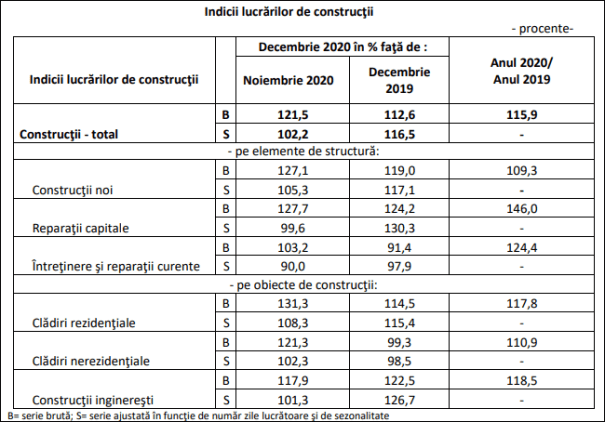
The total volume of construction works, as a gross series, increased by 15.9%. By structural elements, there were spectacular increases in capital repair works (+ 46.0%), in current maintenance and repair works (+ 24.4%) and less spectacular, but just as impressive for a year of crisis, in new constructions (+ 9.3%).
The construction sector registered significant increases. Thus, for engineering constructions the increase was of + 18.5%, for residential buildings of + 17.8% and for non-residential buildings of + 10.9%.
The synthetic data from the National Institute of Statistics indicate an impressive evolution in 2020 compared to 2019:
Source: National Institute of Statistics

Also, in December 2020, compared to December 2019, the total volume of constructions, as gross series, increased by 12.6%.
Increases in the volume of capital repairs (+ 24.2%) and new construction works (+ 19.0%) were registered by structural elements. Current maintenance and repair work decreased by 8.6%.
By construction segments, the gross series highlights increases in the volume of engineering construction works (+ 22.5%) and of residential buildings (+ 14.5%). Non-residential buildings decreased by 0.7%.
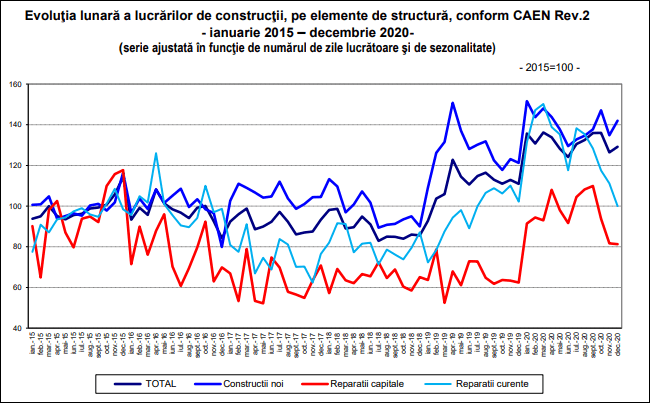
As a series adjusted according to the number of working days and seasonality, the volume of construction works increased by 16.5%. By structural elements, there were increases in capital repair works (+ 30.3%) and new constructions (+ 17.1%).
Source: National Institute of Statistics
Current maintenance and repair works decreased by 2.1%. By construction segments, the series adjusted according to the number of working days and seasonality indicates increases in the volume of engineering constructions (+ 26.7%) and of residential buildings (+ 15.4%).
Non-residential buildings fell by 1.5%.
In fact, after a peak reached in 2015, for four years, until 2020, the capital repair works did not exceed two thirds of the volumes in 2015. Only last year was it possible to stabilize the capital repair market at a level of over 80% compared to 2015. Regarding new constructions, they continued the upward trend started in 2019, and the current repairs had in 2020 the best index of the last decade:
Port Shipping & Engineering
10 years of activity
over 150 completed projects
Project portfolio of 25.5 million EUR
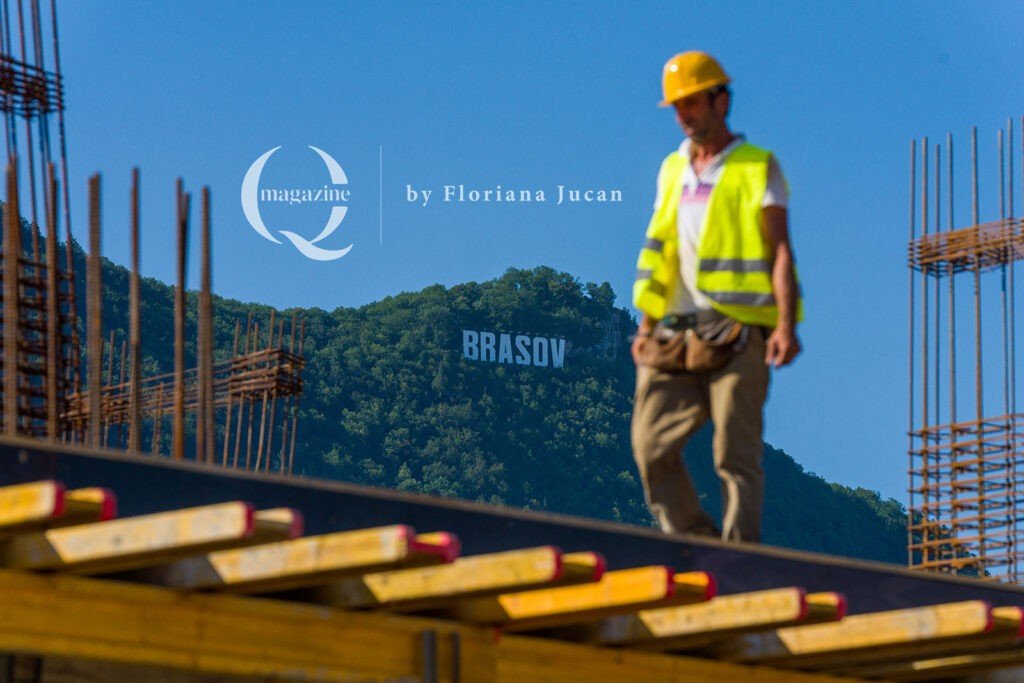
Constructions in Constanța, Brașov, Craiova, Port Agigea, Port Oltenița
CHAMPIONS IN CONSTRUCTIONS AT THE EUROPEAN UNION LEVEL
As a dynamic in the European context, the developments in our country are absolutely impressive; compared to 2015, we have the fastest growth in the entire European Union in the construction sector, with an increase of over 33% compared to 2015, reached at the end of the third quarter of last year:

Source: Eurostat
The Union, in its unity, has had a construction dynamics of 7.5% in the last 5 years, Hungary being very close to our performance (+ 32.7%) and Poland one third compared to our performance (+ 11.6 %). Bulgaria has a fall of over 12%, the Czech Republic is stagnating at the level of 2015, and Slovakia is experiencing a collapse of over 20%!
If we refer to the year 2005, Romania experienced the highest growth rates in construction among all European Union countries, with three absolutely fantastic years: 2007 (+ 33%, the highest annual growth rate in the entire Union), 2008 and 2019 (both years with + 27%).
If we compare to Poland and Hungary, we notice that the construction sector has a discordant evolution in the three states, the two Visegrad states having large decreases in 2016 (-18.9% in Hungary, -14.1% in Poland) and returns to as large as in 2017 (+ 29.7% Hungary, + 14.4% Poland) and 2018 (+ 21.2% Hungary and + 19.6% Poland), while in those three years we had decreases per line (-4.4% in 2016, – 5.1% in 2017 and – 3.9% in 2018):

Source: Eurostat
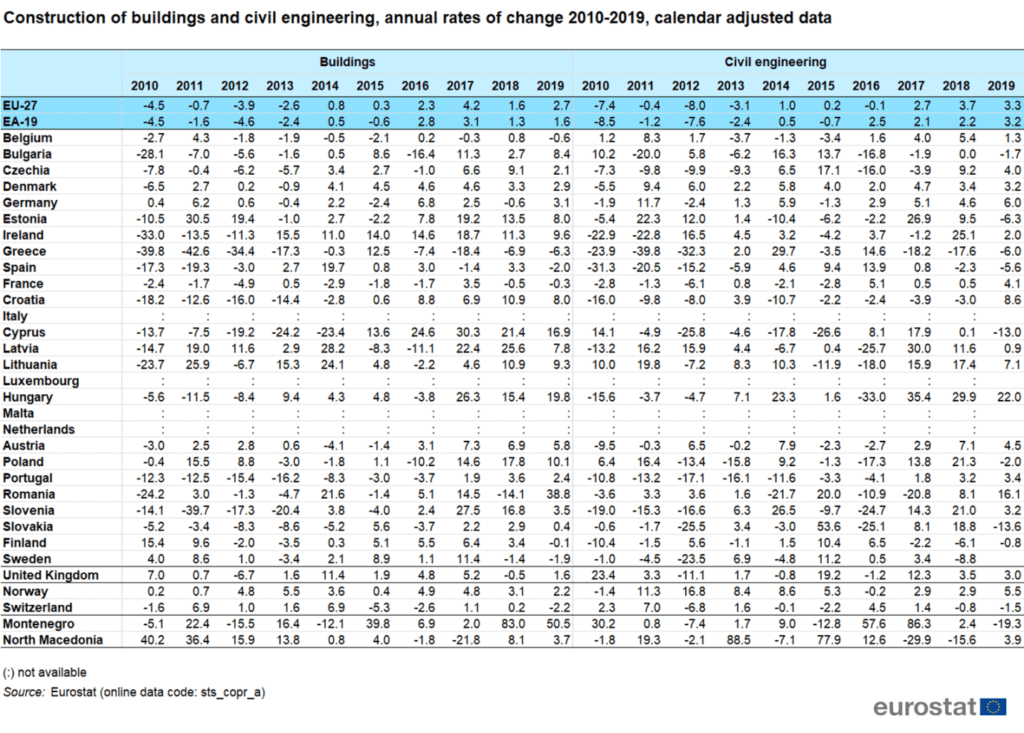
And in terms of the infrastructure objectives sector (civil engineering), the inconsistent evolution can be seen from a far distance: -21.7% in 2014, then + 2% in 2015, again a collapse -10.9% in 2016 and -20.8% in 2017, then rises again to + 16.1% in 2019. In the field of building construction, the maximum is reached in 2019, with an increase of 38.8% in one year, after – 14.1% a year earlier:
Source: Eurostat
The construction sector, despite the zig-zag dynamics, still has an exceptional growth, including an exceptional one in the context of our economy: 97,600 companies operated in 2019 in Romania, in that field. We had, in 2019, over 43% more design and architecture companies than 10 years earlier, with an aggregate turnover of over 47% higher.
31 billion euros, 15% of GDP, was the aggregate turnover of companies in the sectors involved in construction in our country in 2018, with over 20 billion euros produced only by the construction companies themselves.
513,000 people work in this sector, almost 80,000 less than in 2010, which indicates a significant increase in productivity, but also an acute shortage of staff in a sector that depends essentially on the available labor force, here large-scale automation is not possible.
722 million euros came from the European Union in support of the construction sector until November 2019, of which 519 million euros went to infrastructure projects. In addition, the Connecting Europe mechanism brought 118 million euros to the country last year to finance construction projects.
The state has invested almost 6 billion euros in the “First Home” program, money that was used to finance the purchase of 260,000 homes.
These are impressive figures, they are figures that indicate a sector with a large capacity; capacity that can be expanded in 2021, especially in the context in which the Government has committed to spend over 60 billion lei on investments, a large part of which will feed the construction market.
A conclusion is not easy to draw. Contradictory developments from one year to the next, the lack of qualified staff are serious barriers, but at the same time, the huge sums that the administration will pump into the market will produce a re-launch of this sector. The key to development lies in the possibility of returning home those who went to build abroad, especially those who are qualified. Increased wages and the abundance of jobs could lead to a massive influx of them, which could lead to the maintenance of high growth rates.
This comparative and exhaustive study of the dynamics of the construction sector, both nationally and internationally, was executed at the initiative of Port Shipping & Engineering in order to develop a realistic and successful investment plan.