Were the local elections of 27 September 2020 free? Were they correct? In fact, were they really elections? Who fought with whom? It is not clear who won. Instead, it is clear who lost: Romania.
- Acordul Mercosur a intrat în vigoare
- Bolojan: Pensia specială nu va mai putea fi cumulată cu salariul în sectorul public. CSM arată că proiectul adoptat de Guvern e neconstituțional
- Topul libertății presei: România, locul 49 mondial. Ce state africane o depășesc
- Q Magazine face-to-face with Alexandru Balan. Pawn. Spy. Traitor.
- Din fabrica Philip Morris România de la Otopeni spre 54 de țări, pe 5 continente
CORPORATE LIMITATIONS
The so-called “elections” were free to the extent that voters were not forced to vote by illegitimate pressure, nor were they illegally prevented from voting. Obstruction of the vote may be direct, when the act of voting is prohibited, or indirect, when the vote may be exercised, but the voter cannot freely choose who he wants because his favorite candidate has been limited in his ability to be elected.
Caught among countless diversions consumed in the public space, from the “humps” of the Covid-19 pandemic to the chaos of the school-year opening, few watched the behavior of corporations. Those who did so noticed that the multinationals put their “slaves” to the vote using the same methods as those used in January 2017, to take them out into the streets in the absurd protest against Ordinance 13.
Back then, the aim was to prevent the act of governing by terrorizing a government which was, on the one hand, weak, and on the other hand, infiltrated by agents of various occult interest groups. From then on, Romania was placed under the illegitimate siege of a movement with slogans and neo-fascist practices, protected in its anti-establishment behavior by the very person called to be the guarantor of the compliance with the Constitution, i.e. the President of Romania.
Now, the goal has been to legalize the underground operational structures that operated in parallel with the official state institutions and parasitized them. In other words, it is about bringing the “underground state” to the surface, but not to be identified and liquidated, but to be formalized and legitimized.

And this happened against a background in which a lot of persons of sound mind were induced the fear of participating in the vote by the incessant talk about the danger of SARS CoV2 infection. Thus, some were pushed to vote under the threat of losing their jobs, which was already under the pressure of the post-pandemic economic crisis, while others were kept at home for fear of the pandemic. This is a first method by which freedom of vote was affected.
ACADEMIC INDOCTRINATION
If this type of restriction of freedom was practiced with some discretion, more aggressive methods could be seen as well.
Thus, a professor from the University of Bucharest threatened his students and master students that he would refuse to coordinate their graduation papers if they did not prove to him that they had voted. The threat was published on his Facebook page, and some students responded promptly, presenting on the same page pictures with the stamp of the section where they had carried out their teacher’s order. Of course, he had not told them how to vote, but other comments clearly showed his political orientation.
After the elections, obviously, the message in question was deleted. However, it is easy to imagine that we are not dealing with a single case. Without exposing themselves in this way, many other partisan teachers of the #resist movement and the “parallel state” must have done the same.
On the one hand, the penetration of universities by the secret services is almost commonplace. Professor Andrei Marga, former Minister of Education and former rector of Babeș-Bolyai University, among others, has repeatedly denounced this phenomenon. An otherwise prestigious educational institution that has been nominated as a victim is SNSPA, where the famous sociologist Marius Pieleanu also works; he is the provider of opinion polls which, including during the elections in question, supported a huge manipulation.
On the other hand, a particularly serious phenomenon, already known in the Western universities, is the infestation of the academic environment with militant professors who no longer teach, but indoctrinate, organizing cohorts of neo-Marxist and neo-fascist militants. (Among these institutions we must include the National Institute of Magistracy.) Unfortunately, no one or almost no one acts to neutralize this strategic threat and leaves the Romanian university environment to be, beyond its many other sins, an incubator of globalist extremism with fascist features.

PROHIBITION OF THE RIGHT TO ELECT
In some cases, citizens have been restricted in their freedom to elect by restricting the right of some people to be elected. In the case of local elections, the impact of such situations was probably very small, but the phenomenon should not be neglected.
A famous example to illustrate the said mechanism is Adrian Năstase. Convicted without any direct evidence, as officially admitted, he was barred from voting or being elected for several years after serving his main sentence. Such an additional punishment, consisting in the suspension of the exercise of a fundamental right, is provided by law, only that, like any other legal penalty, it cannot be applied abusively. However, the obviously abusive nature of the conviction affects all the more the fairness of the prohibition to participate in the electoral process, as the measure was not applied to some violent criminals of the underworld.
We refer to Nastase not because he would have been likely to run in the local elections, but because it is easy to analyze and understand this case. How many other such cases still exist, where the subjects are people with lesser known names?! To the extent that such bans, whether many or few, are politically motivated, they also represent violations of the freedom of choice.
Putting things together, we come to the conclusion that local elections were not actually free; at least in part.
NO PARTIES COMPETED AGAINST ONE ANOTHER IN THE ELECTIONS, BUT SECRET SERVICES
The fact that elections are free does not necessarily mean that they are fair. The fairness of the elections is not limited to the fairness of the vote-counting process, but it is assessed especially by reference to the fairness in informing the voters about their options in the elections.
A misinformed voter does not have a free conscience, and this makes the elections unfair. From this perspective, the elections we are analyzing were unfair.
From the myriad of examples we could analyze in support of the above argument, we will choose two: the lack of transparency on the real forces involved in the elections, and vote rigging, including with the help of opinion polls.
Throwing themselves into the throes of controversy over who lost and who won in these so-called elections, commentators overlooked the very essential aspect of the real identity of those between whom the choice was supposed to be made.
Incomparable figures have been frantically compared: the results of local elections with those of the elections for the European Parliament or the President of Romania, the results of indirect elections (this is how county council presidents were elected before) with those of direct elections (the system which is now used to elect county council presidents), two-round election results with one-round election results, etc. It was thus concluded that PSD won the elections in absolute numbers, PNL won them as a trend and USR+ as dynamics, however nobody noted that, including in such terms, the victory of the main parties (i.e., the first two mentioned above) is tactical, while that of the anti-establishment party, is strategic.
Such analyzes are the result and continuation of the great manipulation under which the local elections took place: they were not a contest between parties, but between the secret services (Romanian and foreign) or between their various factions, as well as between foreign (state and para-state) powers that influence them, when they do not run them directly.
The main formal competitors – PSD and PNL – are parties captured by occult puppeteers with a global agenda, while USR+, just like ProRomania, AUR or other similar entities, still kept on the bench, are their creations. Leaving aside UDMR, which has a completely different status, origins and purposes, other parties such as ALDE, PMP or PNTCD are allowed to come into play, although they are more or less “free agents”, because they do not matter electorally anyway and they may also give a note of authenticity to the show.
The final objective of all these maneuvers is to change the system of government in Romania and the state as a subject of international law. This objective is in line with what some have called the “continuous coup d’état” that practically has already led to the suspension of the Constitution. It will be followed by its official abolition.
The tendency is that, step by step, the parties identified with the post-communist constitutional order, whose submission to the demands of the “deep state”, although almost total, is not entirely certain, would be eliminated and replaced by anti-establishment parties, fully dominated by their creators and fully dependent on them.
CLEANING ROMANIA OF THE PSD ELECTORATE
The campaign strategy aimed exclusively the large human concentrations, where the candidate’s person with his personal performance is more difficult to know and the choice of the citizens is expressed predominantly for the parties.
In this context, several nodal points were identified, having, due to their capacity of irradiation, a strategic significance, namely Bucharest, Timișoara, Alba Iulia, Brașov, Bacău and, possibly, Constanța. It could have been Cluj and Iasi as well, but Cluj already is the center of cultural segregation between the “superficial mentality of Muntenia” and the “Central-European Imperialist mentality of Transylvania”, and it is not appropriate for the process to be disturbed by untimely bringing new actors on the stage, while in Iasi’s case, Moldovan conservatism is always difficult to seduce with the song of progressive mermaids like Cosette Chichirau. Moldovans will be pushed to break away from Romania through the effect of poverty, not ideology.
Paradoxically, but not illogically, the anonymization of elections was accompanied by their personalization, by demonizing the current political hologram, PSD, its historical leaders from the time when PSD was a genuine political player, and its candidates.
The campaign was centered not on ideological confrontations or debates based on political offers, but on a wave of invectives against PSD (as a collective subject or as a sum of living or “dead” individual leaders, whether active or long gone), an attack to which the leaders of this party did not react or did so without imagination or stamina, as if they wanted to play the game of their accusers; or perhaps they did so consciously and deliberately, confirming their subordination to a common leader.
This was, however, only the visible part of the iceberg. In fact, the problem is no longer with PSD as a party. From a political perspective, PSD has surrendered and became subordinate, ideologically it has become corporatized and globalized, and from the perspective of human resources it has depreciated and no longer has any attractive offer. The real problem is not, therefore, with the political superstructure, but with the electoral base, with the social-democratic electorate which is massive and rejects both corporatism and globalism.
This electorate, then, where and as far as it could be expressed, also elected candidates convicted or prosecuted for corruption (as the famous Piedone, for District 5 of Bucharest, or the mayor of Baia Mare) thus casting a blame vote for the politicized justice which is one of the main pillars of the “deep state” and an outpost of the neo-fascist front. This electorate also proved to be dangerous in Deveselu, where the election of a dead man was not only an artifice meant to lead to the annulment of the elections, given that a party was left without a candidate as an effect of aberrant legislation, but also a form of subtle protest against choosing between puppet politicians. Such an electorate is a threat to the occult powers that want to reduce the people to a flock of sheep.
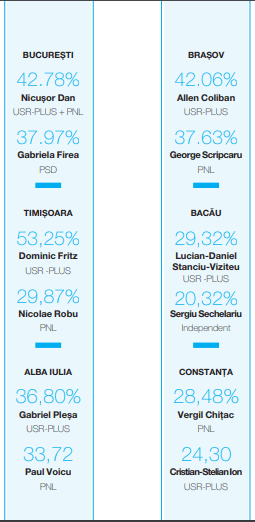
With PNL, things are different. It must not be liquidated, but transfigured, taking the form of USR+, and its electorate must not be destroyed, but transferred to USR+ and mobilized in the final assault against the current constitutional order. This is why, the objectives set by USR+ were strategic, not tactical. He did not have to occupy large spaces, but only sensitive areas from which other offensives can be launched later.
Everything suggests that if there is a plan to dismember Romania, and in this process the holders of local power are essential, it is not Hungarian segregationism which is pursued or encouraged, but Romanian segregationism, in the vanguard of which Banat, and not Transylvania is now placed.
ELECTORAL FRAUD
The “opera” was completed by the acts of patent fraud of the vote. The most obvious fraud took place in Bucharest, especially in District 1.
The post-vote opinion polls were indisputably rigged. Otherwise, one cannot explain the huge difference between the forecasts of independent institutions and those of institutions that have long been suspected of unclean games, as well as between the latter and the result of the actual counting of votes. Manipulation through polls also took place during the voting process, with the obvious purpose and effect of mobilizing a certain electorate and demobilizing another. Then, at the end of the day, the polls allowed the favored parties, PNL and USR +, to declare themselves winners, so that later they would blame the real results on fraud and, sheltered by the scandal, to commit fraud in the most primitive way. And all these, while state institutions, under presidential and governmental in-your-face pressure, treated with partisan complacency the winners of the polls (sic!) and refused to cancel the falsified elections.
If the scheme in Bucharest (where any normal mind could hardly understand how, despite the weakness of PSD candidates, aspirants like Nicusor Dan or Clotilde Armande could arouse the enthusiasm of such a large electorate) is compared to similar situations in other big cities (Timișoara and Brașov, first of all), it can be deduced that the same type of results could be reached, most likely, only by the same type of methods.
The videos showing the maneuvers of the USR party, assisted by a #resist prosecutor, in the warehouse where the ballot bags were located, while the PSD candidate insistently asked for the recount of votes, surprise not so much by what they show (something like this was imaginable), but by the fact that they were brought to light.
The case suggests an intestinal struggle within the group of puppeteers. This is the only really good news. One can only say that, probably, among them, there are some who are afraid to let a fascist anti-establishment party take the lead, knowing that such fantasies have led to global tragedies in the past, as the released elements can no longer be tamed and brought back to where they escaped.
We can only hope that these lucid forces will eventually prevail. At this point they are fighting a rear battle. And all that can be said for now is that the evidence they bring shows that the elections were neither free nor fair.
Their confirmation casts a shadow of illegitimacy on the Romanian local administration authorities in the coming years. This takes us even further out of the constitutional order.
CIVIL WAR…
These were not elections in the true sense of the word. In a democratic system, elections involve different contenders, with transparent identities and alternative offers addressed to the entire electorate, even if they are likely to attract only a part of it.
This time not only was it about a single occult player, but behind the scenes decorated with rich but fake democratic symbols, it is the Romanians that fought directly among them, divided into two groups: one attached to the idea of national and social state (which, according to one observer, remains faithful to the traditional Romanian model of social, authoritarian and egalitarian organization), and another group supporting political denationalization and cultural globalization (which, according to the same observer, unreservedly accepts the extreme form of authoritarian and unequal organization, respectively fascism in its expression which is not only anti-democratic, but also anti-national). Therefore, it can be said that, in reality, we have witnessed a real civil war; a strange one because even the fact that it was fought through intermediaries was just an illusion. In fact, PSD did not represent the first of the two groups mentioned above. He only had a walk-on role, to allow the vanguard of the other group to occupy convenient offensive positions in preparation for the next battles.
What is interesting about the members of the USR army is that they fight against their own interests. They now include many representatives of the third-age generation or people with poor skills and education (not necessarily without diplomas) having serious difficulties in competing in the labor market. They are in dire need of social protection and, obviously, can hardly be attracted by the biographies of USR and PNL candidates, full of references to diplomas awarded in the far Western world. And yet, they voted (because it wasn’t just about vote-counting fraud) for parties or people promising pension cuts, privatization of the healthcare system (i.e., making healthcare more expensive), making the labor market more flexible (i.e., favoring capital in employment relations), rising unemployment, reducing wages, along with limiting civil rights, and much more. In other words, they voted against those who, for better or worse, ensured that their existential needs were met.
Are we dealing with people dedicated to spiritual causes? With people ready to starve to see the corrupt in prison? Hard to believe.
These are fanatical people who behave against any logic, and their fanaticism is the consequence of fears of all kinds and frustration following repeated personal failures to the point of becoming chronic.
Some of them are talented, but unlucky people, who have lost confidence in their ability to perform, and they put this on account of the Romanian society, which would be genetically powerless or unwilling to value them.
All of them are attracted to everything that denies the status quo, even if nothing is proposed to them in return, and to those they do not know, assuming that the “savior” lives among them.
If the current official Romanian state is to be blamed for this, such blame consists in the fact that, wanting to break with the communist past, it threw itself without nuances and without measure into the waves of neo-liberalism, adopting a liberal and unequal model of social organization, which is not specific to Romanian mentalities, without any concern for the social integration of the excluded persons (i.e., those who could not adapt to the change) and the self-excluded people at the top of the social hierarchy (i.e., the people who became reach as a result of the transition).
We are not talking about the poor and the disadvantaged, because they enjoyed some social programs. We are talking about the weakened and alienated middle class, which has accumulated permanent frustrations and now goes blindly into the arms of those who are designated to liquidate it systematically and permanently, and we are also talking about the beneficiaries of the primitive accumulation of capital, ready to betray her country, as she is too weak to defend their fortunes in the increasingly fierce competition with multinational oligarchs.
… OR NATIONAL SUICIDE?
These people and many others have been inoculated with the idea that Romanians are inferior to all other peoples, that they are world champions of corruption, that they are incapable of governing, that they are led by uneducated oligophrenics, that they are the custodians of cultural traits and values which are incompatible with the culture of superior civilizations, of course the Western ones. In other words, Romanians were trained to despise themselves.
This self-loathing, naturally combined with a lack of self-confidence, as individuals and as a people, was expressed in the election results. This explains the success of exotic candidates with names suggesting allogeneity such as Dominic Fritz (parachuted from Germany) or Clotilde Armand (parachuted from France). It is obvious that it was not their qualities or merits that made them eligible, which would not have been criticizable, but their allogeneity.
A distinguished Banat lawyer expressed on social media his pride towards “his people from Timisoara” because they elected a German as mayor of Timisoara. Many congratulated him and expressed hope that the model would be followed in their cities. So, “no Romanians in public offices!”
Someone else demonstrated to us on Facebook that Mrs. Clotilde Armand is an intellectual incomparably superior to the PSD leaders of Teleorman extraction, as she graduated from high schools in France and the USA. Who would have thought that voters would have studied his diplomas? The blank check given to foreign universities is, however, another form of contempt for everything that is local. After all, former PSD ministers Ioana Petrescu (Finance) and Ana Birchall (Justice) also had diplomas awarded in America, but their performances were a nightmare.
A well-known political scientist who is on the paycheck of the Germans convinced us that the people of Brasov elected Mr. Allen Coliban when they found out that his name came from the Van Allen radiation belts, that he was the son of a non-conformist physicist and that he was a performance sportsman, cosmopolitan and environmental activist. This is despite the fact that he has no experience in administration and has not presented any coherent program.
In reality, what mattered to many voters was not that all these candidates are different from the national-liberal or social-democratic establishment, but that they are different from the ordinary, unassuming, normal Romanian. That is, they are not Romanians at all, or they are Romanians to a very small extent. It is not, therefore, about cosmopolitanism, but about anti-Romanianism; not about the refusal of nationalism, but about Romanianophobia.

Hence the conclusion that, beyond the civil war, we are also dealing with a collective suicide in terms of the national identity. We are ashamed of our ethno-cultural identity. We no longer want to be Romanians. Here is excellent news for those who want the disappearance of Romania as a state, as a sovereign nation and even as a people. Terrifying news, however, for those who still believe in the future of the Romanian nation, including as a nation integrated in a European federation of nation-states.
In these elections, not only PSD was demonized, but the entire electorate of the democratic left. And not only him, but also the Romanian nation. Here’s who lost! And the war is not over.
Brainwashed and depersonalized young people, made up of real assault battalions organized by the multinationals in which they earn their living, were sent, under the threat of losing the status of “exploited-assisted”, to storm not the Government headquarters, but the polling stations.
As freedom is indivisible – we are either free or not – it can be concluded that deprivations of liberty, whether limited to certain categories of voters, deprive of legitimacy the result of the recent local elections, as a whole.
When referring to the “cleansing” of Romania from PSD, it is the “cleansing” of its electorate which is envisaged. Which can only be achieved through its physical destruction and its social marginalization, both implying its deprivation of the freedoms and rights granted by the current Constitution of Romania.
We are ashamed of our ethno-cultural identity. We no longer want to be Romanians.
Here is excellent news for those who want the disappearance of Romania as a state, as a sovereign nation and even as a people.