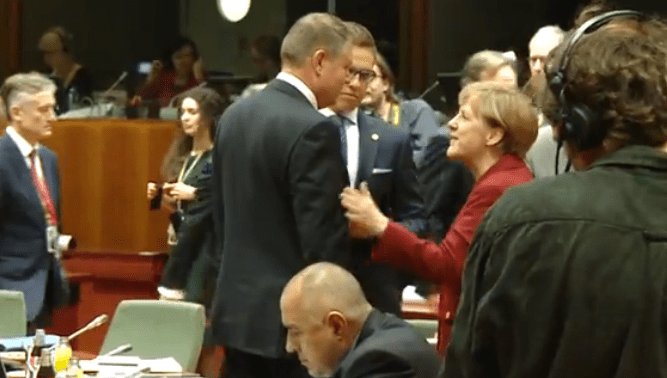

Two Israeli newspapers, one of which is the prestigious Jerusalem Post, published information according to which the German chancellor Angela Merkel supposedly asked President Klaus Iohannis in an imperative manner to block the move of Romania’s embassy to Jerusalem.
We remind you that this move is a strategic objective of Israel’s government.
The President of the USA, Donald Trump, already decided to go ahead with it, while the Romanian Prime Minister, Viorica Dăncilă, announced the intention to do the same.
Why now and why President Iohannis?
The news wasn’t invalided either at Berlin, or at Bucharest.
However bizarre it might seem for Germany to take the leadership of the European resistance against moving the foreign diplomatic missions in the historical capital of Israel, it seems to be real.

From the very beginning of the controversy on this topic, madam Merkel made clear her stand: moving embassies will be discussed only after there’s an accord between the Israelis and Palestinians regarding the status of Jerusalem.
But there’s a long way from that principle to being such a militant, particularly after the nervousness related to the topic had subsided.
Jerusalem Post also mentions that the same message was sent from Berlin to other European leaders.
Among them, the Israeli press only mentions Klaus Iohannis. Was he the most significant name on the list? Why was it brought up again a topic that had been benched? And if there was an intent to reopen the dispute, could Mr. Iohannis have been the best gasoline to be thrown on the embers of the Euro-Israeli fire? That’s highly unlikely.
Germany’s disappointment
As far as the German agenda goes, Klaus Iohannis didn’t perform according to expectation.
After three years of being president, he didn’t manage to overthrow the PSD-ALDE government – which is firmly settled on the Americano-Israeli geopolitical axis – in order to replace it with one that would be dedicated to the German agenda, the Franco-German or Franco-Flemish-German one.
Assuming the role of the rotating EU presidency – of the German Europe, in fact – by a government with an Atlanticist-natured orientation, at a critical time when Germany and France go through internal political troubles, the EP goes through elections, the European Commission goes through the end of its term, the multi-annual financial status of the Union reaches the adopting stage, and Brexit is to be finalized, becomes more and more an unavoidable nightmare for Brussels.
As a result, since the Moor didn’t fulfill his duty, the Moor can fall.
But he could have fallen naturally – because without external intensive therapy, Klaus Iohannis’s popularity, vital in securing a second term next year, is dwindling like a candle in the wind – if there hadn’t been some embarrassing news.
These concerns the connection between the Romanian President, ex-President of the Forum of Democratic Romanian Germans (FDGR), with the Nazi group which was outlawed through the Peace Treaty at the end of the Second World War, a group called the German Ethnic Group (GEG), the successor of which he declared himself; even if he might not have done that in order to perpetuate its ideology, but to take on its inheritance – part of which resulted from seizing Jewish goods.
The FDGR/GEF issue
The chancelleries of the main states which signed the Peace Treaty had been informed at least a year before about the fact that the Romanian President was someone who had questioned – even if for petty reasons – the legal post-war status-quo.
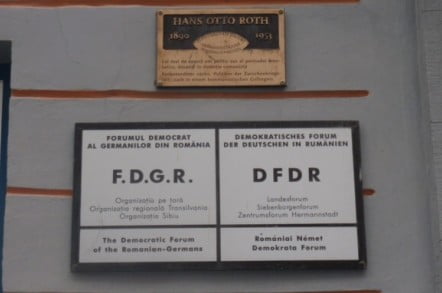
Such information was concerning, since it came at a time when neo-Nazi movements and generally speaking the extreme-right ones began to haunt Europe all over again, when EU sways as the wave of euro-skepticism hits harder and harder and the drum of war keeps being beaten lauder and louder all over the world.
All everyone needed, while the states of the world were striving to stop the ascension of the extreme right, was for a EU and NATO member state to re-legalize – even if only formally – a Nazi organization which had been outlawed by international law. While reeling from the shock of it, an extreme one considering Germany’s susceptibilities, the issue was put on hold with the tacit accord of everyone involved.
But when the topic was resumed in the international mass media, it put Berlin under particular pressure.
The German Ethnic Group was an external faction of the German Reich and Germany can’t stay silent for long about its resurrection.
It’s not a good idea to stay quiet about it. It’s not that good of an idea to talk about it, either. It doesn’t suit German interests to condemn the Romanian decision which results from the guilty collaboration between the former Mayor of Sibiu and the politic-flavored justice supported by the EU. It’s impossible to support it, though.
The flagrante delicto of the anti-Romanian plot
The news regarding the “order” that Angela gave Klaus comes, “conveniently”, only a day after European institutions that are controlled by Germany humiliated Romania by adopting, in bad faith, the EP Resolution and the MCV Report concerning the rule of law in Romania.
It sounds like a plot between the German Chancellor and the Romanian President against Romania’s legitimate Government whose fall the two desire notoriously and which – as per its constitutional powers – plans to move Romania’s diplomatic mission in Israel from Tel Aviv to Jerusalem.
It also confirms the information according to which the two have worked hand in hand to get Romania condemned, at least morally, by the EU and to avoid taking on the presidency of the EU Council by its legitimate government.
However much the Cotroceni Palace might deny it now, nobody doubts the fact that the President is a traitor. And such a perception is lethal for elections.
The plot, voluntarily uncovered, is a good alibi for Germany’s silence on the FDGR/GEG matter (“we don’t approve the rebirth of GEG under any other name, but we have other priorities to deal with as far as Klaus Iohannis is concerned”) and at the same time, through sacrificing the Iohannis pawn, offering some compensation to Israel for Germany’s refusal to move the embassies.
Now President Iohannis is completely compromised, both nationally and in front of Romania’s strategic partners, and the Dăncilă Government has no obstacle in the way of moving the Romanian embassy.
Summoning madam Iohannis to the Prosecutor’s Office, most likely with Berlin’s blessings, and cancelling in a very undiplomatic way the meeting of President Iohannis with the British Prime Minister, probably a move inspired by the Americans, are the perfect complements for the astonishing news in the Jerusalem Post.
The hunting season on Iohannists is open.
Mr. Klaus Iohannis’s compensatory visits to Europe’s euro-skeptic capitals weren’t for nothing. And yet, even those doors are starting to become closed for him.
Germany sacrifices a pawn. Israel makes a move. USA wins.
Next up: the USA-Russia game.