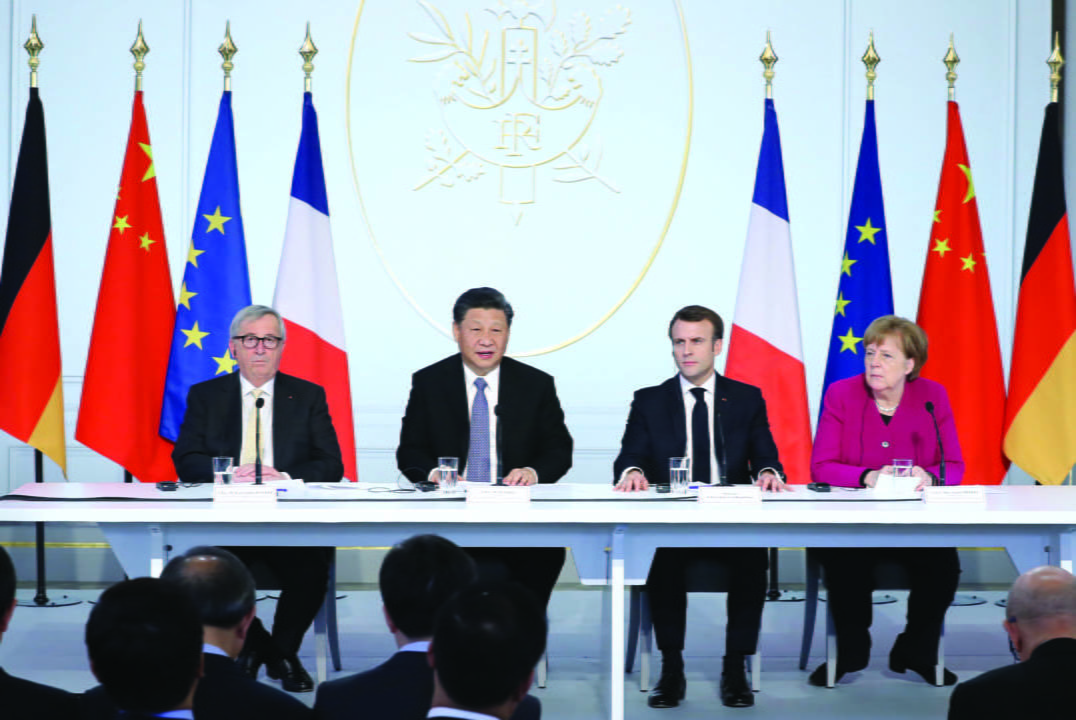

The Chinese people, who were avid of news about the results of the Middle Kingdom’s President’s visit to Europe, woke up on Wednesday morning (March 27th) to pleasantly discover (we can only imagine) on the front page of the official press agency Xinhua, the first article, and the first picture to be seen, a picture of President Xi Jinping chairing his meeting with the European Union, being assisted by the French President and the German Chancellor.
Who reads the diplomacy of the flags?
Xi Jinping’s open, almost smiling gaze, clearly shows that his message was a constructive and positive one for China and for the whole world, as the Chinese leader has already accustomed his citizens for years. On his left side, those who assisted him, or, one might say, the facilitators of this event, France and Germany, show concern about some things’ technical nature, one may conclude from their looks, while the EU’s representative, Mr Juncker, clearly seems to be rather skeptical, considering his facial expression.
The photo captures the press conference at the end of the meeting, when Xi Jinping shared, from the Elysee Palace’s tribune, his thoughts on how global governance should be structured. As we can see, staging is impeccable, as always, with Xi Jinping presiding, sitting centrally under the symbols of power and legitimacy of the place from where France is governed. He has on his right side the most prominent guest, the venerable President of the European Commission, who now serves the last months of his mandate before leaving European institutions and the capital of Europe, perhaps to return home to Luxembourg.
Of course, if we are European citizens, we would see things differently, but, then again, we do not have the same perception as the rest of the globe, we are Europe centric; because for most of the world, this photo found on the front page of all the world’s newspapers will clearly exemplify who told who/ what abouy how things are developing, who is in the position of (at least relative) power, with the resulting legitimacy to fix things in one way or another. Because image and symbols matter.
A diplomat could read the symbolism of the fact that Emmanuel Macron, through the positioning of the flags, signaled that “France and Germany, together, create the framework for this equals’ dialogue, they together host the encounter of equal powers (the mirroring flags on one side and the other, changing the EU-China-China-EU order) of the European Union and China”. Only then the patriarchal approach of the old continental powers, classic diplomacy, had to come into contact with the realities of new times. And who reads the diplomacy of the flags? The easiest thing to read – Xi stood at the center of the table under the seal of the French Presidency. Pretty Clear.

By reading the (Chinese) article, the readers would have understood the fact that France and China agreed that countries would work together to eliminate protectionism and push global governance towards a regime based on the rules and framework of the World Trade Organization. Summing up the rest of the article, France agrees with China’s proposals to work towards a fairer, open world, and closer ties with China on the basis of Chinese geopolitical architectures.
Changing the perspective, a Parisian insider would have procedurally noted the attention that Beijing offers to Europe and especially to France, as Xi Jinping went to Paris at Emmanuel Macron’s invitation for a bilateral summit / forum; and unlike the young and energetic French president who has changed arrangements along the way by inviting J-C Juncker and Angela Merkel (giving an important European signal of coordination and not just playing a bilateral game, be it even financially fruitful), the Chinese president respected the rigor of the initial framework discussed and for which he went, and highlighted the results of the China-France meeting.
But that Parisian observer, or any other EU citizen, can remember that the European press statements and headlines have titled, already one week before the meeting, that Europe will meet with the Chinese president to explain how things stand, or should stand, with regards to the openness towards investments, the economy, the unfair rules applied to Western companies in China, Huawei’s possible blocking at critical infrastructure auctions, and other critical topics.
Where did this volte-face (180 degrees turn) come from? Politeness due to hospitality or else. Certainly, somewhere there was a difference in communication. Because if we look at the following headlines on the front page of Xinhua, we can read things like “Five years later, Xi’s vision of a civilized world is more relevant to the times we live” or “The Chinese White Charter for Democratic Reform and the successes in Tibet” or “Germany-China, a deep human rights dialogue”.
Could this possibly be an example of a plot of the West-European liberal press, as the American president and some of the European leaders often invoke? (Unclear. But it is certain that this morning, in China, the country’s first four newspapers had the same front page, with the same photo, with the same four articles on Xi Jinping’s proposals for the organization of global governance. Freedom of the press has its say …)
This change of tone reminds us of another similar moment from 2007, when during the G8 summit, President Sarkozy had a tête-à-tête meeting with President Putin, following which he was supposed to go to the press conference and baffle a global audience through its inexplicable behavior. After many years, we were to find out from the French press that, apparently, in the duel of the great men of the planet which Sarkozy was trying to play, Vladimir Putin had explained him the order of food chain in this world, with the smoothness of a Russian special agent.
Thus, it seems that at that press conference, the French president was still under shock – an explanation for his unusual behavior. Of course, we cannot imagine the same thing about the Chinese President Xi Jinping, who is well known to be a refined cultural diplomat and subtle leader, who acts on the basis of confucian precepts, and who disrupts the determination and aggression of competitors through soft actions, with the purpose that, ultimately, China achieves the goals it had in mind from the very beginning.
Beside the way this meeting was reflected in those national newspapers, we can read the following: Xi met strictly for business with Italy and Monaco. If Italy is a G7 country (the world’s top 7 industrialized countries – a traditional format that, like all other Euro-Atlantic-centred architectures, is being challenged by the emerging economies of the world), Monaco is a gift. Because as Xi informed European leaders, it was important for China to get anchored in Europe to further expand its economic presence on the continent, and Italy was the least on the same wavelength from all the G7 member countries.
As far as Monaco is concerned, it is well known that Chinese luxury tourism and Chinese global players tend to develop more and more a taste for art, refinement, casinos, and so on. From this point of view, after the conquest of London and Paris, there was no gem of the crown of European multicultural culture more appealing to a Global China than Monaco. (But to mention the strategic perspective as well, and not just the spectacular one, Monaco signed an agreement with Huawei last year to develop the Principality’s 5G infrastructure; so we can think of that deal from the perspective of all personalities and people with higher accounts using Huawei’s infrastructure to communicate, trade, access bank accounts, etc., kudos to China Inc for scoring / outsmarting opposition in the era of great power competition).

Monaco Casino
Xi met with “the German Chancellor at the global forum organised with France to discuss China’s future economic developments in Germany and in the EU”. And with France, he met for diplomatic and global architectural aspects (separately from the Airbus billion deal). Through this, we can see that China continues to appeal to old cultural patterns, which are well rooted in great power diplomacy, in which Germany has only the role/relevance of an (yes, major) economic power, while Paris is the one from which the West understands diplomatic directions. Considering the photo with the four leaders, the silence on the statements about the EU and the discussions that Xi Jinping and Jean-Claude Juncker would have had is deafening. Maybe, as in the case of Angela Merkel, Xi preferred to discuss long term issues with the European leader with a lasting perspective, keeping tactical and technical discussions for the two leaders who are in their last year of office.
But this is very a positive signal for Emmanuel Macron. Xi signals his confidence in the French President’s ability not only to survive the Yellow Vests, but also to win a second term. This is also good for the European Union: in a context where a whole set of the “old guards” of European leaders change, the Chinese choose their European champion as a binder between the passing and the future times, with whom they want to be in dialogue for the next decade. Habemus Papam.
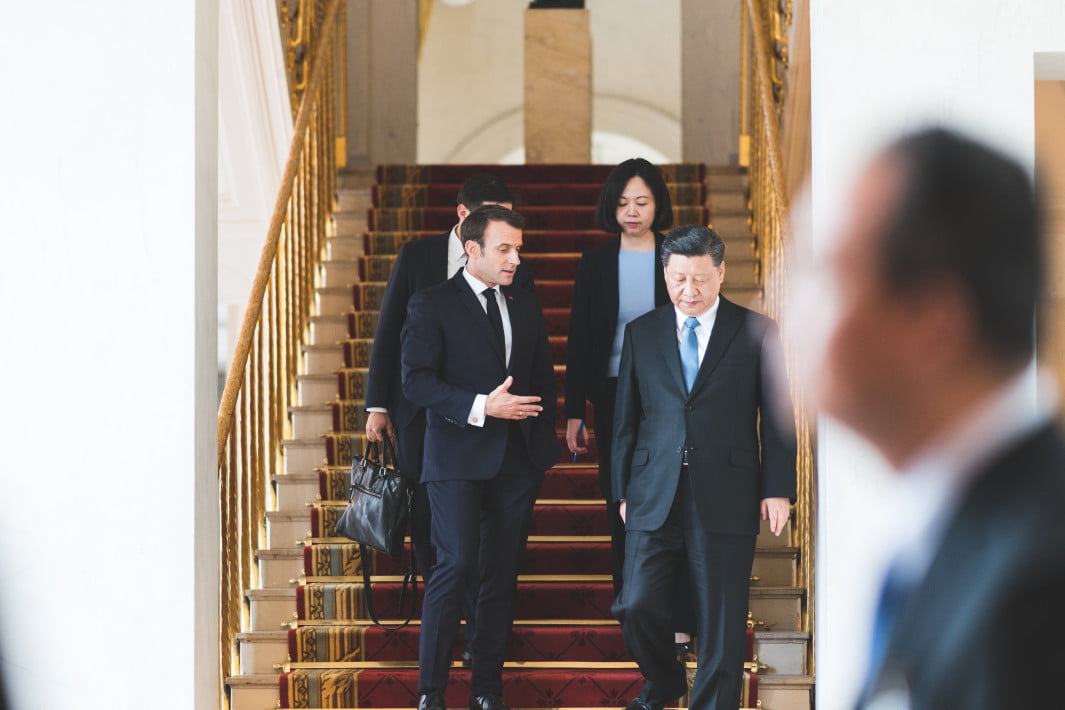
France signed tens of billions euro contracts with China, on Xi’s visits at Paris
Europe is not ready to be the leader of the world economy
The fact that Xi Jinping has been accompanied by a significant delegation to Paris, in a meeting with President Macron (a young, freshly elected man at his first term) concerning delicate issues (and burning for both Europe and China), proves that the relationship with Europe is of utmost importance to China. In the rush of bad news about China-Western relations in the last year (particularly on the US side), even Europe’s relationship with China got into turbulent waters. What is confirmed, then, is that China is listening. And now it was the time for a discussion with Europe.
The fact that he had the meeting in Europe at this forum organised by the French President, only with France, Germany and the European Commission, is instead a less appropriate signal towards other Europeans, especially near so many national elections and the European polls in May 2019. If the skeptics now feel the urge to disprove this perspective, the solution lies in the answer to the question “Do you think that President Xi meets in a random format by knowing how specific the Chinese are when it comes to symbols and politics?”
Xi confirmed through this meeting that (Western) Europe exists (and matters), and only then comes the 16 + 1 format. In this combination it is unclear whether the format or the conclusion were first, but the reality shows that China wanted this particular relationship with Eastern Europe and another, with the “leading” Europe, still with its hands on the gear. It would be interesting to know whether the EU has expressed some concern about this format 🙂 Let’s not lose sight of the fact that the next 16 + 1 Summit will take place in Croatia in April.
But Europe has also confirmed that it is not ready to be the leader of the world economy and global geopolitics. Of course, in a multilateral system, in order for it to be multilateral, there must be more actors. But from there until giving up the first hand in the round of opening talks on global governance, somewhere something must have broken. And in this case, it seems that Europe has partially blinked, with elegance. President Macron’s statements at the beginning of the press conference, which touched on global issues such as Africa and climate change, show that Europe preferred to try an agreement with China rather than a competitive perspective, thus contradicting the European Union’s last week’s strategy document about a strategic rivalry or competition between China and Europe.
In order to argue this, we can look, for example, at a document from the International Energy Agency (an independent body developed by the OECD) published this week, entitled “The Global Energy & CO2 Status Report”, which shows that despite the Paris Agreement, CO2 emissions have actually accelerated their growth compared to the previous year, with China, India and the United States being the main responsible actors for this growth, while France and Germany have reduced their carbon footprint. On this background, the French press’ questions, with regards to what Macron and Xi Jinping could have discussed in regards to climate and energy transition, persist.
In terms of global economic order, if President Macron’s statements would have sent the discussion on the World Trade Organization at the EU-China Summit to be held on 8 April, where the reform of the Organization is going to be discussed and negotiated, the message received by the official press in Beijing seems to have understood that things are already clear and will continue on what already exists in the WTO. Time will confirm which party has understood more clearly what has been discussed.
If this ample reflection seems too tough, then let us give to Caesar what belongs to Caesar. We, those observing the events, are not the ones who are the toughest, but the very porter of the French civil society is the most demanding, and more specifically the Hexagon press. It did not only comment on the content delivered to the press as a result of the meeting of the four international leaders, but also on the absent topics and the gestures beyond statements. In the full swing of The Yellow Vests movement, arrived at the 19th consecutive weekend of demonstrations, and raising questions first and foremost on the “religion of capitalist liberalism”, the same way more and more authors refer to the world order built (also) by Europe since the 1990s, the French press raises questions about the pertinence of the intentions declared by the French Presidency before the forum, as both France and Germany have mixed up this meeting with the consolidation of economic relations and the usage of opportunities.
Because if some have lived a real moment of schadenfreude (joy generated by the unhappiness of another) seeing some difficulties of American corporations in this trade war, which seems to have been fought with China and with Europe as well, France did not hesitate to take advantage of the unfortunate situation of the Boeing planes to initiate the largest Airbus command to China – a record contract that almost eclipses the rest of the discussions between the Chinese and the European side.
And, perhaps not surprisingly, this tactic of “giving with one hand and taking with the other” has attracted attention, including DW, who was wondering about the counterproductive optics that could result from these maneuvers. But let’s not build our hopes up – from a Chinese perspective, that order can be withdrawn at any time as easily as it was done, as China and Russia produce airplanes whose quality improves from year to year. So we can say that Europeans, through the economic understandings they have reached, have fallen into the sin of showing that, for Europe, trade is quite worthy if not above politics and principles – a remark often made even by European leaders about the transatlantic brothers.
Another moment of schadenfreude, but this time one which has turned against them, is lived by the Eastern European countries. In a kind of self-fulfilling prophecy, those who have been accusing Brussels for some years of ruling in favor of Western states and against the interests of the new Member States, and who have sent messages, since the beginning of the migration crisis, to Western leaders telling them that they should think more pragmatically, now come to see what it means when Western leaders start thinking more pragmatically, without expecting a common European position before having direct talks with China.
In this equation, in fact, everyone on the old continent is losing, because if one from the 16 + 1 format had imagined so far that they could profit and receive from both Brussels and Beijing, they find themselves in need to ask now more seriously what they really get from Beijing. And the answer to this question is that it depends strictly on the Chinese side, as in the case of the New Belt & Road Initiative (BRI), 16 + 1 is not an international body, nor a multilateral forum, both “projects” being in fact China’s foreign policies for managing relations with third countries.
But the messages of the French and German leaders were not leading to such issues, and the next EU-China summit will probably not even reach such issues. Macron’s and Merkel’s messages sounded somewhere between an invitation and a request that China accepts to talk honestly and be a friendly competitor, for not only the EU-China relationship, but also for the entire world economy, not to be shaken by what would mean a competition between the two economic giants.
With countless rehearsals of the notions of friendship, multilateralism, and cooperation, the European speeches sounded, now more like ever, similar to those of Chinese diplomacy. In addition, the moderately passionate discourse of the Chinese leader, who used the same notions, sounded almost shy, compared to his other speeches in which he promoted the idea of multilateralism and reform of the global system. Clearly, one of them was more in need than the other to feel reconciled by the idea that there would be negotiations in good faith.
The diplomat – maybe the most versed in the room -, who could often be tough, but who also knows how to put a smile on the public’s face when talking about politics and negotiations (an artist who increasingly seems that he’ll be missing from the European stage) was the only one that was not taken too seriously and explained to the Chinese public that things could also be taken in the second sense, in the figurative sense, that one thing could mean more than one thing.
The European positions towards China
Referring to the irritation of some of the Chinese when hearing that the EU considers China more recently a rival, Juncker explained that this is in fact a compliment. And indeed, this is a great compliment, because it comes from a Europe that, as a whole world has learned from Marxist ideology and the KGB’s influence and kompromat laboratories, was “the imperialist power who dominated the world and controlled people” (except Russia, of course).
And, indeed, nothing says that you have reached a certain level in the world rather than when the most developed club in the world says it is in competition with you. Of course, the Chinese may not look at things the same way, and of course, they probably do not see with the same good eyes the self-comfort and self-sufficiency that Europeans want for themselves.
With a bit of boldness, we could say that the ambitious and competitive China from present days is the product of the material needs and the spiritual child of the American example. In this competitive weltanschaung (understanding of the world), how far is Europe going to go before the exit from comfort level leads to the overthrow of the order of the state of assistance? Both French and Germans may have something to say on this subject.
Last but not least, the news of Germany’s desire to join the BRI project, expressed by Angela Merkel in the press conference, is a surprise in itself. An American thought on the topic would say, “If you own 20% of my debt, I have a problem; if you own 80% of your debt, you have a problem”, or in other words, Germany would think that it might be more influential inside the BRI than outside. But it might at the same time be more of the tactical movement expressed by a chancellor on her way out, as in a year or two we will see her successor at the CDU leadership, already known as AKK (Annegret Kramp-Karrenbauer), who might herself make a volte-face.
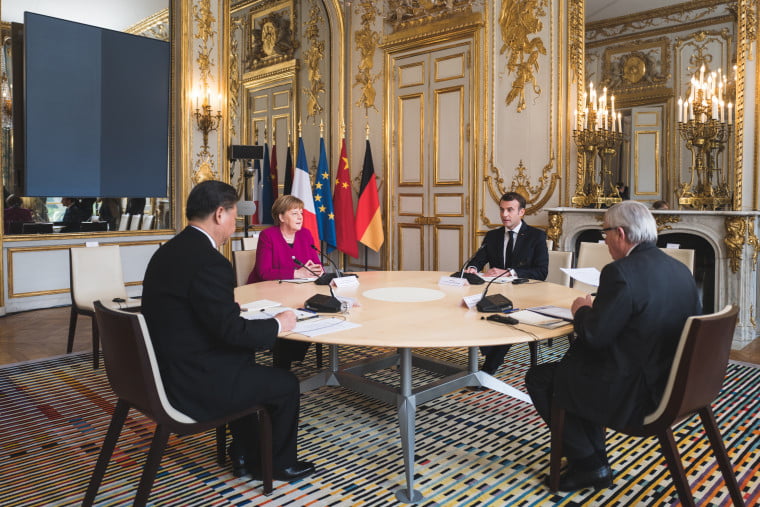
French President Emmanuel Macron, German Chancellor Angela Merkel and European Commission President Jean-Claude Juncker and Chinese leader Xi Jinping at the Elysee presidential palace, in Paris on March 26, 2019
The European surprise of joining China’s domestic economic development policy, known as the New Silk Road, will “suffer” clarifications in April, when China will meet with the EU in three distinct formats, through each encounter being able to filter and see who is truly loyal to it. The China-EU Summit will bring the team on its way out from Brussels face-to-face, and even if nobody said anything in the European press about the Emperor’s clothes, no doubt that the Chinese strategies have leaned on this issue at least once.
The 16 + 1 Summit, we might say, will include Italy for the first time (they still have time to decide), as between Italy, in general, Trieste, more specifically, Croatia, Greece and the Balkans, the Adriatic Sea begins to become a kind of Chinese sea. This can only mean enormous potential for its eastern shore, that is, precisely the countries of the Western Balkans that need so much investment during this pre-accession period, and for whom a massive Chinese tourism influx would now be a relevant part of their GDP. Last but not least, the BRI Summit – again in Beijing – will bring together those who are not only waiting to receive from Beijing, but also willing to make efforts.
Regarding the balance of power (or global competition), the speeches of European representatives this week seem to mark a strategy change. And yes, strategy rather than a concession, because looking at how great the reluctance to get involved with Chinese projects in many European countries was (and it remains?), the rapid change of position is not just a way to improve the flexibility. Here we have some models of thinking, one of which says that you can influence things much more from the inside than from the outside; but that applies especially when we talk about institutions – such as The Asian Infrastructure Investment Bank, and less when we talk about the domestic policies of another country with extraterritoriality ramifications, such as the BRI.
From an electoral perspective, it is very risky to escalate the European positions towards China now, whether for or against; there is no good option for the internal public, as for some these moves will mean a betrayal of European workers in favor of the Chinese industry, and for others it will mean an attempt to limit economic and financial opportunities (Italy is more likely to fall here, where the populist wave will always prefer to say that China’s financial deal for acquiring Italian debt will “save Italy from the hands of the Germans,” as a well-known former Greek finance minister, who has been lobbying against the Euro currency, has said.
The best scenario we can hope for is that a plan for stabilising the “China-EU”, “EU-US”, “EU-rest of the world” relations has already been drafted in the EU foreign policy laboratories and (at least) some European capitals. But even in this optimal option, we have to be moderately optimistic, because we are facing, at a European level, one and a half years of electoral season with relevant changes in more than half of the Member States.
In addition, a functioning Parliament and Commission will only be back in the autumn of 2019 when people will finish the campaign, when the composition of the new Commission will be voted, when the political staff and cabinets will be equipped with national representatives (after unceasing negotiations). So Europe will be more quiet towards the winter season, when we’ll be all exhausted and expecting Christmas and the New Year. And here we are, in 2020, the last year of funding from the current multiannual financing cycle.
So two years of reviews, in which Europe will have to adapt to internal changes, while China will continue with the engines to the fullest. Thus, it is rather preferable not to have an ideal plan, but to have the lucidity that we also need to deal with the current affairs, even if we have so many electoral moments in front of us.
If things continue as we have seen so far, especially in the last few months, Europe will continue to be absent from the global circuit, leaving things to be discussed first at the US-China level, the Russia-China tandem with Asia, Japan and the Pacific region with China, and so on, Europe being again invited to talk when it regains its internal coherence (and cohesion). It is said that people learn best from crises.
The irony is that, in a way, through BRI, China offers some European countries the option of choosing the escape route from fiscal responsibility and proper management, because when you know you can bet on rising foreign loans, you maximize as much as you can the internal propaganda channels, in order for them to say how well you govern, while the real account situation is more known to external decision makers than your own population. The alternative would be for political leaders in Europe to make the ethical and responsible choice and to force themselves to solve within the EU all the difficulties that exist before discussing with the world again. But this probability is “shy” at present.
The (eternal) hope of the Romanians
Romania is currently in the situation where it has tried to play more sides, but none succeeded. From the Russian energy projects that go around the national territory (and it is good this way), to the Chinese ones that pass either south of the Danube or through Ukraine, to the European ones from which we have withdrawn ourselves through the absence of investments from the national budget and through the non-attraction of European funds, to the decapitation of political and commercial ties with the Muslim world (not just the Arabic Gulf) through ambitious statements about international politics, and so on. And the (eternal) hope of the Romanians in relation to the US comes with costs – because even if the US is on our side, security cooperation does not mean that the Americans will put money in our pockets – we also have to support our part of cooperation; and we can do that if we have a balanced budget and economy.
The relationship between Romania and China can be expected to remain positive, relatively good (in fact, “quite good” as one hears soundbites in the public space, more words and less big projects), since the intensity of common exchanges and activities in recent years has only remained at a warm level compared to the south-south Danube cordon which, even at least discursive, has plunged into China’s relationship to offset a frail relationship with the intense core of European economic activity.
The strategy that Romania has to adopt is not to make mistakes by being inactive, but to engage in as many activities and engagements as possible with respect for EU and NATO principles and norms. For, as once said, the European shirt is closer to our skin than other ones for the moment. Romania could have played a more complex and smarter game that would have allowed it to combine a strong solid partnership with the US, good chemistry with France and Germany in advance of Europe, and a healthy business relationship with China, but for that, Bucharest had to be wiser in its foreign affairs and not to consume so much energy internally, with consequences in terms of global image and external influence.