
„As a very young teenager, I once found myself on a golf course with then Senator Kennedy. We played perhaps five or six holes together before he was whisked off to Hammersmith Farm, the home of Jackie’s mother and stepfather in Newport, Rhode Island. While memories fade, Kennedy’s grace and relaxed deportment certainly were impressive”, remembers Harlan Ullman, Senior Advisor at the Atlantic Council, for Q Magazine. A remember of November 22nd, 1963, drawing a portrait of the Man and the President John F. Kennedy.
Americans of a certain age will recall vividly where they were on the early afternoon of November 22nd, 1963. That, of course, was the day that President John Fitzgerald Kennedy was shot and killed in Dallas, Texas. About him and his murder, controversy and questions will swirl for decades to come. And his initials, JKF, are now irreversibly woven into American history.
The Man, not the President

About Kennedy, there is little that has not been widely reported either about his early years or during the twenty one months he served as America’s youngest elected (and only Catholic) president at age 43. Teddy Roosevelt was the youngest but elevated to the presidency when President William McKinley was shot dead in 1901.
His marriage to the glamorous Jacqueline Bouvier riveted publics round the world. Only Kennedy could quip that he was the fellow that accompanied Jackie on the presidential visit to Paris in 1961 and mean it. And while he presided over the disastrous Bay of Pigs fiasco in April 1961, his handling of the Cuban Missile Crisis in October 1963 was regarded as a textbook case of presidential leadership. Whether America would have stumbled into Vietnam had Kennedy lived is unanswerable. But the real story is about Kennedy the man not the president.
John Kennedy carried with him like a cape a palpable aura of grace, leadership and charisma unique not only among politicians but celebrities and movie stars as well. Perhaps only Thomas Jefferson rivaled Kennedy in intellect, breadth of interests and seductive attraction. Urbane, charming, sophisticated, articulate and handsome, Kennedy was still deeply flawed. Many of those flaws came from the very competitive and dysfunctional nature of his family and his dominating father—the very successful and ruthless businessman and politician Joseph P. Kennedy Sr.
John’s elder brother Joe Junior was the family’s heir apparent and groomed as such by Kennedy’s father relegating the future president to second-class citizenship. Not only did that status generate both a healthy and unhealthy sense of irreverence. It almost certainly led to Kennedy’s often rebellious and reckless behavior (and further charm) because, as the second son, he was accountable to no one. And following Joe Junior was not easy.
The eldest Kennedy son excelled in sports, academics and in life. At Choate and then Harvard, it was clear Joe was headed for greatness. Johnwould follow in his brother’s long shadow. And young Johnwas afflicted early in life with a series of illnesses culminating after World War II in Addison’s Disease that ultimately would imperil his health and presidency due not only to treatment but dependence on drugs to ease the pain of his many ailments and slow down the effects of his illnesses.
Shortly before World War II broke out, both Joe and John, then having graduated from Harvard, joined the Navy. Joe became a pilot. John was assigned to Washington and through his father’s influence to the Office of the Secretary of the Navy. In due course and after Japan attacked Pearl Harbor, Kennedy romanced a Danish journalist, Inga Arvad who was under surveillance by the FBI as a possible Nazi collaborator—the first of many public affairs and marital infidelities that would surround him.
FBI Director J. Edgar Hoover doubtlessly informed Joe Sr. about the affair, probably to remind the elder Kennedy of potential political vulnerability through his second son’s affair. Although “Inga Binga” as John called her was older and probably more than just a Nazi sympathizer, Joe Sr. was afraid that John’s infatuation could lead to a serious involvement and even marriage. So, the elder Kennedy, in political exile of sorts because as the U.S. Ambassador in London had gone on record predicting Hitler would defeat England and win the war, intervened to get Johnout of town. And shortly thereafter, Kennedy was off to the South Pacific and command of PT-109, an 88-foot long, highspeed wooden torpedo boat. In the early hours of August 2nd, 1943 in the Solomon Island chain, while on patrol in enemy waters, PT-109 was cut in half by the Imperial Japanese navy destroyer Amagiri.
The rest is part of Kennedy lore. Despite a bad back that had kept him out of the Army, Kennedy towed a badly burned crewman ashore clenching the injured fellow’s life vest strap between his teeth so that his arms were free to swim. He then ferried his crew to a second island from which they were rescued. Kennedy was awarded the Navy and Marine Corps medal for heroism along with a Purple Heart for wounds received in the collision.
In fact and little known, Kennedy came close to court-martial. How a 1500-ton destroyer could ram a relatively tiny and far more maneuverable PT boat in conditions of relatively good visibility even at night was a question never answered. The fine hand of Kennedy’s father had plucked his son from danger. The Navy retaliated by awarding Kennedy a non-combat medal as surrogate punishment for losing his boat.
A year later, Joe Junior was instantly killed when his explosive laden B-24 inexplicably blew up over the English Channel. John became the favored child and the focus for his father’s vicarious political ambitions.
Kennedy reinvented the legend of Camelot
After recuperating in Massachusetts from the back injuries sustained in the South Pacific, Kennedy won election to the House of Representatives in 1946. In 1953, after three uneventful terms, Kennedy won a Senate seat. And in 1956, he made an unsuccessful run for the vice presidency.
Propelled by his father’s ambitions, Kennedy chose 1960 as the opportune moment to win the Democratic nomination for president defeating two senators—Hubert Humphrey and Lyndon Johnson in the process. Johnson ultimately became Kennedy’s pick for the bottom of the ticket. In what was then the closest election in history, Kennedy defeated Republican Richard Nixon. While the election could have been contested by Nixon over irregularities if not out right ballot box stuffing in West Virginia and Cook County Illinois that tipped both states to the Democrats (as would happen forty years later when the Supreme Court finally resolved the George W. Bush-Al Gore standoff in favor of the younger Bush) it was not and Kennedy became the nation’s 35th president.
Because of Kennedy’s youth and charisma, the legend of King Arthur’s Camelot reemerging in Washington was born. Somehow the White House became the 20th century of the famous “round table” filled with the best and brightest of both parties. And, indeed, Kennedy made little distinction between Republicans and Democrats appointing Republicans as secretaries of defense and treasury as well as keeping Allen Dulles at CIA, a decision he would regret.
Brother Robert F. Kennedy, known as “Bobbie,” became the attorney general and would remain John’s closest advisor and confidant. Unfortunately, despite the brilliant oratory of his first inaugural address—“we will pay any price and bear any burden” to defend freedom and “ask not what your country can do for you but what you can do for your country,” the administration tripped and fell badly from the outset. The Bay of Pigs fiasco was the first catastrophe. And allowing Nikita Khrushchev, Soviet First Secretary, intimidate him in Vienna that summer, further marked JFK as a foreign policy novice.
Worse, while Kennedy’s predecessor President and General of the Army Dwight David Eisenhower had convinced Khrushchev that a nuclear arms race was a colossal waste of money, the muscular new administration embarked on a reckless policy of greatly increasing defense. Not only did Kennedy decide to increase the size of America’s nuclear deterrent by several-fold. He also introduced a defense policy of “flexible response” that would enable America to defeat the Soviets if war came both on the nuclear and conventional battlefields.
Khrushchev had already begun cutting Soviet defense forces and spending dramatically to free up resources for rebuilding the economy. Now the Americans were abandoning Ike’s sensible policies and were, from a Soviet perspective, embarked on a major rearmament program as well as taking more aggressive actions against Moscow as demonstrated by the failed Bay of Pigs Invasion to unseat Cuban leader Fidel Castro. And Kennedy was sending Green Berets into Southeast Asia to help America’s allies stem the so-called march of communism in the region to prevent the “domino effect” of toppling regimes and turning them into Communist states.
At the Extraordinary 21st Party Conference in October 1961, held two years early, Khrushchev was forced to fight a delaying action against powerful adversaries who believed that America was now about to overwhelm the Soviet Union through its rearmament program. Khrushchev countered with the scheme to station short-range ballistic missiles in Cuba to outflank U.S. intercontinental rockets aimed at Russia. Besides, the U.S. already had short-range Jupiter missiles stationed in Turkey pointed at the Soviet Union so turnabout was fair play. Ironically, Kennedy had ordered those same missiles removed from Turkey, an order the Pentagon somehow failed to obey.
The result was the Cuban Missile Crisis of late 1962. Little more need be said about those crucial days. Ultimately, a deal was struck in which Russia would remove those weapons systems and the U.S. would promise never to invade Cuba as well as ensure that the Jupiter missiles were likewise removed. Yet, the U.S. and much of the world took this as an American victory. And two year later, Khrushchev would be ousted from his office in a coup whose origins stemmed from the Cuban debacle. Tragically, the episode probably extended the Cold War by decades as the Eisenhower-Khrushchev tacit agreement to reduce defenses led to a further arms race that persisted for two more decades. And Kennedy’s muscular foreign policy contributed to sending forces to Vietnam and the disastrous war that would claim 58,000 American lives and at least hundreds of thousands of Vietnamese on both sides of the DMZ.
With Kennedy, on the golf course
Kennedy, of course, presided over a number of domestic crisis beginning with attempts to integrate schools in America’s south. He also introduced tax cuts and other economic policies that did not bear fruit and were unfortunate legacies that successive administrations would have to correct. Still, Kennedy’s magnetic charm and intellect kept him popular. For aspiring politicians, Kennedy’s press conferences, conducted in the State Department auditorium and not the White House, were brilliant case studies to be followed in which the knowledge, wit and disarming as well as incisive thrusts of the President in dealing with the media were on full display.
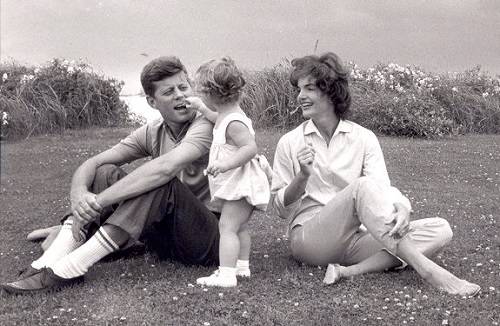
And, as Jackie produced two children – John and Caroline – and lost a third in pregnancy, the nation became mesmerized by the glamorous “First Family.” Indeed, Hollywood has never been and will never be able to find actors and actresses as stunning and attractive as the Kennedys. Camelot may have been the wrong metaphor. But the style and appeal of that White House has never been repeated.
Had Kennedy lived, who knows what might have been. JFK’s charisma and charm dispelled his naivete and inexperience. A more restrained press never revealed his many indiscretions that were surely well known at the time. Hence, the questions of what might have been outweigh the poor performance and shortcomings of the young president’s time in office.
As a very young teenager, I once found myself on a golf course with then Senator Kennedy. We played perhaps five or six holes together before he was whisked off to Hammersmith Farm, the home of Jackie’s mother and stepfather in Newport, Rhode Island. While memories fade, Kennedy’s grace and relaxed deportment certainly were impressive. And missing a few shots, his self-deprecating critique and bad language were refreshing even to someone barely removed from boyhood.
Grace and style count. In that regard, John Fitzgerald Kennedy had no peer. But likewise, he was an enigma. Privileged in life, he was reckless and irreverent, traits he never abandoned and often added to his charm despite the risks he incautiously accepted. One would like to think he had the right stuff to mature and become a very effective president. Unfortunately, we will never know.
 Harlan Ullman is Senior Advisor at the Atlantic Council in Washington, D.C., Chairman of the Killowen Group that advises leaders of business and government.
Kennedy – the legend in images