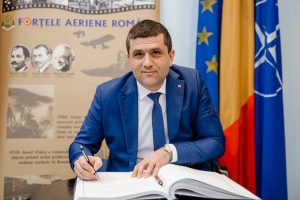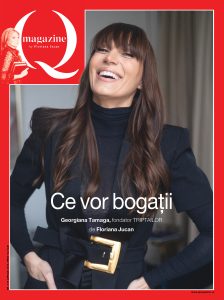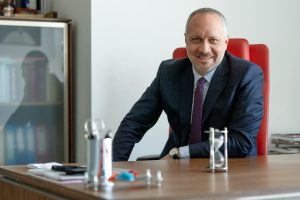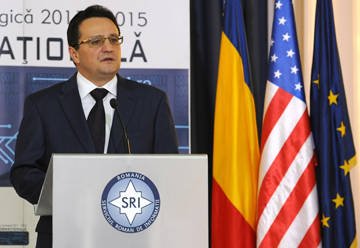
George Cristian Maior, the director of the Romanian Intelligence Service, in an interview for Q Magazine about what can be said at the time being… for the rest, we will wait for the declassified history.
I do not believe in providential people
What national project did Romania have after becoming a member of the North Atlantic Treaty and the European Union?
Joining NATO and the EU, indeed, defines the coordinates of a national program started during period that preceded the First World War, one of the ideals and dreams of a state man such as Titulescu, reflected in integrating Romania in a system of collective security in which everyone could express naturally their potential in terms of politics, economy, culture or geo-politics. Becoming part of a system that could grant the state’s safety and security, facing the dangers that will always lure in this part of Europe. The project continues. It is tied to our growing presence within these institutions, our development and our prosperity that can relay on our own strength and capacity to make a stand in these organizations. Seldom, we try to invent things that are, in fact, well defined in the structure of our evolution and development.
Did Romania have in the last 10 years, specifically, a target after these two goals being accomplished?

Specifically, we have to reach that level of prosperity in order to eliminate the gaps between us and other European states, to be in accordance with our territorial and demographical status in the EU. Hence, “prosperity” is the key word. Reaching a good security status for its citizens and projecting its economic force, geopolitical and even intellectual, inside these organizations and beyond our eastern borders, this is the key direction that we have taken responsibility for, with all of its mishaps which were, also, based on domestic vulnerabilities, economic crisis, so on and so forth.
Is there a certain Romanian personality that has gathered the country around him, in past years?
In my opinion, teams are what matters, teams that lead strategically, starting with the chief of the state, of course, the prime minister, ministers in key places, political elites, cultural elites. This is a matter on which we should all reflect more seriously. I do not believe in providential people. It is a post-modern world where, I reinstate my opinion, the contribution of a team is important.
The relation with the US is symmetric
Palmerston said that nations have neither friends nor permanent allies, only permanent interests. Hence, if we were to leave aside the paradigm of strategic partnership with the US, and I asked you which is our major interest regarding the US? What did the US do for Romania, in the past 10 years? US is on the 12place in terms of foreign investments in our country, the visa status is the same, a new ambassador has not been detached for more than a year, meanwhile Romania has given US ALL that it was asked of it in terms of politics, military force, economics…
It is interesting what you are saying, but at the same time, this degree of comfort related to the state’s security, given to us by the partnership with the US (and we see it more clearly today due to regional events) is extremely important for our safety, our security and the way the country is progressing.
Economically, there has been observed a progress. There are big companies, with a strategically purpose which have invested in Romania, I will not give their name, you already know them.
A more substantial dynamic to the partnership with the US, from an economical perspective, will also be granted by the American companies having an interest in the area of natural resources from the Black Sea. There is also the anti-missile defense system, which is the symbol of a major strategically development concerning a more special dimension of our security. And regarding the visa program be sure that this will change in the next three years.
Due to the involvement of the EU!
Indeed, this is important. The relation between the US and the EU has this dimension as well, being able to talk and even impose certain incentives that are natural between two partners, two allies.
Do you consider that the US could have done more for Romania?
I believe that it is a symmetric relation, even if there are some who try to demonstrate the contrary. It is true that we have also given a lot, but in accordance with our national interest. And since you were talking about Palmerston, you should know that the old saying which has, no doubt, dictated the ancestral politics of Great Britain has changed in the last decades. Even a prime-minister such as Tony Blair noted that this saying is no longer valid. There is, also, some rhetoric in this. In a world such as this, with natural alliances, I believe that we can look at things from a different perspective, as well.
Too busy with the multinational interest, have we not we neglected the national one? Was it not more comfortable for our safety and for our security to have a closer relation with Russia?
This is the key to the problem. I have said it and I will say it again: a relation with Russia must take place in terms of equality and symmetry. We can have this in a closer future, due to our membership at NATO and the EU, and in accordance with our partnership with the US. When it comes to our national interest we have to know to take advantage of all sorts of liaisons, beyond ideological aspects, more or less visible, and try to have a very down to earth perspective.
Nonetheless, this can only be accomplished by means of diplomatic intelligence and throughout the projection of an economical and geopolitical strength that we are still lacking as a state.
What is the relation between Romanian Secret Service and Russia’s Secret Service and its Foreign Secret Service? Do you cooperate as well as you do with other intelligence services?
It is rather cold and this is because of the things that I was telling you earlier. Naturally, in case there was entail which could harm the security of both countries (terrorism, for instance), which could jeopardize other states and their citizens we are willingly, anytime, to exchange information with the Russian Secret Services, without taking into account any kind of political aspects.
What about them?
I believe that it is in their best interest as well to cooperate, because, the situations are often slippery, and in this area of filed once you have an information and you do not send it further to another state, things will eventually come to light. And reciprocity in this filed is very important.
Is there a major interest from Russia’s Foreign Secret Service for Romania, at the level of the intelligence community?
Yes, especially coming from Russia’s Secret Service. Obviously, there is an unseen fight in terms of attempts. Everyone has this interest – to gather information that is important for our own national security.
Very often, we counterstrike well and effective. There is not much talk about these things. Here, things are clear; there have always been like this!
The declassified document “The fundamental political orientation in the area of National Security of the US-1956” viewed the changes of the regimes of the soviet countries as an essential strategy. Practically, the US wanted to exploit the vulnerabilities of the countries placed under soviet influence, presenting them the alternative of the Occident, of the West, which indeed promoted the interests of the US but also the fundamental rights of human beings. Can we say that the US is the moral author of the fall of communism in this part of the world? Does Romania owe its democracy to the US?
I believe so. This is clearly one of the reasons. On the other hand, there are also other reasons related to the domestic shrinking of the communist system, of its own inability to develop economically, because of its denial of globalization which had become a rising element in the 1950’s and the 1960’s, in terms of technology progress and communication. This denial led to the asphyxiation of the state and of the system, concurring with an implosion from inside. This is, in fact, what happened with Ceausescu and its regime, as well.
26 Romanian soldiers died in Afghanistan and Iraq. Their memory, their families and the other soldiers who participate in operations in Iraq and Afghanistan, did they not deserve a public message from the US president at the 10th anniversary of Romania’s membership in NATO, instead of a message coming from the Deputy Secretary of State?
We can talk about diplomatically nuances. I believe that there were moments when the US president visited hospitalized romanian soldiers wounded on the battle fields and it was a gesture widely shown by the international media.
We are expecting negative surprises in the cyber area
New types of threats, especially in the cyber area, have led to the uprising of the digital power. Interestingly enough, this power does not belong to people with power of decision but instead it is in the hands of those who have the skills to gain it. For instance, we have witnessed, in the last few years, some rebellion movements (Egypt, Tunis, Turkey, and these are only a few examples) that were instrumented with the help of social media. In the light of these examples, they become a very powerful weapon in the hands of the crowd. How do we control these phenomena?
These are elements of new power, impossible to be controlled by classical mechanisms. The positive and the negative aspects, from the point of view of cyber threats, are clear. It is clear that the new definition of power will have a cyber-component more and more visible.
The security environment has developed; the information became global – Big Data. At the time being, is it more difficult to make a prediction or a prognosis due to the high volume of information?
Yes and whoever works with the idea of prognosis and prediction based on supreme knowledge is, clearly, making a mistake. Scenarios, possibilities and probabilities, these are the instruments to work with these days. The entail is, indeed, huge. It must be searched in its deepest essence by the Secret Services, it floods rapidly and it expires at the same rapid pace. All of these have resulted in changing the trends and the paradigms in this area.
Recently, in the public debate, especially during a Govern-Presidency dispute, the subject of risking the national security has been brought up, by giving some parts of the informational/computerization system to Huawei, the Chinese company suspected of espionage by many states. President Traian Băsescu said that we should also take into account the American companies when it comes to signing such contracts. Are we under a threat by the collaboration with China? Are the American companies safer? Why not a Romanian company? Were you consulted with regards to this subject? I have seen that you previously said that you are not asked about this matter.
We were not consulted. On the other hand, rest assure that we have all the necessary mechanisms to protect ourselves, including what is currently referred to as critical infrastructure in the area of communication. I would not be concerned about this.
There are many cases that are not brought up in the media, due to the restrictive legislation concerning terrorism – for example, some attempts of derailing the fast trains in Japan (Shinkansen), which are completely computerized or some attempts to hack the air control system. How well prepared are the security structures in our country to face these dangers, especially in terms of critical infrastructure? How resilient are they?
We already experienced some attacks in the area of critical infrastructure. I can specify the ones which targeted the Ministry of Foreign Affairs or some agencies in the filed of natural resources and it proved that we were ready to face them.
Do we know who attacked us?
We do, but it is a field where it is difficult to prove and to publicly expose it. However, this aspect is discussed at the level of inter-communication between the Secret Services. On the other hand, we know that we are dealing with an area where one cannot establish a totally defensive architecture. We are expecting negative surprises, for this point of view, just like any other state.
This is not very reassuring!
But it is real! And if we deceive ourselves, I do not believe that we will mange to contribute to creating a safer environment and grater caution in this area – which, of course, are necessary.
3 out of 10 best hackers in the world are from Romania. How do you bring them to the good side?
I know that it is appealing to be part of the Secret Services and working on this particular segment, and, just like in religion there were examples of conversion, also in this area, people with a vision and a lot of patriotism can convert themselves.
Is there a success rate?
Yes, I can say that it is rather satisfactory.
Secret services can bring down a political regime!
Let us move the discussion from virtual to reality! Publishing the security records, was it a mistake or not? Did it not create the feeling that tomorrow, if the leaders of the Secret Service were changed, records of the opponents of the political power might be “leaked”? By doing so, did you not destabilize a whole security link that the former “Security” had nourished for years, one that might have been used later on? Has it not induced the feeling of fear in collaborating with the Secret Services of the country?
On the contrary. Rest assure that there is not an issue from this point of view. When we talk about the former “Security” we are actually referring to an ideological organization, hence not about an intelligence service in the classical meaning, because even the pattern of action and the idea of serving a system defined from a political point of view is in disagreement with the idea of intelligence services.
It is my opinion and I have said it before. There were professionals and valuable people in this structure, indeed. We speak about individuals, not about a system, and publishing those records was absolutely necessary in order to understand the wrong doings of our past and how it affected the lives physically, professionally and the dreams of so many Romanians. I do not regret having declassified the records, in a legal manner, just like other states have also done it.
On the other hand, you spoke about the risks of this action related to our work. After decades, of course, there will come many other declassified documents, just as in the US or GB. It is also important from point of view of national history. I laugh to the idea of those wondering what the Romanian Secret Service has done to protect the national and the international security?! Let’s see how they will speak then.
The former “Security” had a vast informative network, in all the important countries, and it used to recruit mostly amongst the foreign students who came to study in Romania. A former officer told me, recently, that they used to know what everyone thought about Romania, and that our country had sources at the highest levels, amongst ministers and influential persons in different states. How much of that network has been kept in present days?
It is pitifully and dishonest in what he said. And even if it was so, what service has it brought to us? Let’s ask ourselves: how did this fact reflect on the national security, citizens’ protection and prosperity? Nothing positive happened.
Yes, not because of the Security Service, but because of the political regime!
If the former Security was indeed a powerful and positive force, it would have brought down the regime. This did not happen, on the contrary.
Hence, Security Services can bring down a political regime?
History shows us this is true. If there are certain circumstances involved. But, in our case, it didn’t. Furthermore, I believe that they created an informative fog in order to preserve themselves, where the realities of the world were hidden or misinterpreted by the former Security Service, thus Ceausescu was living in a void of knowledge for which he eventually paid with his position and his life.
You know that in Secret Services area there aren’t any friends and that despite all the regulations of the Warsaw Pact which prohibited spying the members of the alliance, not even for a second did we abandon the recruiting operations, even amongst the other security services. Did you continue it?
Let’s leave the archives to speak in the future. Indeed, there have been some elements of preserving our national interest inside the Warsaw Pact with actions against some of the allies. But even at this point, there is a lot of exaggerating, including the famous anti-KGB unit, which, succeeding its end, was mainly concerned with monitoring the committee of politicians, in order to aid the supreme commander of the state.
Did you present certain information to the beneficiary, without having been preceded by a decision, action?
Not always a piece of information has to be backed up by a decision. I am glad that most of them have been used by the Government, by the Presidency or other institutions of the state. There will always be a gap between what we offer and what is transposed into a political decision.
It has been the frustration of the Services since forever. On the other hand, we are, ourselves, lacking perfection. I can say that, maybe, we also might have failed to provide useful information for the state, at some time. Things cannot be perfect. In this area, there isn’t, as I have said before, absolute knowledge. This idea is an illusion.
Mark Lowenthal said that every nation practices intelligence work taking into account its interests, its particularities, even if it has the same values as other countries. Hence there is not a border between espionage and counter-espionage, not even between strategically partners and state friends. Are there infiltrated officers and agents of influence, belonging to countries that we love, follow and summon as democratic models, at a decisional level in Romania?
No comment!
Confidential versus transparent. Not even a single democratic government will accept total confidentiality of the secret’s Services operations, and Lowenthal believed that there is no country to have debated this dilemma like the US. Eventually, a single man such as Snowden or a case like Wikileaks can cause multiple damage compared to a controlled transparency from within. Where would you draw the line between need to know and need to share?
I think we are moving from need to know towards need to share, as a result of global risks and the spread of information from different sources. On the other hand, the transparency of democratic system has been a trigger of what you call the Wikileaks or Snownden phenomena. In other states, which I shall not name this did not occur and there was no debate on the matter due to the state’s autocratic character.
I believe the contrary. I don’t think that the transparency of the Secret Services led to these leaks, but their internal vulnerabilities.
Yes, also on account of an open environment regarding the debate, which was uncontrollable. At this, I was referring, especially.
Thus, the good side of things is that the US is an opened society focused towards the truth, even if that truth might be used against them.
It has its own mechanisms of self-regulation. For instance, look at the debates and certain measures of balancing the transparency and the confidentiality.
Do you pledge for a certain type of active communication, or on the contrary, you stick to the fundamental mission of a Secret Service
The essence of our activity lays its secret character. This is the starting point. Of course, in an era of global information and counting also the pressure coming from the media, there has to be more transparency in order to legitimate our actions and make them trustworthy. All of this must be handled with caution and intelligence.
Are the cults and sects an instrument of recruiting? It is said that priests are the best spies. Are there undercover officers in Churches and amongst cults? Do you monitor them?
There are undercover officers operating in the same parameters just like all other democratic service from the EU or NATO. It is the standard phrase from which I will never deviate, when we are tackling such a sensitive area of our act.
A Secret Service has to be respected, not loved!
We live with the fear of being taped and listened to. The paradox is that during the former Security there was a rumor or a sense of belief that we were followed or taped, but nowadays it has become a reality. Hasn’t the overexposure of this technique led to its depreciation?
We live in a world where in order to assure the protection and the safety of its citizens we also have to make use of this procedure as well. But, the idea that “everyone is listened” has a very precise cause: the political element that often wants to promote this idea. I do not think that citizens have something to be worried about from this point of view.
There have been different leaks in the media. Did you ever find out the sources of those leaks? Did you ever ask your partners, for example, the National Anti-Corruption Agency, to eliminate this procedure?
From within the Secret Services there were no leaks, for many years now. Nonetheless, if the indictment is also supported with transcripts when the accusations are made public, than is a totally other situation which can be dealt with for al legal perspective.
There have been leaks even before a public indictment!
I believe that every institution should be and it is forced to undertake its own security measures, but I would not extrapolate it.
Exactly these leaks and the feeling that you are spying and following everyone have created a sort of mistrust and fear with regards to this institution. Is this what you want when people think about the institution that you run?
It is the other way around. I believe that the institution’s credibility is great, keeping it constantly around 50%, a clear sign that the population appreciates our efforts. On the other hand, a Secret Service does not need to be loved, but it has to be respected, if it shows professionalism. And I trust this also applies to us.
There isn’t a public campaign of awareness, to educate the citizens within the idea of national interest and the need to work together with the Secret Services. People are lacking the security culture they are unaware of the meaning of national interest and, my opinion is that you do not have a tidier connection with the civil society and with the population. To whom do we owe this gap, this fracture? And how do we fix it?
I believe that in the last years I have created a better link by means of different seminars, for example, with prestigious universities such as Harvard. For instance, I think that there has been a program to develop this awareness which had positive effects, raising the interest of young people in joining the Secret Services, with very good results.
I read in an ODNI (Office of the Director of National Intelligence) informative brochure that during 2009-2011, the intelligence community has been included amongst top 10 best working places in the US. Working for the Romanian Secret Service can it be a perspective for a young man?
It is relevant to say that there are almost 100 candidates per place, trying to work for the Romanian Secret Service. I am glad to see this numbers.
The Romanian Secret Service brings its contribution to the state’s budget
Besides the psychoses that I was mentioning earlier, both institutions and common people were affected by the financial tsunami from 2008 which has its effects even in present day. How did the financial crisis affect the security paradigm, at a national level? Did you feel, on this basis, a growth in the espionage operations in the area of economics, for instance?
Yes, the economic crisis had certain effects at the level of social stability with geopolitics effects. It is this crisis that has shown us how important it is to keep a direction in terms of economic security within the Secret Services, which was, neglected before the crisis and in the years that followed 1989.
We have shown this important component – the economic security – and we have tried to offer useful analysis to be beneficiaries in this area.
The Romanian investments and the domestic industry, in general, produce less and less, giving more space to the foreign investments. You know very well that behind every big investor, especially when it concerns strategically companies, lays the interest of the states’ or even the secret services’. Do you monitor these investments?
I will never say what the Secret Service is monitoring. Rest assure that we follow closely whatever might be of concern from the perspective of Romania’s national security.
In 2012, there was a case of a Russian citizen detained at “Henri-Coanda” airport with geological documents concerning the natural resources from Moldomin. The Romanian Secret Service caught him before leaving the country. Have there been any kind of incidents such as this one ever since?
I have told you that there is a constant in matters of economic espionage. We know the all the details of this phenomenon and we control it.
There are many cases, also pointed out by the media, where hungarian citizens and their families forged documents in order to be reinstated with properties, lands, forests and even certain objectives of national interest in Transylvania. The Nadas village is such an example, but there are more. Did you monitor these situations? How was it even possible?
In the Nadas cases, it was also thanks to us that things were legally treated in justice, in an adequate manner. We collaborate closely with the courts of justice in these types of situations.
What role does the Romanian Secret Service play in bringing down tax evasion?
It is big and when we made public our results this year, we pointed out we have send nearly 800 notifications to the ministerial group in charge with tax evasion, having good effects in bringing down this phenomenon which will still be visible in the next years, but we will try to lower it. A concrete effect is reflected on state’s budget.
If we know how to distinguish the threats coming from economic, military, human or cyber aspects, in terms of ecological security it is rather difficult to operate with the concept. What is more exactly ecological security and how do we contain its effects? You spoke at one time, during the protest against the shale gas and Rosia Montana, about a certain ecological activism with effects on the national interest.
Indeed, there is a significantly activism, not just in our country but also in other states affected by this type of issues and it is justified. On the other hand, if a certain border is being crossed in close connection to anarchism and violence, it is natural, that from the national security perspective, we need to look into the matter. Especially when there are involved some key points concerning the national economy, we should appreciate things from a wider temporal perspective, on medium or long term, bearing in mind that classical resources are fixed. The state’s economic force and its place in a global economy depend on how we will define our evolution in this vital area.
Is this activism against exploiting certain resources supported by foreign influence coming for other states?
There will always be this!
And also financing?
We are carefully looking into all the aspects related to this matter. Of course, the beneficiaries should be informed, should know all the phenomena and together we should to try to bring them down.
General Michael Flynn, the director of Defence Intelligence Agency said in an interview that the Obama administration was aware with at least a week in advance, about the pro-russian movements from Crimea. Did the Romanian Secret Services know about the military movements in Crimea?
Yes, we were aware of the evolution of events in the area.
Is there a risk for this scenario to take place also in Moldavia?
Certainty there is a regional risk related to the security in this area, which is carefully handled by us.
What can happen based on national intelligence predictions, in a short period of time? Even George Friedman who is a strong observer was making a point about a potential conflict in Moldavia, which will also affect Romania.
An analyst has the luxury of tackling different aspects, even those related to geopolitics or military. I do not believe that there is any kind of risks concerning Romania’s national territory.
You have said, several times before, that the threat to our national security lays in corruption and I have seen your active involvement alongside other institutions in order to eradicate it. Still, how do explain the belief (from the polls) that Romania is even more corrupt, in present days, compared to how it was ten years ago?
Ten years ago, perhaps there was not so much debate around this subject, although the feeling was there. The more you tackle a phenomenon directly straightforward, the more it seems that it is actually developing or growing. I believe that we succeeded in making progresses in this area.
The Romanian Secret Services have had a fundamental contribution to the international security. It will be seen over years!
Does Romania still have a political personality worldwide? In which situation did Romania make a stand in the EU or in the region?
In many cases, and without going into details, I will speak about the organization that I represent, its information and its analysis having led to addressing some phenomena extremely sensitive from the point of view of international security.
We are the 2nd contributors with information at NATO’s civil unit. And this thing will be seen in the future, when we will have the declassified records.
I give you two examples: Mossad, with the operation “The wrath of God” executed more than 10 terrorists all over the world, in just one year. The CIA needs 10 years to find a single man, with no updated equipment both technologically and military. Can we be more effective than the big intelligence services? Did you have such cases?
There have been seldom and things have been emphasized even by the directors of these services, who do not come to Romania, trust me, out of courtesy.
They come out of gratitude.
Exactly.
Even Q Magazine published a few years ago, information from the intelligence community asserting that MI6 officers, before becoming operational, were tested, evaluated by those from the Romanian Secret Services, fact which resembled to me as an homage brought to us.
You did not comment than and I know you will not do it now, as well.
At the conference from March the 26th , you mentioned that president Traian Basescu helped to the reform of the institution. Is not because of you and the team that you lead that the Romanian Secret Service owes its evolution? Can the chief of the state influence the internal politics of the institution?
I have only emphasized the freedom that he granted us, which is a great deal for an intelligence service, in order to perform the transformation that you mentioned, indeed, put together by the leading team. It was a difficult process to build the Romanian Secret Service, it has made mistakes, at the beginning, but its appearance it was of outmost importance. Mistakes might take place, perhaps, and I assume it, but I assure you that it is a strong institution both intellectually and operative, inside the intelligence community.
What did the Romanian Secret Service get wrong and what do you hold against you, from this perspective?
This is something that summons another talk.
You spoke about ‘teams”. How was it the collaboration with your deputy Florian Coldea?
It was good, I had all the freedom and this is essential in order to build something. And I am not speaking only about the Florian Coldea but also about the other deputies and leaders of the main departments within the Service. I am pleased with what I have accomplished counting on their help.
A team-player President!
At your request, I will leave aside any scenario related to the presidential campaign, though I ask you what type of President does Romania need beginning with 2015? Should it be a player, again, or a moderator? You said that one of the conditions is to continue to help the Secret Service.
I believe that the team he will build will count a lot in Romania’s key areas. If he is a moderator, than he can show the red flag, because the moderator has this option. If he is a team player, even better.
Can you explain the meaning of what you said, in relation to the future president, a possible man or a woman?
Do you see any other option?
Do you take into account the possibility of a woman being president in Romania?
I have already answered.
Is there something that only you know?
We do not know everything, but I reinstate what I have said. Do you see any other possibility?
Does it come from the internal prognosis?
I told you that we do not operate with prognosis, only with possibilities and probabilities.
At the end of this year – when you will probably complete your term – what will be your future plans?
I will let you know then. And, on what do you asses this probability?
No, I am not assessing. I would personally like to be continuity, if the organization is doing so well.
Anyhow, we will have a talk with the future president and I think that it is important to keep the good things that were accomplished so far.
And to understand that at the Secret Service he will find a deposit of strategically know-how and knowledge, necessary in order to run properly the state in times which are bound to be extremely riotous in the region, international and also from the perspective of the national security.
Would you like to continue?
I have told you…everything at its time. We will have a talk with those who decide this.
Let us wait, than. Thank you!
Cooperation & Information
130 partners in 65 countries
19370 exchanged messages
113 joint operations
9049 notifications towards the legal beneficiaries
2977 notifications towards law enforcement authorities
876 notifications remitted to the Interinstitutional Work Groups and to the Operational Work Groups against tax evasion