Indisputable evidence exposed the FSB’s assassination program.
- In the same week that Poland signed 29 defense contracts with its own national industry, Romania signed with a single German supplier and rejected the only project manufactured domestically
- Mircea Cărtărescu împlinește 70 de ani. „Viața e mai mult decât scrisul! Îmi spun asta, practic, în fiecare zi, dar, îmi spun și asta: eu nu pot percepe viața decât prin scris! E diformitatea, monstruozitatea mea”
- Copiii României: Aproape 20% nu merg la școală, 25% se simt „frecvent triști” și 56% suferă de oboseală
- Iran nu crede „nici în cuvintele, nici în promisiunile” SUA
- Putin are acum confirmarea: Raportul tehnic a stabilit că drona de la Galați era rusească
RUSSIAN SECRET SERVICES, DEFEATED BY THE WESTERN PRESS AGENCIES
The latest revelations after Alexei Navalny’s, incognito, December 21 conversation with Konstantin Kudriavtsev, a covert FSB officer specializing in the use of chemical and biological weapons and a participant in the Russian operation that led to Navalny’s poisoning, invalidated even the last lines of defense and the last ditch attempts to save face by Russia and its secret services.
The recorded and published discussion confirms the existence of Russia’s chemical and biological weapons of mass destruction program, as well as the existence of its program of domestic and foreign assassinations, led by GRU and FSB, under the direct leadership of President Vladimir Putin.
The embarrassing and guilty reveal of the entire “Navalny operation,” carried out by Russia’s internal intelligence service, FSB, shook the entire institutional security system of the Russian Federation for the second time, after the operation targeting the former GRU agent Sergei Skripal and his daughter was proven step by step, including by identifying the killers.
Just like the Skripal case, the poisoning operation of the opposition leader Alexei Navalny created major problems for the Russian secret services, due to the ability of some media institutions to identify and publicly expose telephone contact records, travel records, circumstantial evidence, people involved, etc.

This includes the famous telephone conversation in which one of the operative officers, fooled by Navalny, admits and describes in detail everything in a recorded phone conversation.
The strongest intervention of public disclosure and exposure of the actions of the Russian secret services, along with evidence usable in court, is enough to lead to the dismantling of Russian military units specializing in the research and production of chemical weapons, as well as command units of state assassinations against domestic and foreign enemies.
Given that the investigation went so far as to expose the connection of the poisoning operation with the Kremlin and Vladimir Putin’s close associates, it is all the more humiliating for Russia and its intelligence community.
Considering this was an OSINT type operation – using only open sources, with the help of investigative media institutions, which did not have access to the content of telephone communications, and identified only by their logs – we can assume that the journalists are in possession of many more embarrassing details and compromising and humiliating evidence for the Russian intelligence services, as well as the fact that the Western intelligence services most likely have the content of these conversations which show, beyond a shadow of a doubt, the guilt of those responsible for ordering , planning and executing the failed assassination of Navalny.
It is no coincidence that the President of France, Emmanuel Macron, was annoyed when, in a discussion with his “friend” Vladimir Putin, he was taken for a fool and told that Navalny is an lowlife blackmailer, who extorts money from the oligarchs to whom he presents various evidence, and that the selective public exposure is made only for those who do not want to pay him and his organization.
Horrified by these absurdities, the French president was so upset that, not only members of the French cabinet and his European partners found out, but also the Central and Eastern European intelligence services and even the French press. He immediately called German Chancellor Angela Merkel and asked for drastic sanctions on Russia, including the Nord Stream 2 pipeline project, and all those involved.
Even though he did not fully get what he wanted, Russia’s share of prestige in the West collapsed dramatically before the year’s end.
A TOP NOTCH JOURNALISTIC INVESTIGATION
The investigation was carried out by the site specialized in cyber investigations Bellingcat together with CNN, the Russian site The Insider, the German newspaper Der Spiegel, and the Spanish publication El País.

The media outlets revealed data and findings that prove Alexei Navalny was poisoned with Noviciok, that this combat chemical is produced and is used in state-ordered political assassinations, at the highest level, that the chain of command leads to the Kremlin and Vladimir Putin and we also have the open confession of one of the perpetrators, in addition to evidence regarding communication logs, travel records and stalking of Navalny by FSB operatives – the Russian domestic intelligence agency – who are part of the unit in charge of eliminations by means of the Noviciok weapon.
The investigation was based, first of all, on the telephone calls and travel documents of those involved.
At a certain point, the identified Russian officers began to change their names and use alternative documents and burner phones.
Due to the fact that the investigators could still track them and that these phones were kept together with the ones already identified, it was easy to draw links and to identify both their aliases and the burner phones they used.
In addition, the Bellingcat database from previous investigations was used, which contains both the FSB and GRU headquarters, and those of the Noviciok production facilities in Russia.
The entire journalistic investigation ended with the identification of all the people involved and, in particular, with a filmed interview attempted by CNN with one of the identified operatives, who closed the door and refused to communicate with the reporters when he realised his cover was blown, but who otherwise appears on cameras and in pictures everywhere.
The real blow, however, was a 45 minute telephone conversation in which Navalny, who pretends to be one of Russia’s Security Council investigators, talks to one of the operatives sent to erase the traces of the Noviciok poisoning who explicitly states in the recording how the whole thing happened, confirmed the existence of the entire activity and the whole process, and discussed where it went wrong so that the target, Navalny, Putin’s most important opponent, is still alive.
Those who contributed decisively and involuntarily to the uncovering of this “firing squad” were their own colleagues in the FSB who sold the personal databases of the Russians, along with those of the entire staff of the FSB and the Russian intelligence services.
Specifically, the main blame for the revelation lies with the stupidity and corruption of lower-ranking FSB officers. All of Russian citizens’ databases are information that is being sold by corrupt FSB officers on the Darknet.
In April 2019, journalist Andrei Zaharov wrote an entire article for the BBC about how he managed to buy personal information about himself and his whole family.
With the help of this database, bought illegally by the investigators in question, the members of the assault team were identified and the discussion with the person which revealed the entire operation, during the recorded conversation with Navalny, was planned.
THE JOURNALIST WHO BROUGHT THE FSB TO ITS KNEES
The main and acknowledged public protagonist of the operation against FSB in Navalny’s case is the Bulgarian journalist Hristo Grozev, from Bellingcat.
Bellingcat had purchased databases with the phone call logs of Russians, buying them from Darknet in Russia, to investigate the case of Skripal’s poisoning.
Following the analysis of the phone calls, Grozev also managed to find evidence for Navalny’s case. He noticed a large number of telephone conversations on June 6 between FSB agents and the Signal scientific institute in Moscow, where Noviciok is allegedly produced.
He called Navalny and asked him if anything significant had happened that day. The Russian opposition leader told him that his wife felt bad in Kaliningrad. Grozev thanked him and added nothing else.
Grozev analyzed both the databases of telephone calls from Russia bought illegally on the black market, and the databases of flights and personal data of passengers, obtained using the same illicit method.
It was concluded that Navalny has been closely stalked since 2017, during more than 30 trips, involving at least six identified operative officers.
Grozev used the GetContact application to identify their phone numbers and the method of geolocation by manual triangulation, and was able to determine the exact location of the phone number owners who were in contact with the FSB, and they were in the vicinity of Navalny.
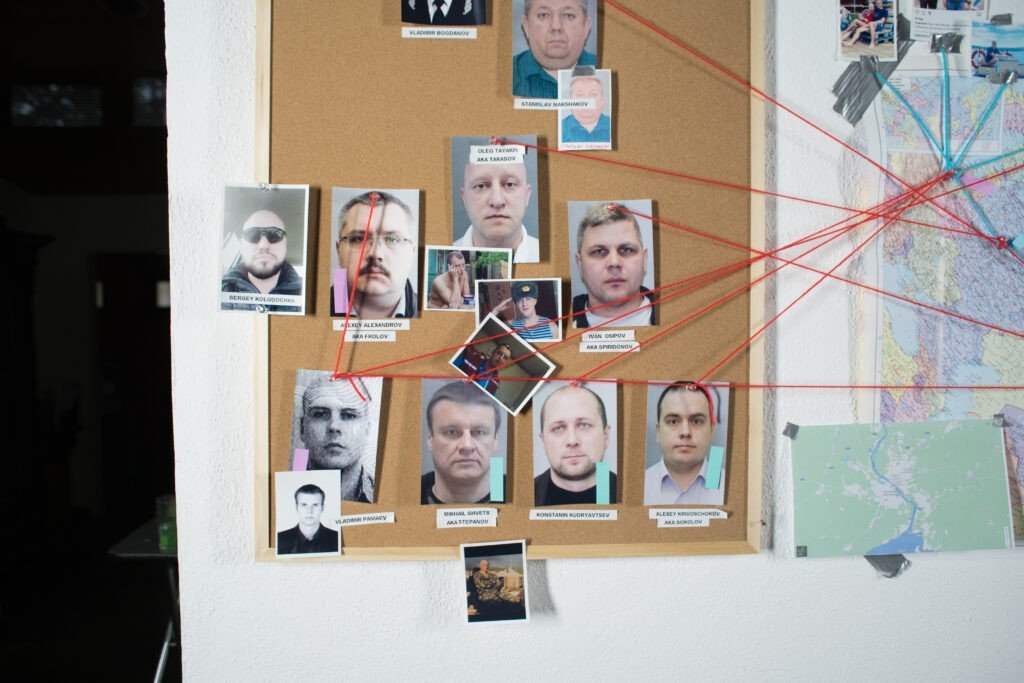
Navalny was not monitored by simple operative officers, but rather by specialists in neurotoxic agents, chemists and career biologists from GRU and FSB – the army security agency, respectively the internal intelligence service.
Grozev has revealed the identities of eight FSB and GRU criminals he holds directly responsible for Navalny’s poisoning. He said he also had the identities of other officers – 15 in total – who were involved, but the rest were not directly linked to the assassination attempt.
According to the investigation, the coordinator of this “firing squad” charged with the political assassination was Colonel Stanislav Makshakov, from the Institute of Criminology of the FSB.
He repeatedly called Major General Vladimir Bogdanov, director of the FSB’s Center for Special Techniques. Makshakov previously worked at the Institute of Chemistry of the Ministry of Defense in the city of Shihan, and among his academic publications is an article that studies the effect of neurotoxic agents, such as Noviciok, on the human body.
Subordinate to him is also the specialist in biological and chemical defense Konstantin Kudriavtsev, Makshakov’s former colleague in Shihan, who fell into Navalny’s trap, confirming the operation and its details.
The commander of the field operations was Ivan Osipov. He worked with Oleg Taiakin, who appeared on December 15, on CNN. Taiakin closed the door quickly when he learned he had been exposed.
His reaction can be considered evidence of complicity in the August 20 attack, because he did not even try to refute what happened and did not have a natural attitude when the accusation was presented to him.
HOW NAVALNY TRICKED A HIGH-RANKING FSB OFFICER
On the 21st of December, Navalny ended the operation of humiliating and exposing the agents of the Russian intelligence service FSB who poisoned him. He used an application that changes the caller’s phone number and called Kudriavtsev, posing as Patrushev’s subordinate and insisting that he had his number from Bogdanov, claiming he was tasked with completing the investigation.
Using a false identity and taking advantage of Kudriavtsev’s naivety, Navalny spoke to him for almost 45 minutes and extracted information that could be considered incriminating evidence for many FSB officers.
Kudriavtsev confirmed to Navalny that Osipov coordinated the operation on the ground, and he is only a specialist who has given instructions on how to use Noviciok.
The officer revealed what everyone had been trying to find out until then – how Navalny’s poisoning operation ensued. Thus, at Maksakov’s command, the inside of Navalny’s pants and underwear were contaminated around the crotch area.
Kudriavtsev also said Navalny would have died if the plane had not landed so quickly, confirming suspicions of the FSB’s involvement in the false bomb alert at the Omsk airport. Kudriavtsev also added that on the same day, together with his colleague Vasily Kalashnikov, an expert at the FSB’s forensic institute, they had the mission to decontaminate Navalny’s clothes in order to destroy the evidence.

The night he entered Navalny’s room, no. 239, at the Xander Hotel, there was an increase of telephone conversations made from the Moscow command center to Alexei Alexandrov, one of the operatives of the involved toxin team, who was near the hotel.
Kudriavtsev stated in the phone conversation with Navalny that he knew him and praised his work. Subsequent investigations showed that Kudriavtsev is a specialist in chemical and biological weapons, that he graduated from the Russian Academy of Chemical Defense in Moscow and that he worked at Center 42 of the Ministry of Defense, the GRU’s biological defense research center.
The joint investigation showed that Kudriavtsev flew to Omsk on August 25 for the “cleaning” operation.

FURIOUS, UNCONTROLLED AND UNCONVINGING REACTIONS
Putin repeatedly confirmed in press releases, in the annual discussion with the public and in front of the Human Rights Commission, that Navalny was being followed by FSB agents. He also said, cynically, that if he wanted him dead, the Russian agents would have killed his opponent.
Both Dmitry Peskov, the spokesman for the Kremlin, and Vladimir Putin called Navalny’s case a false flag operation, an example of information warfare carried out by foreign intelligence agencies.
The Bellingcat-CNN investigation was downplayed or falsely accused of being part of the campaigns orchestrated by the West against Russia. Putin spoke of a “fabrication, fabrication, fabrication that is representative of a type of information warfare that seeks to impress citizens and instill distrust of Russian political leadership.”
On the other hand, Russian officials and state media launched an operation to cover up and hijack the facts presented, using a host of ludicrous scenarios, competing in terms of absurdity, in order to deny that the operation proven by the journalists’ investigation ever happened.
Navalny’s poisoning was also attributed by Sergei Lavrov, the Russian foreign minister, to an operation that took place on board the plane taking him to Germany or even in the hospital in Berlin where he was treated. One of the favorite theories disseminated by the Russian media was the blaming of Navalny’s deputy, Maria Pevcic, who allegedly works with the British intelligence services and was the one who poisoned him, in order to defame the Russian government and Putin.
At the meeting with members of the Russian Human Rights Council, Putin said there was no need to open an investigation into the attempt on Navalny’s life because prosecutors do not always do this when someone is almost dead, but acknowledged that he asked them to look at the case and the evidence. He claims that Russian specialists offered their help to France, Germany and the Netherlands (where the use of Noviciok was traced and confirmed) but they were refused. Nobody invited them, and no one is coming to Moscow to talk to the Russian side. These are the proofs of his and the Russian services’ innocence, nothing more.
1 million rubles – the approximate cost of such an investigation
15 thousand rubles – information about a single flight
2 thousand rubles per person – passenger data for a whole year
10 thousand rubles per person – databases on telephone calls for one month
50 thousand rubles per person – determining geolocation based on phone number
*Estimated costs according to the journalists from The Bell
CONCLUSIONS AFTER THE NAVALNY OPERATION
- Russia has not ended its chemical weapons program and has not destroyed the quantities produced, according to the commitments made, and they are hidden at the level of state research institutes.
- Russia operates an assassination program that requires a go-ahead, as was the case with the assassination attempt on Navalny, from “the highest levels in the Kremlin” before acting.
- The team used in Navalny’s case had a formal affiliation to FSB, but came from two secret sources within FSB and GRU. They were specialists with training and diplomas in the medical field and experts in chemical weapons, all of them being members of special operations teams.
- According to Navalny, it was an act of state terrorism that was personally approved by Vladimir Putin, in his capacity as president, before it was implemented.
* Photo credit of the “Navalny Operation”: Bellingcat