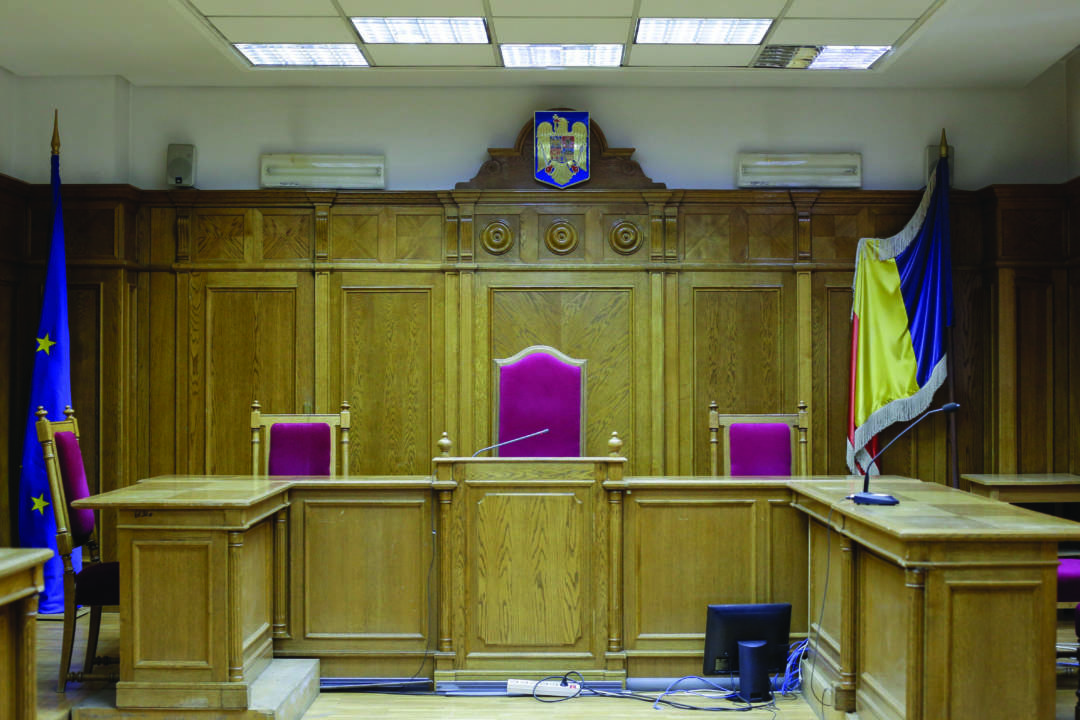

The Constitutional Court of Romania (CCR) has made public its reasoning on the constitutional conflict between the Parliament and the High Court of Cassation and Justice (HCCJ) regarding the formation of the five-presiding-judges panels.
Read here: Untold Truths about Viorica Dăncilă
THE CORRUPTION OF THE JUDICIAL POWER
The court decision says that both the Government – that signaled the existence of the conflict – and the Parliament – whose will imbedded in law had been disregarded – are right.
This represents a non confidence vote on the HCCJ administrative leadership and its judges. But what is going to happen to the victims whose constitutional rights were violated? How will the guilty parties be held accountable?
Every day pulls out new information on terrible deeds by the judicial authorities, that is to say by that state power which should guarantee citizens that their will – written in law through their parliamentary representatives – is abided by everyone.

When we’re dealing with a constitutional conflict between the Parliament and the HCCJ, what we’re really talking about is a conflict between the people (whose point of view is expressed by their representatives forming the legislative power), on the one side, and some Law graduates who are not subject to elections and thereby they’re not mandated by the people, and who, through a not-so-transparent procedure, marked by political subjectivity, received the power to trial people, on the other side.
This particular power corrupts, just like any other power. If the abuse made by the legislative power is constantly supervised and promptly exposed by the mass media, discouraged and moderated through actions of the opposition and the bicameral mechanism, collectively neutralized through the constitutional control of the laws, and individually punished politically through elections and legally, by the acts of justice, when it comes to the judicial power things are slightly different.
Judges work in the safety of council rooms where – far away from media’s eye – they receive, it seems, instructions from the Secret Services or from other extrajudicial parties, and decide the fate of things outside any democratic control.
The almost absolute character of their power, the only one constitutionally declared as “independent” and thereby placed beyond any control by the legislative or executive powers, makes absolute corruption a real possibility.
That is what the CCR discovered, described, and publicly denounced through sharing their decision regarding how the five-presiding-judges panels – or, in layman’s terms, a “firing squad” – were formed by the administrative leadership of the HCCJ on the top of which diabolically shined, during the critical time, the judges Livia Stanciu and Cristina Tarcea.
As far as the latter is concerned, one must add that, although after she took office as the head of HCCJ there were some encouraging acts of probity which would have been impossible to even contemplate under the “tin-dictatorship” of Livia Stanciu – judges “dared” at times to refute inconsistent indictments of DNA prosecutors, acquitting those sent to trial based on political criteria or refuting evidence which had been tampered with by the Prosecutor’s Office – and which gave hope to the Romanian people garnering her their support, in the end she chose the truth of power over the power of truth and maintaining evil instead of eliminating it.

The head of HCCJ, Cristina Tarcea
If Livia Stanciu – drowned in frustration and dizzy due to the heady heights she’d acceded to through a random set of circumstances – had lost her wits to the extent of admitting before the defendants that she was judging them in collaboration with the prosecutors, or of compromising any credibility of the justice system only in order to settle her rivalry with her late husband’s secretary, Cristina Tarcea had proven to be able to distinguish between right and wrong.
Despite all of that, in the end, she thought that being neutral between the good and the evil is enough, without comprehending that such inaction placed her on the side of evil, and that the guiltiest for evil spreading in the world are not the wicked, but the righteous who don’t oppose it. That is why she is the guiltiest – because she willingly allowed herself to become corrupted by power.
Read here: „We are the DNA!”: 63% of judges and 60% of prosecutors in Romania were under penal investigation
THE DECISIONS OF THE FIVE-PRESIDING-JUDGES PANELS ARE ENTIRELY NIL AND VOID
Let’s resume the CCR findings. We do so after carefully studying the about 100 pages of the decision, both to help readers who are interested in the truth to avoid errors in interpretation which they might spontaneously fall victim to, and to protect them from the traps laid by the propaganda that was quickly set in motion by the protagonists of selective justice (politically driven) and the interested political circles from both inside and outside the country.
First of all, the main idea of the CCR decision needs to be restated and emphasized: as of 2014 and to this day at least, all – but all! – five-presiding-judges panels were formed and trialed with the violation of the Constitution of Romania; as a result, their verdicts are entirely null and void.
To that end, CCR unequivocally stated that “observing the rules on the constitution of the panel of judges is a duty of public order, and therefore breaking those rules renders null and void all decisions pronounced by that panel”.
ȊCCJ stated for Q Magazine that since 2014 to present day, the five-presiding-judges panel released 2266 decisions, of which 975 were of criminal law, and 1291 were of other legal natures.
How did things get here?
ȊCCJ PLACED ITSELF ABOVE THE LAW
One of the main sources of all evils is the fact that, on their own behalf or following external orders, the Presidents of Romania of the last 14 years – Traian Băsescu and Klaus Iohannis – instigated the judiciary to openly confront and defy the political actors (Parliament and Government) on their concept regarding the public order, when what it should have been doing was to simply protect it.

Klaus Iohannis and Livia Stanciu
The so-called “rule of law” was pushed to place itself above the legitimate political factor, deemed a priori as “penal”, and to enact laws instead of it.
CCR pointed out two such occasions. One of these took place when, at the initiative of its President, judge Livia Stanciu, the HCCJ Board, while claiming that it regulates the inner activity of that Court only, adopted a set of rules through which it would decide how to constitute the trial panels, in the beginning when there was no law to explicitly regulate that process, but afterwards even against such a law. Another occasion was when the next President of the College, judge Cristina Tarcea, simply refused to randomly draw names of judges to become part of the five-presiding-judges panels, thus suspending in fact the application of a law with crystal-clear provisions which regulated the process.
An old juridical adage says “Culpa lata dolus equiparatur“, which means that a gross mistake, which no one would make – no matter how uninformed he or she might be -, equates to an act committed in bad faith, with misleading intention.
In that regard, CCR notes that Mrs. Tarcea cannot refer to the freedom of judges to interpret law according to their professional conscience only.
In this case, there was nothing to interpret. The law states clearly that forming the panel of judges is made through randomly drawing names, and not in some other way. As a result, judge Tarcea acted in bad faith.
It’s also impossible for the magistrates who are part of Romania’s highest courts to not know that secondary regulations, no matter who adopted them, cannot have precedence over a law; they cannot modify it or add to it.
Addressing all of that, CCR’s decision falls like a hammer: “HCCJ, by means of interpretation, gave laws a different understanding on how to appoint members of the five-presiding-judges panels and expressly refused to follow the instructions of those laws,” while the relevant legal texts “did not comport any difficulty in understanding the process of appointing and composing the five-presiding-judges panels for criminal matters”. CCR also notes that “HCCJ, through the nr. 3/2014 and nr. 89/2018 decisions of its administration Board, modified through an administrative document a law adopted by the Parliament, which expresses an opposition to the legislative policy“.
THE ADMINISTRATIVE FORUM PLACED ITSELF ABOVE THE JUDICIARY FORUM
But what is the Board of the HCCJ? It’s not a court of law, but an administrative forum! While forming the panel of judges is a court matter and not an administrative one.
And judges, unlike prosecutors, are independent, so they do not have an administrative hierarchy. CRR says so too: “The leading Board – an essentially administrative entity – took on an attribute that pertains to the jurisdiction of the supreme court, breaking art. 126 alin 1 of the Constitution; it not only took on such an attribute, but also interpreted wrongly the text of art. 32 of the 207/2018 Law, refusing to apply it during 2018 – a deed that contradicts art. 61 par 1 and art. 126 par 2 from the Constitution”.
So Mrs. Stanciu and Mrs. Tarcea, together with their colleagues, not only believed that their administrative roles place them above the members of Parliament – the legislative power -, but also above judges and the power of the court of law. As a result, the panel of judges were constituted at the discretion of the administration. But, “in reality, the problem of composing the five-presiding-judges panel is a matter of procedure, and solving it falls within the competence of the court”, CCR mentioned.
The judges who became members of those panels accepted it without question, even though the issue was – as was previously proven – not merely one of judicial procedure, but also a matter of public order. That not only imposed them to check the competence of judging in every particular matter, but also to ex officio act in order to correct the legal infringements in forming the panel.
As a result, the HCCJ President, the Board members, and the judges that were members of the panels were accomplices. As the CCR decision says: “The five-presiding-judges panels followed the administrative practice of the ruling Board of the HCCJ, ignoring the law themselves”.
Under the protection of anonymity, one of these judges tried to claim in their defense that they had to abide the administrative decisions of the Board, because otherwise they would have attracted disciplinary sanctions. Of course, just like the Auschwitz guards claimed to be forced to kill innocent people because they were obligated by hierarchical order; if they wouldn’t, their paychecks would probably have been affected.
All of that proves a way of thinking and acting which goes beyond the letter of the law.
The Presidents of HCCJ, Stanciu and Tarcea, saw themselves as some sort of all-mighty leaders of the judges, having discretionary powers over the act of justice to be executed by the magistrates, the latters being treated as their subordinates from the judicial prospective too and not just from the disciplinary one.
So one can easily guess and understand how their orders also included the substance of decisions, and not just the appointment of the judges to make those rulings; judges that, being appointed by their “bosses”, obviously felt obligated to follow their guidance in all matters.
CCR’s decision eloquently undoes and proves this hellish mechanism, noting – with references to ECHR jurisprudence as well – that “through imposing ex officio members as part of the five-presiding-judges panels via administrative documents, there can be latent pressure exerted over the members of the panel, resulting in the judges becoming subservient to their judiciary higher-ups or, at least, in the hesitancy/lack of desire of the judges to contradict them”.
That’s why these bosses were visited by officers of the Secret Services, foreign ambassadors or presidential advisers. They were the “transmission belt” of matters of political opportunity to the rulings in courts of law.
In this context, it might be useful to also mention the bizarre circumstances according to which the HCCJ President is also “chief of the security structure” of the HCCJ. Whatever that structure is, that makes us think of some sort of counterintelligence service. Leading it is hardly compatible with the magistrate status and it gives the one holding that title an almost magical power over other judges.
UNDERMINING THE OBJECTIVE IMPARTIALITY OF JUDGES
CCR makes another essential note. The act of justice is not just an artisan’s hand-made. Justice doesn’t just need to be done, but also to be perceived by the citizens as being done.
To that end, the fairness of the trial does not depend solely on the subjective impartiality of the judge (lack of personal interest in the cause or of personal ties with the parties involved), but also on the objective impartiality (the cause being assigned without any potentially subjective intervention, i.e. randomly).
The decision mentioned that objective impartiality has two components: the formation of the panel by drawing names at random, and distributing files to panels by drawing panels at random. The obligation to do so, meaning to exclude any subjective factor and any political rational from the process of forming and empowering the competent panel, results from the Constitution’s stipulation regarding the citizens’ right to a fair trial, as well as those of international treaties on the matter, to which the Constitution gives precedence over national legislation.
As a result, CCR notes that if the applicable law would not have mentioned the obligation to draw names at random, once that would have left room for a procedure that would not be its equivalent, that law would have been unconstitutional.
It means that, in fact, any (other) panel of judges that was formed otherwise than at random, regardless of the method used for doing it randomly and no matter how different those methods might be, is unconstitutional, even if the law doesn’t include any specific stipulation on the matter that can be censored by the CCR.
Such a statement constitutes a principle and it cannot be limited to the five-presiding-judges panels alone. By the same reasoning, the conclusion also applies to panels of three, two, or one judges. That raises questions regarding an unconstitutional practice which has been infecting the Romanian act of justice since almost forever and in a general manner.
Under such circumstances, CCR established that forming the panels through drawing names at random must include all judges who are functioning in a court or at a specialized section of it (for instance, the criminal section of the HCCJ) and it regards all judges that become part of the panel.
In this respect the decision lets us understand that even when names were drawn at random, President Cristina Tarcea and most likely her predecessor Livia Stanciu used a short list, presumably sorted considering the criteria of how busy the roster of judges were, but which in fact – coincidentally or with malice? – kept in the game precisely the “trusty partners” of prosecutors (particularly the DNA ones) and of the secret services.
Such a procedure reeks of bad faith from a mile away, and those responsible for it need to be held accountable. Because, as CCR adds, HCCJ “affected the right to a fair trial, as far as the impartiality of the court of trial was concerned”.
AN EXTRAORDINARY SOLUTION FOR AN EXTRAORDINARY CONFLICT
Going on with these findings, CCR established an unprecedented way to settle the constitutional conflict. It is noted that the gross and continued lack of honesty of the HCCJ leadership robs any of its acts regarding the forming of the panel of judges, of the mandatory credibility needed to qualify a trial as fair.
As a result, the Supreme Council of Magistracy (SCM) is petitioned – as an administrative institution (just like the Board of the HCCJ) which according to the Constitution and law has the role of guaranteeing the independence of judges and of defending the credibility of the judiciary – to undertake the task of putting in place the right procedure for forming the trial panels through drawing the names at random (in this particular case, the five-presiding-judges panel).
The CCR decision is worthwhile to be recalled: “as a result of the constitutionally sanction-worthy conduct of the HCCJ, through its leading Board, which is not of the nature to offer guarantees regarding the fair re-establishing of the legal functioning of the five-presiding-judges panels, the obligation to find principled solutions regarding the legal way to appoint the panel of judges and insuring they are applied falls to the SCM’s judges department, based on its constitutional and legal prerogatives.”
Beyond the technical nature of this decision, it represents a personal blame on the current President of the HCCJ, Cristina Tarcea, and also on the previous President, Livia Stanciu, who – after recently becoming a member of the CCR – chose to be a part of the very trial regarding the constitutional conflict we are talking about, ignoring the conflict of interest in which she was, and daring even to formulate a separate opinion, obviously pro domo.
The resignations of the two are imperative as a modicum of assuming moral responsibility for the judicial cataclysm they were patrons of and promoted.
Keeping their current titles would generate a scandal which would affect the credibility of Romanian justice even more.
How can someone like Cristina Tarcea remain the head of HCCJ, when she disregarded the Constitution in bad faith, opposed the law instead of defending it, and is deemed by the CCR as incapable of offering guarantees regarding the correct re-establishing of the legal frame of functioning in the institution she’s head of?
Which defendant that discovers the finding of the CCR can still trust the current President of the HCCJ, and a HCCJ led by her?
How can Livia Stanciu remain a CCR judge, as previous President of the HCCJ, when she thinks – against the opinion of her colleagues – that breaking the conditions that guarantee the fair nature of trials is not an issue, or when in the recent past she promoted the procedures for which Romania was sentenced at CEDO (as it happened in the case of the Mayor of Rȃmnicu Vȃlcea)?
We are talking about a constitutional judge who, in this quality, judging her own deeds, without remorse – to be specific, by breaking the sacred principle according to which “no one can be judge of their own cause” – claims that some phantasmagoric bias of the CCR is to blame for the constitutional abuses of the HCCJ inaugurated by her and her successor.
President Klaus Iohannis, who was involved in appointing both ladies to the positions they are currently holding and who recently even declared that he is “a President that abides the letter of the Constitution entirely”, has not only the opportunity but the obligation to urgently intervene and demand the resignations of the two.
If they refuse to resign, he can ask the SCM to act in order to remove them from office; just as, on another occasion, he asked it to challange the decrees adopted by the Government.
As far as the role of the SCM, one can’t ignore the fact that its concern for fighting the press and politicians in order to cover up the misdeeds of magistrates has taken its attention away from their grave sins, now noted by the CCR. In fact, some members of the SCM are now – through their inaction – participants to the judiciary crimes committed by the HCCJ judges. It’s time for them to be on the side of the defendants, who have a right at a fair trial, and particularly on the side of political indictees or those found guilty on political grounds, not on the side of those who practice selective justice and political policing, just because they work in the field of law.
Just as the CCR decision demands, considering the constitutional and legal prerogatives, SCM now has to organize the coherent frame for applying the law regarding the formation of the panels of judges at all levels and of all sizes (nothing stops it from doing so), considering the letter and spirit of the law, the CEDO jurisprudence, and the Constitution of Romania.
SCM can and must project guarantees of the objective impartiality of judges by establishing and / or improving methods of randomly distributing cases and randomly forming panels of judges, under completely transparent circumstances.
Read here: From the Bible to space – How jews changed the world.
WHAT HAPPENS WITH THE VICTIMS OF THE UNCONSTITUTIONAL JUSTICE?
Last but not least, regarding the applicability of the CCR decision we are talking about, it states that it refers to all future trials, but also to the ongoing ones which, as a consequence, will be suspended until SCM (the judges’ department) will organize and finalize the procedure of randomly drawing names for the five-presiding-judges panels. Also, the decision will be applied to cases already tried if those concerned are still able to exert the ways of extraordinary recourse.
Of course, CCR couldn’t do any more than that. It cannot adopt or even initiate legislation which must repair all consequences of unconstitutional situations that it points out.
But the ones who are left out are the victims of these acts of injustice whose legal term of action for annulling the decisions given by the illegal panels, as well as the 6-month term from the judicial decision that limits the right for an individual recourse to the ECHR, expired. What is going to happen with them?
Is it acceptable for them to carry the wounds of judicial sentences pronounced not just by panels which were incorrectly constituted, but by judges who willingly broke the law and the Constitution, most likely following political agenda with no connection to law and justice? Of course not!
If we were to talk about their suffering only, we’d still conclude that the judges who caused it should be immediately trialed under the criminal law for abusing their office and exerting unjust repression. Just like judges Stanciu and Tarcea should be held accountable in a criminal court for their misdeeds, which had grave social consequences. Stripping all of them of the magistrate status is a minimal and urgent step which needs to be taken.
Beyond organizing the random drawing of names, disposed by the CCR, SCM needs to get energetically involved, with the support of the Judiciary Inspection, in investigating all members of the HCCJ Board who are guilty of taking the outlined unconstitutional measures, as well as all magistrates who applied them; the next step is to establish the nature of the deeds and, accordingly, to decide on withdrawing the magistrate status and/or address the Prosecutor’s Office in order to begin due criminal investigations, in rem at least.
A POLITICAL SOLUTION IS ESSENTIAL
The magnitude and exceptional nature of the wrongdoings committed by the HCCJ magistrates make it impossible to find reparatory solutions based on current legislation or at least on the judicial logic on which the institutions of law are built. So the ultimate solution is the political one. It can be resumed in one single word: amnesty. It means amnesty for deeds in the trial of which were involved five-presiding-judges panels from 2014 till 2018.
The alternative, a Solomon-esque solution would be to reduce the duration of the punishments with a significant number of days (observing that the average length of punishments in Romania is seven times bigger than the European average), followed by an automated rehabilitation after the main sentence is executed. In addition to that, a special procedure could be established by law to revise the civil part of the penal trials in which the calculation of the material loses to be covered was not submitted for neutral expertise.
What Livia Stanciu, Cristina Tarcea, and others made of the same stuff have done constitutes a catastrophe not only for the Romanian justice, but also for the Romanian society. They have submerged into penal darkness the HCCJ and with it all of the Romanian justice system, transforming the activity of the highest courts of the country into a quasi criminal affair. This cannot go unsanctioned.
Reclaiming justice and rehabilitating the rule of law cannot be achieved until those responsible won’t pay and their victims won’t get justice done. Without these, just like this historical decision of the CCR says, in Romania nobody will ever trust the act of justice again. And without trust there is no sustainable social cohesion, no stable public order, and no peace of mind for the nation.