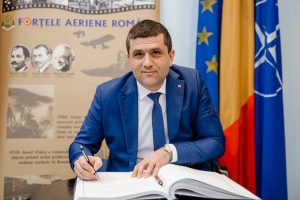
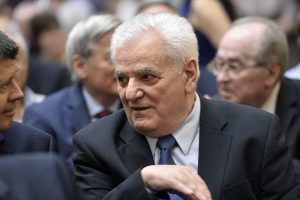
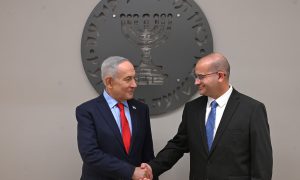
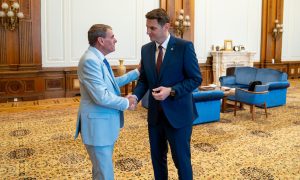
A decade of work as MP, Chief of the Special Oversight Committee for of the Foreign Intelligence Service, and, recently, Head of our Delegation to NATO PA, Gabriel Vlase becomes the first Romanian MP to get the post of Vice-president of NATO PA. About the White Charter of Defense, and about The National Strategy in this field, in an interview for Q Magazine.
- AFT, companie românească, arată cum putea fi interceptată drona care a explodat în Portul Constanța. MApN are sistemul care ne-ar putea apăra aici, dar îl ignoră, preferând să dea banii altor state
- Guvernul României: Ucrainenii au pierdut controlul asupra a patru drone. Una dintre ele este cea care a explodat în Portul Constanța
- În România, contrabanda cu țigări și produsele contrafăcute ajung la 6,9% și generează pierderi de 324 milioane euro
- Primul vaccin creat de inteligența artificială
- SANADOR: Ordinul pentru completarea Normelor tehnice de realizare a programelor naționale de sănătate curative poate restrânge accesul pacienților la servicii medicale esențiale
A month ago, you became the first Romanian MP elected in the highest echelon of AP NATO, as Vice-president.
Is useful to mention that this position was not reserved to a country, or to me as a person. I had to enter into a competition with another candidate from Holland. The achievement is equally for Romania, certainly. What counted the most in this exercise are the skills acquired in two consecutive mandates, or eight years of working relationship with this institution, first as a member, and afterwards as Head of the Romanian Parliamentary Delegation to NATO PA.
Did it change your priorities concerning security and defense?
My duties multiplied, and they are strongly time consuming. I went already in few missions with Hugh Bayley, the President of NATO PA, but I had to deal with other things, in order to fulfill my promises to PA Plenum, at validation. It means to strengthen the Alliance’s ties with the Parliaments of the member states, a more profound awareness and understanding of the key security topics, a higher transparency of NATO’s policies in our today turbulent world. The last, but not the least, is about a better adaptation of the Alliance to the changes of the global security environment.

You have a Doctorate Degree awarded by the National Academy for Intelligence. How deep is “Intelligence Community” involving in the political fight for supremacy in Romania?
Intelligence Services are working only for the national interests of the State. They are serving the state’s institutions and not the persons leading them at a moment or other. Deviations from this trend may appear, of course, meaning that pieces of intelligence to be used for a different benefit than national interest, but for such cases we have the parliamentary oversight committees, the Supreme Council for Defense of the Country and so on. From my own experience I may tell you that such sideslips does not exceed in number or size the ones produced in any other democratic country.
Defense can’t enjoy quietness
In the last hundred years, Romanian Army got through at least three transformations, always after concluding a war. After the First World War we needed the French “savoir fair”, after the Second World War the transformation was imposed by the Russians, and after the Cold War, this have been assumed in accordance with our NATO membership. There where, after all, another 24 years since the Revolution. How long this transformation will last. Do we have a chance to witness this final act of this process?
We knew from the very beginning that transformation in this vital sector is a long lasting process. During our preparation, NATO experts warned us that states admitted before us, in previous waves of enlargement, where still striving to reform themselves, and they still had to go through some stages. I am sure that there are chances to see this process finalized, but I am also sure that, at the end of it, there will be other priorities in front of us, which will force us to continue the transformation’s effort. The military reform process in today world can’t be seen sequentially. This is a uninterrupted one, and depends of the security’s dynamic in all its vectors. Military defense remains an important pillar of State’s power, so we can’t anticipate a quiet landscape from this point of view.
One of the objectives I found in the White Charter of Defense is the transformation of the Black Sea Region into a geo-political space of cooperation, security, and stability. Is just a hope, or there are specific projects to fulfill for this task? Further more, which chances does have such a project as long as Russia violently reacts to protect its old sphere of interests and Turkey seems to be reluctant to any strong NATO presence in the Black Sea?
The Black Sea Region takes a major importance for the security of Romania. The size of the problems which could generate security deadlocks here is not diminishing, but growing continually. We have to be realistic to see that the states around the Black Sea opted always in history to save their security finding allies outside this basin, looking to the West, the Arab World, or the East. Unfortunately, the situation did not change. In different moments, the Great Powers recognized as an error that they did not define a specific and strong motivated policy toward the Black Sea Region. This missing point was perceived only after adversities between neighboring countries here matured, and the local conflicts got structured profiles, becoming more or less “frozen”. Yes! It is in the interest of Romania that the Black Sea Basin and the extended region around it becomes one of cooperation, stability and security. Concerning a NATO “stamp” here, we may go through this concept into a future discussion. The Alliance does have now three member states around the Black Sea, and it gives a strong NATO “stamp” to the region, being a key factor in its power balance. For Romania, it is particularly significant, being a “frontier state” for NATO.
About National Defense: Between chevron and efficiency
An Army cannot be richer than its country, but, an efficient Army requires strong expenses, not only for equipment. How disposable is the political establishment to agree upon the necessary budgets for the military to make it fully functional, taking into account that would be necessary tremendous amounts to acquire just few multi role planes?
As I see, this conversation with you becomes a challenge, as you are shutting more and shrewder questions…
It is you who inspire me!
I fell a genuine satisfaction as I see how skilled you are in matching together different strategic interrogations. The key question here, and I am sure this is your target, is to get a replay on “how big or small, or how easy or difficult is to budget an Army, in order to make it an efficient one?”. There are not receipts, either perfect or fully agreed upon, even for the world leader in military field, the United States. You may find a motivation for this, and the answer is found in “defense economy”. It is the factor which should be considered by any government implementing the national policies. At the same time, one should recognize that the military foreign aggression do not confiscate the modern security models. Modern security has a rich “wardrobe”, and multiple patterns. Cyber terrorism, for instance, does not wear a military uniform and is not claimed by any state.
And I think this will be the future of the war, if we speak of costs versus efficiency. A conventional weapon costs up to two million euros and a virus just 3000 to 50,000 euros. Aside of this, a rocket rich the target in 33 minutes, but the virus needs few seconds.
I agree…the cyber war could have devastating effects. Think only to its gridlocks to any of the big metropolis of the world. It is known that NATO is founding its policies of defense on the aggregated capabilities of the member states. If an allied state is coming down the “red line” becoming detrimental to the responding capacity of the Alliance, one have to be sure that its experts will alert immediately the right echelons in order to ask to that state to restore order. I am sure that we have to buy modern fighters, and our Air Forces should do a long awaited skip over the threshold and align to the Alliance’s standards. I also agree with your insinuations about costs versus efficiency.
We will buy fighters, but the new SRI budget, institution coordinating the National Startegy for Cyber Security, is not sufficient for aquiring the necessary equipments. I think that setting priorities remains a problem at the level of the Defense and State Strategies.
We have to be optimistic…
Taking into account that the National Army takes a prime responsibility to defend the national territory, and the allies only after that, and the last can be operational just after a complicated political decision process, do you appreciate that our 90 thousand soldiers, as they are now will be sufficient to defend ourselves immediately in case of a conflict?
Numerical parameters of the Romanian Army have been established after thorough analysis with the Alliance’s experts since the period of preparation for membership. Then, a Road Map has been marked annually by complex evaluating documents.
Yes, I know…”Membership Action Plan”
Right! So, these figures have been validated on the basis of norms and specific standards, of similar experiences involving other states which became members before us. Any other opinion concerning this subject risks being a partisan one, or founded on ignorance. You imagine, there are other states EU members which are not NATO members. Romania could decide on such an European engagement, but the ones who are placing a question mark on the Alliance should remember how enthusiastic were Romanians after 1990, when over 90% of the population requested to enter into the Alliance. Coming back, it is now right that many Romanians question if the Alliance is good for us? I would say that such a stream of opinion is noxious. NATO represents the only political-military alliance in the world which passed successfully the test of time, insuring the collective defense of its members, as well as the only global vocation alliance. We should not forget that being a NATO Member is like having a chevron of a respectable club. This club guarantees optimal defense and security in the larger sense of the word, and a strong protection for the economic patrimony and of the society as a hole.
In many NATO doctrines, American, British and French, especially, is clearly specified that military system protects and promotes the interests of the respective states, when we speak about military campaigns in operation theaters. Aside of some previous obligations, which were assumed, concretely, what are the Romanian interests protected in operations in Afghanistan, Iraq, or Western Balkans?
Look how original is this changing of azimuth! Let us start with the national interests…From the most powerful to the most vulnerable state, there are specific national interests. We should not be mistaken to look after national interest solely into our “courtyard”. The modern world is an interconnected one, with a strong global pattern, in which our own interests are becoming global. Coming to the operation theaters, I would start with Western Balkans. The civil war in former Yugoslavia occurred in times when Romania was not a NATO member. The total embargo on Belgrade amputated drastically our economic interests. Let us add that no country can relax assisting to the atomization of a neighboring state with which exists substantial cooperation ties. Romanian involvement into operation theaters here represented just one of the strategic actions aimed to consolidate our national security. Romanian presence in Afghanistan and in Iraq should be connected to the domain of combating international terrorism. It is known that in the sphere of the transnational terrorist ties Romania is a transit country, as is the case for other trans-border asymmetric noxious threats. At the same time, due o its geo-strategic potential, Romania find its place in the first third of the European States, then, we may speak about the right of Romania to have strategic options, single or in tandem with its allies sharing the same security options. Last aspect, Romania is an essential sector of the EU and NATO eastern frontier. At any rate, is better to fight for defending ourselves in Afghanistan, than in…Craiova. The idea is that we always obtain a strategic gain playing all our trumps. We to not have financial availabilities for operations “out of area”, but we proof our good faith sending our boys there.
You are a perfect diplomat for NATO, but not for me as a journalist. You did not answer to my question, because you are not allowed to! The truth is that Romania did not get any economic profit, but suffered because the embargo, loosed receivables, contracts and economic favorable ties in some regions of the world. But I understand that you can’t evoke some truths …So, I wish to ask something else. The American base in Deveselu created acid reactions in Moscow. It is also true that any such a move comes with a set of risks. Is there any clear analysis of the cost-benefits ratio of the Romania’s decision on this subject?
I would say that many other strategic decisions of Romania along the time did produced acid reactions from the part of some states. Did you really think a second that Moscow will keep silent this time? It is out of discussion… There is long range strategic decision to harbor on the Romanian territory the system known as “Anti Nuclear Shield”. Or, in the field of security the most profitable are the long term investments. Let us think in a different perspective: what would obtain Romania if it was inactive concerning “The Shield”? It would prevent other acid reactions? Would it obtain tangible benefits of any kind? I am pretty sure that the answer to both questions is negative.
If Romania had more pragmatic leaders and more powerful, we where not missing advantages from one side or other. Unfortunately, Romania remains a country with a profound complex of inferiority in negotiations. I spoke with some officials in Pentagon, recently, and they told me that Americans are respecting two things to a partner: the election vote and attachment to national interest. They said that from President Ion Iliescu until now nobody had both. Coming to the White Charter of the Army…there are vaguely defined the risks and threats addressed to Romania, only terrorism is clearly mentioned. Do you have other specific marks?
I am not a supporter of the exclusive security and defense approach through the lenses of the external aggression, military or of other type. I think that security problems along this century should be considered in a flexible way, with an inclusive vision on the level of the risk factors. There are already outdated the times when Governments kept working quietly and looked at the security matters only when external relations inflamed, generating crises and armed confrontations. The fight for security today needs approaches on all governing fields and in any format, internal or external, starting with the germinal stages of vulnerability. Global economy’s connections, trans- border ties of the world financial sector, or of the international companies and state’s institutions, are proving that security management is equally present on internal state field and deals with: intelligence, military sector, trade, production, banks and financial sector, environment, social, health, critical infrastructure and so on. I am not sharing the idea that Romania would not be aware about the risks and internal and external vulnerabilities. What the White Charter is doing is an alignment of the present patterns taking into account the actual evolution in the security environment. If I remember well the structure of the Strategy of the National Security of USA, from 2010, I would be sure to say that President Obama would not signed such a document if it included express indications about the security threats from the part of Russia or China. A document like White Charter has to clarify perspectives, and not to bring irritations on the international scene.
In 1970, European Conference for Security and Cooperation was founded, and it became European Organization for Security and Cooperation, in 1995. By the acceptation of 12 new states from the Soviet Zone, the message of the organization diluted, and it kept distance from its initial objectives. Accepting so many eastern countries is there any risk for NATO to loose strength, and for Romania to be avoided in the decision making process?
NATO is in danger to lose its strength, but not because of the new comers. On the contrary, the new members are very active in operations. The risk comes from the tendency to lose the interest of the public opinion, and it creates a strong difficulty to the decision making people, especially those working on budgets. We should decide if we want to have a chair at the negotiating table, and stop complaining that my travel to attend a standing committee costs money. We can’t be avoided into the decisional process, due to our geographic position. Even these posts: mine, the one of Sorin Ducaru, means that we stay at the table with a badge in front of us, on which is written “Romania”.
Moscow does have strong resentments against growing role of NATO in Eastern Europe. How much takes into account NATO the Kremlin’s opinions when is about the interest of the states in the East, which used to be, till 25 years ago, under Moscow’s influence?
The Alliance cannot make the error not to consider the Kremlin’s opinions. But about the interests of the Eastern States, the best illustration is the installation of the “Shield” in Romania, despite the repeated irritated clamors from the part of Kremlin.
How good is our Defense Budget?
According to some sources inside the Army, there are many units where the ammunition is not sufficient numerically or operational. Are you aware of this situation? Is the Special Parliamentary Committee, where you are a Secretary, committed to look into the situation?
When one proceed to check into a crucial field of national security the discussion should be based on concrete data, not on unidentified “sources”, which are not accredited.
As a journalist, I am working with sources I can’t identify. I want to ensure you that they are at the level of command and control.
It is important that our nation knows, in the field of defense things are in order, thoroughly checked, and the standards are scanned by experts that are putting at stake their carrier and do not operate with whispers. I give you an example: if a rumor is expanding that soldiers are not served with the necessary food, there are two possibilities…or the situation is real and are issued immediately orders to restore order, or we have a diversion. Let us assume that stocks of ammunition are insufficient in some military units. Then, the General Military Staff, the Ministry of Defense, and Supreme Council of Defense of the Country come under red alert. Any thing can be said about the White Charter of Defense in its last version, but not that would hide realities, irrespective how grave would be these. The Parliament can be alerted, of course, but competencies for solving these problems are harbored into the above mentioned institutions. I wish to ensure you that within institutional architecture of national security there are not errors such as the ones you mentioned, and I know this system very well in all its components.
Maybe there are not errors, but only a patronizing of an impossible situation which cannot be solved due to lack of resources, or even of a vision and of a strategy of prioritization. If 85% from the military budget is directed to personnel expenses, what remains for maintenance or acquisitions?
I must say that I don’t have answers to all questions. What I know is that the Minister of Defense stressed that lacks of any kind are treated with highest preoccupation. You know that programs of modernizing the Army have been finalized, taking into account the special conditions of any branch. Two such programs are focused on short and medium term equipment supply, bringing the potential to NATO standards.
…Unreachable objective if the budgeting will not be increased to 2% from GNP
You’re right!
Romania, credible strategic partner… and predictable?
We got possibility to negotiate with the Americans transit conditions for 50,000 soldiers from Afghanistan, through Romania, and to draw a profit out of it. What our country obtained, in concrete terms?
Offering to the American Side facilities as the ones you mentioned, or concluding arrangements of any kind of military transit are part of special agreements linked to the military cooperation between Romania and USA. We do not speak here about a “give and take” process, but of a security investment, as I already mentioned. In my opinion it is not important the rental you get for a foreign base on your territory. But, concluding such an agreement, the State becomes a strategic partner, a reliable and predictable ally. Personally, I fell better when a friend is asking me a favor, than seeing that he is avoiding asking for it.
From the beginning of our discussion you did not indicate a single advantage of all our strategic military partnerships…
I do not agree with you.
That’s normal. Let us go back to the White Charter. In the content, there is a mention: “the level of preparation of the combat forces at NATO standards is insured with difficulty, and includes vulnerabilities, especially against intrusions in our airspace, and growing number of air “accidents”. In this case, if we will be attacked by air, we do not have the force to respond immediately? Isn’t this a concern?
It is certain that the White Charter is making a responsible and objective X-Ray. This includes the signal of vulnerabilities in the Air Forces. During the last years, the Army budget has been diminished from 2% from GNP to 1.26% in 2012. Under such circumstances, the chances to bring the Air Forces to NATO standards are minimal, and a major decision to redress the situation is needed. As I mentioned earlier, any attack comes after maturing some differences. But the actual situation in our Air Forces is not singular. Other member states are facing similar problems.
Between1982-1989, Romania produced its own military equipment and armament; at the same time, we used to export tanks and artillery pieces to countries which are now supplied by other NATO member states. We used to be the 9th exporter of military technique in the world. Do you think our national defense industry will ever recover?
In that period we where in a different political and military construction, and the export was directed in some parts of the world. The conditions changed dramatically, especially concerning technology, so the situation then and now can’t be compared. We are not a big country, we have a lot of economic problems, and an eventual development of the defense industry, as long as we should adapt technically to NATO levels, would be difficult.