
To think about Solomon Marcus means to think about the future.
We hugged. It was to be for the last time. “Tell me…” his magic formula, “may I read the books you just published by Springer?” He asked for permission to honor me with his attention. The most important Romanian intellectual, and one of the most amazing among the people I’ve met during my entire life, remained a shy adolescent.
Solomon Marcus never ceased to ask questions. Never ceased to question. He asked questions within his family, in school, at the university, in the Romanian Academy—everywhere. He questioned everything presented to him as indisputable truth. But his was not questioning for questioning’s sake. He found answers to some of these questions, many of which became original contributions to mathematics, semiotics, linguistics, and information science. Solomon Marcus initiated new research domains: mathematical linguistics, mathematical poetics, semiotics of folklore. In recent years he submitted the educational system to his questioning. This is the subject that has preoccupied both of us for a long time. In my view, education has to be anticipatory, driven by an understanding of the future, not by current fashion, such as “We need more” reading, or mathematics, or medical equipment technicians. “Tell me,” he asked naïvely, “do you really believe that the schools and universities of today should be closed?” I answered, probably more radically than he expected, “I would blow them up, so that no remnant of the mediocrity they produce and encourage would be left.”
“Tell me” became his typical formula in his meetings with Nobel prize laureates, or with the readers of his articles (even those published for the benefit of a broad public). “Tell me, how much time do you spend on the Internet?” he would ask students in the schools he visited, as he was trying to understand what is going on with teaching and learning in these days. He genuinely expected to learn from them how they learned to navigate a fast changing existence for which there is no manual and there are no instructions. Yes, we talked about Guccifer, the Romanian hacker, not because he was interested in this guy’s obsession with celebrity. Rather,”Tell me how do he did it.” He wanted to know not out of some trivial curiosity, but rather trying to understand how the taxi driver, with no technical education, was able to discover the personal server used by none other than the Secretary of State of the USA. “In the absence of education, talent can become destructive,” he believed, and I was sorry that nobody hears his words in the USA—a country he actually liked. He firmly rejected informational fraud, but not the thought that the new generations think differently, and refuse to become victims of those who abuse their own personal data. Solomon Marcus appreciated their determination to protect their own privacy.
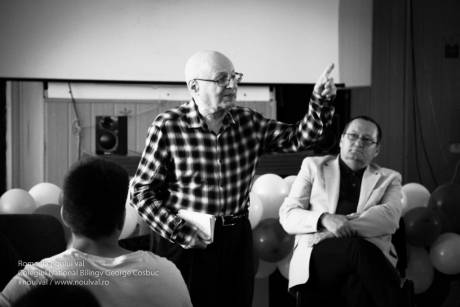

“Tell me” is a charming formula. The English word tell has a German root (pointing to storytelling). In Romanian, spune has a Latin origin, denoting to present, to explain. Solomon Marcus’s “Tell me” was like an invitation to establishing a link, inviting you to step out of your comfort zone and take the first steps towards self-discovery. It was a subtle encouragement to try to discover that we are all on our own. The need to break away from yesterday in order to make your own tomorrow of questions and answers was part of his thought. Dialog among generations was implicit in his formulation. “Tell me” translates into dialog. In Solomon Marcus’s heuristics, there was never an attempt to catch someone on the wrong foot, and never a test of the other. It was an informal gesture of extending his hand to anyone interested in exchanging thoughts.
I discovered Solomon Marcus almost 60 years ago. I was not sure—and I’m still not sure—of which direction I wanted to choose in life. I knew only that I was interested in creativity. He couldn’t tell me what I should study. But he helped me understand that nobody, not even he, the young mathematician of those years (at the time, he was the assistant of Nae Cioranescu, my future professor of Analysis at the Polytechnic) could free me from the responsibility of making my own choice. I did not have too many options, but to choose among those possible meant to want to know who you are and what you seek. Somehow Solomon Marcus was for me, in those years, what Marcel Marcian, his brother (11 years older) was for him in his parental home. Marcel helped him find his own way, without giving him the direction, without forcing him to follow the example of others.
Over time Solomon Marcus became “the big brother” of many. His students perceived him and felt him as a brother. School kids wrote to him as to an older brother; colleagues found in him the brother you could count on, you could trust. He didn’t want to disappoint anyone. Sometimes he did not have the answer for those who believed in him, and who could not have accepted even the suggestion that he did not know everything. In such cases, he appealed openly to his “brothers”, i.e., those he thought would be able to help. “Tell me,” I heard him say to Grigore Moisil, asking about computers and programing. The eight biological brothers in the home of his parents, Alter and Sima Marcus, extended to, figuratively speaking, hundreds, if not over 1000, members of his spiritual family, satisfying his “need for people.”

He noticed, slightly frightened, that people expected quite a lot from him, way more than what he could offer. Honest as he was, he knew his limits. Very few know, because we expect the best to be perfect, how passionate he was in learning continuously. He devoured books and professional publications, was present at exhibitions, attended concerts, gave lectures at international conferences, and listened to lecturers on all kinds of subjects. Even fewer people took note of the demands he made on himself. An intellectual of exemplary integrity, Solomon Marcus did not print one line that he had not gone over many times. After publication, he scrutinized every text, asking, without hesitation, for help from those whom he respected. Mathematical formulae were repeatedly verified, bibliographies were checked out with a sense of responsibility proverbial among those familiar with his publications. The immense library of articles and books that he read remained alive in his working memory. “Tell me,” he asked, “Rilke writes ‘Wir sind die Seinen.’ Does it mean that we belong to death?” Afterwards, unexpectedly: “Tell me, does your book contradict that of Ivan Illich?” (He was referring to Illich’s Deschooling Society of 1971 and to The Civilization of Illiteracy, whose translation into Romanian was just published on his initiative.) In the Spiru Haret Auditorium of the School of Mathematics and Information Science of the University of Bucharest, where Solomon Marcus introduced my book, his words had, for me as an author, an almost prophetic sound: “Mihai Nadin’s book is about the meaning of life in a provocative new civilization. The crisis of education about which he writes is the crisis of the values that we continue to force upon the new generations. This is not a matter of a lack of possibilities. Today we could do much better in education than we have done in the past, when education ignored the individuality of students. We have science and technology on our side.”
Only those who understand the most complicated theories, only those who master the most abstract science, can explain them to others in common language, without trivializing them. Solomon Marcus was able to talk about computational biology, genetics, and quantum mechanics, with a naturalness that made many of those hearing him wish to study such subjects. He is one of the very few scholars who considered the need to make science intelligible. “Tell me, when was the last time you went to visit an elementary school in America. What are American school children like? Were they able to understand what you do?” He laughed when I answered, “They understood more than my colleagues in academia.” He knew that overspecialization has not only virtues, but also profound weaknesses. Specialists seem to know nothing outside their areas of interest. In his model of education, the dialog among disciplines is a necessary premise.
Claude Lévi-Strauss, who invited Solomon Marcus to give an address at the Sorbonne, told him (in 1993), slightly saddened that his own ideas were met with a certain lack of understanding: “Je ne suis plus de ce monde.” The words of the famous French anthropologist obsessed Solomon Marcus. But he is, more and more “de ce monde” (of this world) because he felt all the time responsible to fight for ascertaining his ideas. “If we want a better world, we’d better make it. Nobody will give us as a gift the world as we would like it to be.”

He refused to accept a future of mediocrity. It is for this reason, but not only, that to think about Solomon Marcus means to think about the future. “You did not leave,” I would tell him now that he is no longer among us. “Your brothers, the new generation, will continue the journey that unites your life with their future. Thank you for having existed.”
I am aware of those who tried to convince Solomon Marcus that his own life would have been easier at a well-endowed chair, someplace in the world not behind the Iron Curtain. I can testify here that Romania had, in this impressive encyclopedic personality, one of the most passionate lovers of this “gura de rai”—Gateway to Paradise. He recited poems, would make reference to stories; he knew a lot about Romanian folklore, while at the same time writing a very learned history of Romanian mathematics. After “finally,” as Marius Iosifescu in his induction address took note, becoming member of the Romanian Academy, Solomon Marcus dedicated himself to maintaining the highest criteria of selection. “Tell me”—I can still hear his voice as we spoke during the days I hosted him at my pied-à-terre on the Atlantic Ocean, “how can you evaluate originality? How do we determine the significance of a scientific contribution?” He discovered Google Scholar, and was happy to see the extent to which the international scientific community acknowledged him. The road to this recognition was not easy. In today’s world, only very few have a profile like the one described by Iosifescu: “You are an atypical member of our brotherhood. Your interests transcend those usually associated with one discipline. There is nobody in the other sections of the academy who has such a profile. If I were to try to explain how you expanded from a mathematical domain to the multitude of humanistic subjects to which you contribute, I could not do it without using an analogy.” The analogy was to an orchestra conductor: there are some musicians who are virtuosos in one instrument, or some composers who are also very good conductors.
“I have a longing for the happy years of my childhood” he wrote to me, without forgetting that he did not have a happy childhood. “The passion comes from childhood, from school, from friends.” I am convinced that education became the final theme of his life because he recognized the important role it played in his own adventure in life.
“Tell me” started a new question: “a library without books? How is this possible?” He posed the question after the inauguration of a new library, literally without any book on the shelves, serving the new medical school at the prestigious Brown University in Providence, Rhode Island. Some days later, on an iPad (put in his hands by Sorin Istrail, his former doctoral student who hosted him), he discovered the vast virtual library in the absence of which the dedicated study of modern medicine is not possible. He accepted my answer: “The message is the media.” My reply to McLuhan’s “The medium is the message” led him to think about alternatives to writing and reading. In the new library without books, students have access to simulations of operations on the brain, to virtual surgery, to the interactivity of new forms of learning, which transcend theory. Let me add that his presentations at Brown University, accessible on the Internet, are an example of the high level at which he operated.
His dream was to convince everyone that education is Romania’s most important resource. For him, the future is extremely concrete. He knew that survival under dictatorship—he survived two dictatorships—is less difficult than survival under the pressure of commercialized science and education. He refused to accept a future of mediocrity. It is for this reason, but not only, that to think about Solomon Marcus means to think about the future. “You did not leave,” I would tell him now that he is no longer among us. “Your brothers, the new generation, will continue the journey that unites your life with their future. Thank you for having existed.”