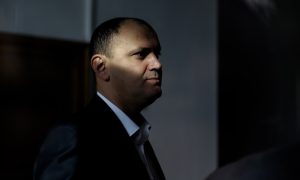

The ECBA Human Rights Committee respectfully urges the Romanian authorities to do everything in their power to investigate and evaluate the case of romanian lawyer Robert Roşu in a fair, balanced and impartial manner, protecting the Principles on the Role of Lawyers.
- Patria Prima a făcut plângere penală în baza Legii Vexler împotriva Asociației Dexonline care a promovat online transformarea cuvântului „CREȘTIN” în „CRETIN”
- Deputații au votat interzicerea înstrăinării acțiunilor deținute de stat la companiile și societățile naționale
- Nazare, audiat ca martor în dosarul vaccinurilor anti-COVID
- Bilanțul „reformei Bolojan”: au crescut veniturile statului din impozite, taxe și TVA; au scăzut investițiile; au câștigat băncile
- Volodimir Zelenski, din ce în ce mai nerăbdător la porțile Europei
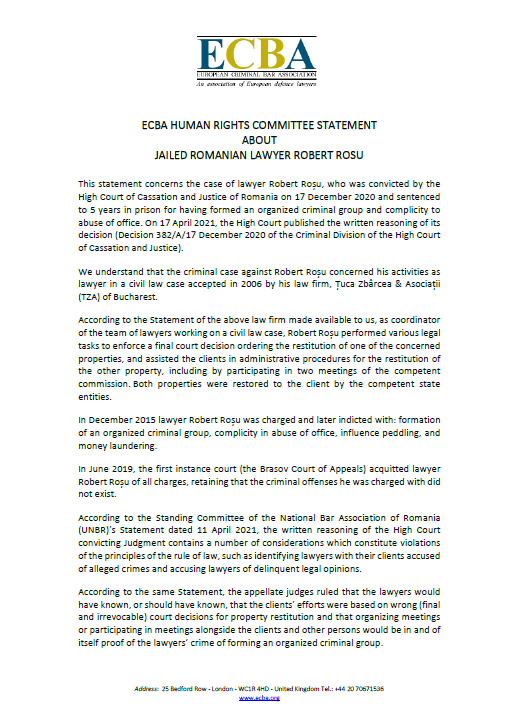
„This statement concerns the case of lawyer Robert Roşu, who was convicted by the High Court of Cassation and Justice of Romania on 17 December 2020 and sentenced to 5 years in prison for having formed an organized criminal group and complicity to abuse of office. On 17 April 2021, the High Court published the written reasoning of its decision (Decision 382/A/17 December 2020 of the Criminal Division of the High Court of Cassation and Justice).
We understand that the criminal case against Robert Roşu concerned his activities as lawyer in a civil law case accepted in 2006 by his law firm, Țuca Zbârcea & Asociații (TZA) of Bucharest.
According to the Statement of the above law firm made available to us, as coordinator of the team of lawyers working on a civil law case, Robert Roşu performed various legal tasks to enforce a final court decision ordering the restitution of one of the concerned properties, and assisted the clients in administrative procedures for the restitution of the other property, including by participating in two meetings of the competent commission. Both properties were restored to the client by the competent state entities.

In December 2015 lawyer Robert Roşu was charged and later indicted with: formation of an organized criminal group, complicity in abuse of office, influence peddling, and money laundering.
In June 2019, the first instance court (the Brasov Court of Appeals) acquitted lawyer Robert Roşu of all charges, retaining that the criminal offenses he was charged with did not exist.
According to the Standing Committee of the National Bar Association of Romania (UNBR)’s Statement dated 11 April 2021, the written reasoning of the High Court convicting Judgment contains a number of considerations which constitute violations of the principles of the rule of law, such as identifying lawyers with their clients accused of alleged crimes and accusing lawyers of delinquent legal opinions.
According to the same Statement, the appellate judges ruled that the lawyers would have known, or should have known, that the clients’ efforts were based on wrong (final and irrevocable) court decisions for property restitution and that organizing meetings or participating in meetings alongside the clients and other persons would be in and of itself proof of the lawyers’ crime of forming an organized criminal group.
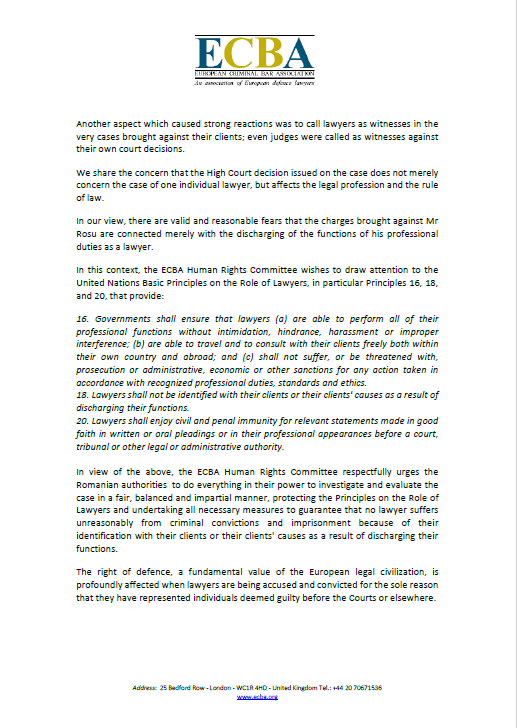
Another aspect which caused strong reactions was to call lawyers as witnesses in the very cases brought against their clients; even judges were called as witnesses against their own court decisions.
We share the concern that the High Court decision issued on the case does not merely concern the case of one individual lawyer, but affects the legal profession and the rule of law.
In our view, there are valid and reasonable fears that the charges brought against Mr Roşu are connected merely with the discharging of the functions of his professional duties as a lawyer.
In this context, the ECBA Human Rights Committee wishes to draw attention to the United Nations Basic Principles on the Role of Lawyers, in particular Principles 16, 18, and 20, that provide:
16. Governments shall ensure that lawyers (a) are able to perform all of their professional functions without intimidation, hindrance, harassment or improper interference; (b) are able to travel and to consult with their clients freely both within their own country and abroad; and (c) shall not suffer, or be threatened with, prosecution or administrative, economic or other sanctions for any action taken in accordance with recognized professional duties, standards and ethics.
18. Lawyers shall not be identified with their clients or their clients’ causes as a result of discharging their functions.
20. Lawyers shall enjoy civil and penal immunity for relevant statements made in good faith in written or oral pleadings or in their professional appearances before a court, tribunal or other legal or administrative authority.
In view of the above, the ECBA Human Rights Committee respectfully urges the Romanian authorities to do everything in their power to investigate and evaluate the case in a fair, balanced and impartial manner, protecting the Principles on the Role of Lawyers and undertaking all necessary measures to guarantee that no lawyer suffers unreasonably from criminal convictions and imprisonment because of their identification with their clients or their clients’ causes as a result of discharging their functions.
The right of defence, a fundamental value of the European legal civilization, is profoundly affected when lawyers are being accused and convicted for the sole reason that they have represented individuals deemed guilty before the Courts or elsewhere”.