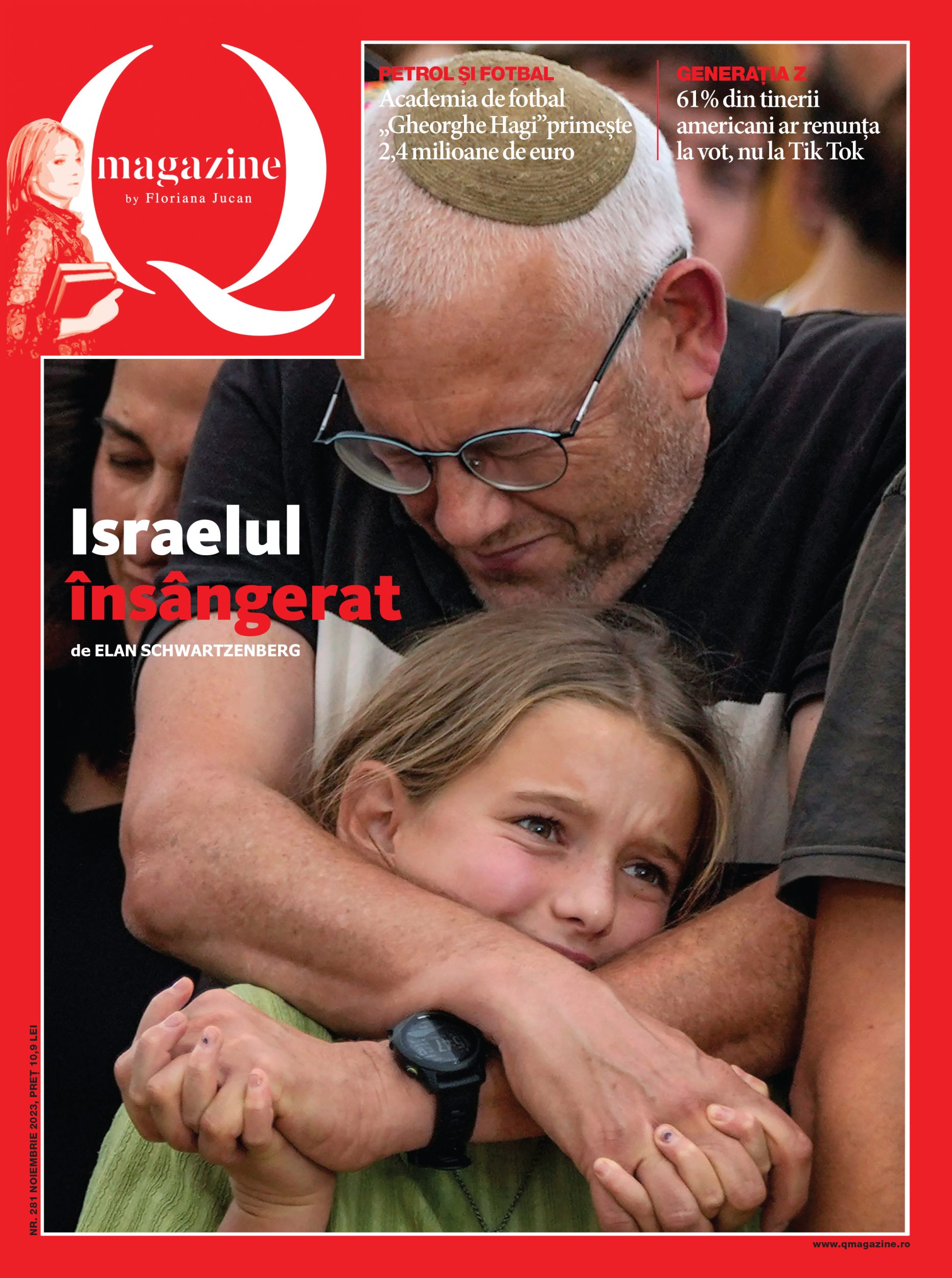

How was this possible? This is the question that still haunts us, even many weeks after the 7 October massacre. Some possible answers, from here in Israel, for Q Magazine.
by ELAN SCHWARTZENBERG, reservist in the Israel Defense Forces
- Andreea Nistor, co fondator al Asociației „Tehnologia pentru Umanitate” a anunțat de la Palatul Cotroceni că „una din opt surse oficiale răspândește dezinformare în mediul digital”
- Nicușor Dan: Consulul general al Federației Ruse, declarat persona non grata
- Incidentul de la Galați, oportunitate de război între partide
- Țuca Zbârcea & Asociații câștigă premiul „Tranzacția Anului în România”, pentru asistența acordată Vodafone
- Ministerul Culturii acuză. „Acțiuni de presiune și intimidare perturbă evaluarea managementului instituțiilor de cultură”
WE SPEND MORE TIME WITH OUR MOBILE PHONES THAN WITH OUR GUNS
Three years ago, I was invited to the wedding of a young girl. She’s the daughter of a good friend of mine, a general in the army. I was sitting next to General Ytzhack Brick. We had a drink, we chatted, he asked me how I met the bride’s father. I told him that a few times a year, as part of my military service as a volunteer reservist, we go together on unannounced inspections of various military bases to check their readiness, etc. From that point on, General Brick talked non-stop for about an hour.
I was shocked to learn that in his opinion (after personally inspecting several military sites) the army was not prepared for a surprise ground attack that Hamas could launch at any time, that we were unmotivated and overconfident in our technology, that we had become far too arrogant and that we spent more time with our mobile phones than with our weapons.
The general also told me how he wrote a lengthy report on all the shortcomings he had identified, but unfortunately the entire army leadership, including the Minister of Defence, laughed him off, arguing that he was outdated, out of touch and didn’t understand how a modern army worked.

I listened in fascination, the man seemed extremely knowledgeable and to the point, but although I was hearing what a general was saying, the reflex of a military man with blind and absolute faith in the army hierarchy kicked in, leading me to conclude that if the Minister of Defence, the Chief of Staff and the rest of the generals had read the report and were amused by it, then my interlocutor was clearly talking nonsense.
Today, General Brick has been urgently called in service to advise on the current crisis…
WHO WAS WRONG
Historically, people have used a natural obstacle (a river or a mountain range) whenever possible to establish a border. Military doctrine defines three elements needed to protect a border: a fence, observation elements (human and/or digital/electronic), and a rapid reaction force in case of need.
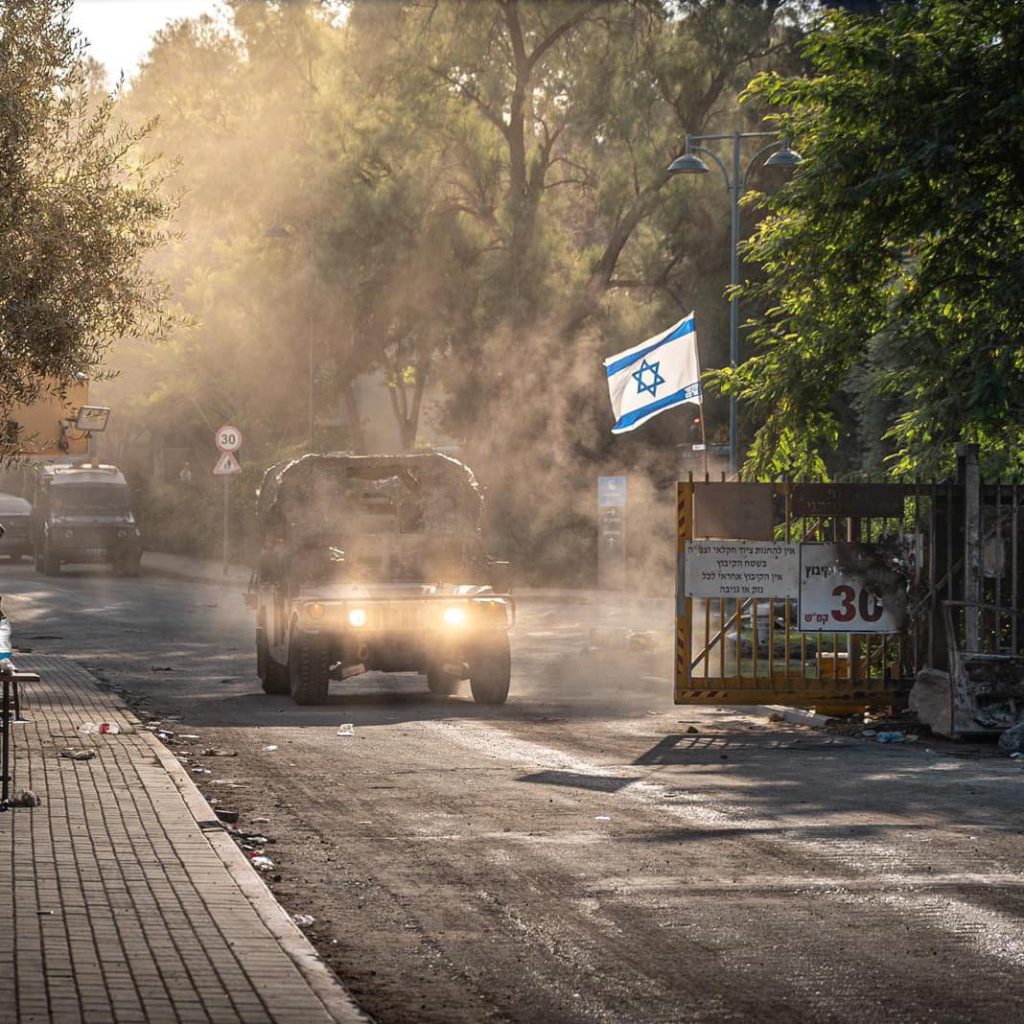
On Saturday, 7 October, the fence between Israel and Gaza was bulldozed. The irony was that most of the terrorists entered from Gaza directly through the main gate, which at 6:28 a.m. was guarded by two soldiers, both with minimal combat training.
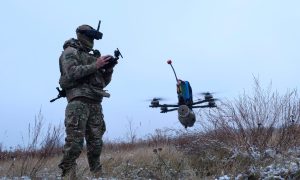
Of the 4 Zeppelins monitoring the almost 100km fence, 3 were undergoing repairs on the ground. The static machine guns were neutralised from above by small, cheap, explosives-carrying drones, or by hand thrown grenades by terrorists who had arrived in eight hang gliders.
With 360o protection, including from the ground up, the designer omitted the usual steel roof on the top. The military command and control centre, located 100 metres from the fence, had only one soldier at the gate, a 19-year-old girl, who was shot at dawn.
Once inside the base, the terrorists used high explosives to immediately neutralise warning and communication capabilities, including the base’s servers that could communicate with the rest of the military.
De facto, the entire border was ‘guarded’ by several dozen soldiers who were literally asleep at that early hour. In reality, there were less than ten soldiers guarding the posts, which were sufficiently far apart.
Rosh HaShana, Yom Kippur, Sukkot, pretty much the whole of September was a month of holidays, culminating in Simchat Torah, which on 7 October was also on Shabbat, which meant that all of Israel, including the army, was in total lethargy, very much like Romania at dawn on 1 January.
Religious and quasi-religious Jews turn off their TVs, radios and telephones on Shabbat, and most of the population had their mobile phones switched off at 6.30 a.m. anyway, as it was a holiday. So even “civil” communications were non-existent.
In the collective subconscious, the fence, with all its installations, was an insurmountable obstacle. There are many examples of this in history, such as the “Maginot Line” built by France during the Second World War, which, because it was difficult to cross, was circumvented by the German army in the north.
Moreover, 2022 and especially 2023 were the calmest and quietest years in Gaza-Israel relations. Shabak (the equivalent of the Romanian intelligence service) and AMAN (the military intelligence service) were unanimous in informing the government and policymakers that Hamas, for various reasons, did not seek or want a conflict. The Israeli military, for its part, echoed this sentiment. As a result, all of the above-mentioned organisations have concentrated on the West Bank, where there has been a new bombing every week, plus the small friction/teasing on the northern border with the Lebanese Hezbollah, a superior and far more lethal force in terms of military equipment and number of experienced fighters compared to Hamas.
At the same time, quietly, steadily and in full view of everyone, Europe, the US, the UN and, above all, Qatar have been sending mountains of aid to Gaza, most of which has traditionally ended up in the pockets of the Hamas leadership, with the rest going to arm and pay the organisation’s 35,000 terrorists, with only the scraps going to the civilian population.
From Sinai (Egypt), through secret tunnels, they received weapons sent by Iran, and 500 metres away from the fence, in full view of everyone, Hamas would carry out all kinds of training, including simulated attacks and hostage-taking. By day, not by night like thieves!
Everyone was convinced that these training sessions were Hamas’s way of showing its sponsors in Iran and Qatar how their money was being spent, and of keeping its fighters fit for a possible confrontation with the Zionist enemy. This confrontation, however, was perceived by most terrorists as something very vague and undefined in time and space. The Gazans would fire a few rockets every 2 or 3 years. Israel would stop most of them with Iron Dome. Nothing serious, thanks to this phenomenal missile shield. Even the training terrorists didn’t know this attack was coming until the last moment. Mohamed Deif, Yahia Sinwar and a very small number of criminals in his inner circle were the only ones who knew what was coming.
Even the training terrorists didn’t know this attack was coming until the last moment.
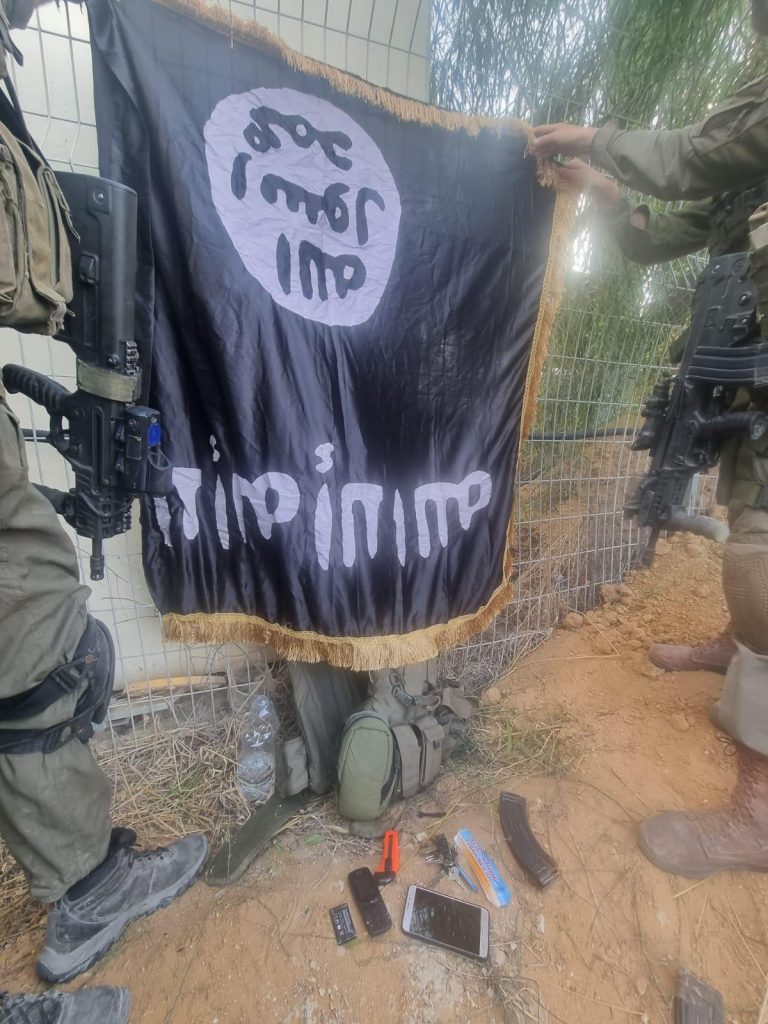
ISIS flag found in a israeli kibbutz among Hamas equipment Foto IDF
HAMAS IS ISIS
On that fateful morning, 100 terrorists – the first to attack and breach the fence – entered Israeli territory, followed by a second wave of another 1,500 terrorists.
Just that morning, everyone was given maps and detailed written information. Most of it was information gathered over the years by thousands of Palestinian daily labourers who came from Gaza to work – details of every village, kibbutz, greenhouse, livestock farm, civil guard post, military base, mobile patrol routine, all described, photographed and documented in minute detail.
The instructions were clear: kill, torture, rape and burn every civilian, regardless of age or sex. Finally, they were asked to take prisoners. Everything was done, resulting in 1,400 deaths (1,100 civilians and 300 soldiers), 229 hostages and over 5,000 wounded.
It is not for nothing that experts from various services and armies – people with experience on many fronts – have said, in the face of such horrors, that “ISIS terrorists are nothing compared to Hamas”.
The fundamental mistake made by the Israeli side was that they completely underestimated their opponent and completely misinterpreted their intentions – in fact, they got the opposite of what their opponent intended.
From the Israeli point of view, as long as the Hamas leadership could steal a lot of the money sent as aid and there was something left over to keep the population afloat, everyone was happy.
There were also theories that “people don’t seek scandal on a full stomach” and that “the rich want peace, not war”, etc. The screenwriter, producer and one of the main actors in Fauda, despite having extensive experience from his younger years as an officer specialising in the Arab world and a creative imagination typical of a screenwriter/director, vehemently rejected the idea that someone in the director’s staff had (for the following season), which depicted a scenario similar to the events of 7 October, saying it was unreal and too “far-fetched”. But then, real life is stranger than fiction!
In Gaza, water and electricity were supplied from Israel, as was medical care in Israeli hospitals for special cases. And many other things. Free or almost free. All for the sake of peace and quiet.
And add to this the firm belief (until three weeks ago) that no one is crazy or suicidal enough to attempt a frontal attack on Israel.
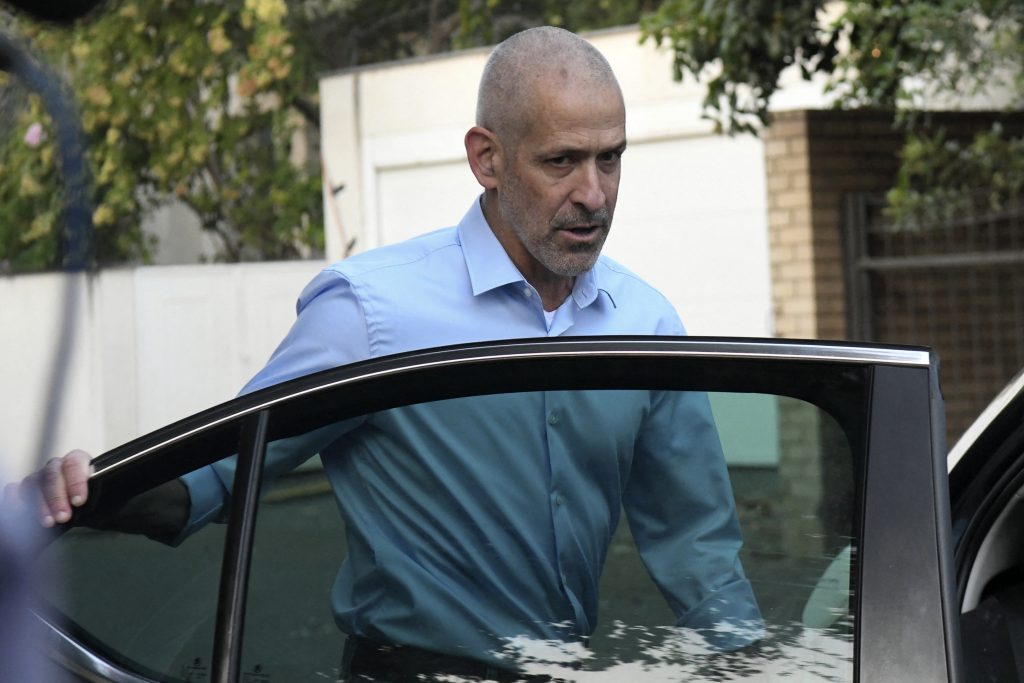
The director of Israel’s Internal Intelligence Service (Shin Bet), Ronen Bar, has taken personal responsibility for his agency’s failure to anticipate the 7 October surprise attack. Israeli military sources had told Q Magazine the day after the attack that Sin Bet was the intelligence service responsible, while everybody blamed Mossad. In a letter sent to Shin Bet members and their families, Bar admits that, despite “a series of measures taken”, the Service he heads has failed “to generate sufficient warning to enable us to thwart the attack”. “As the person at the top of the organisation, I take full responsibility,” Bar admitted, adding: “There will be time for investigations, now we are fighting!”. Profimedia Photo
We were all the same, from the lowest to the highest ranks: foolish, conceited, shallow, irresponsible, and above all arrogant. Mossad benefits from mitigating circumstances because Gaza was not in their job description (bad news for Hamas bosses in exile – they are now on Mossad’s list, so I recommend urgently notarizing some inheritance papers!).
We were all the same, from the lowest to the highest ranks: foolish, conceited, shallow, irresponsible, and above all arrogant!
WHY NOW AND WHAT’S NEXT?
Because the imminent peace between Israel and Saudi Arabia was immediately diminishing the importance of the Palestinians in the Middle East, and further isolated Iran from the already existing international blockade. Russia, on the other hand, indirectly benefits from the distraction of everyone’s attention to the new hotbed of conflict, and from the division of American resources (money and arms) between Israel and Ukraine.
Qatar, which wants to shed its label of “main sponsor of Hamas” and its involvement in the recent corruption scandal at the top of the European Parliament (the case of Eva Kaili, Vice-President of the European Parliament, accused of corruption, money laundering and lobbying in favour of Qatar), is trying to monopolise the manoeuvres to free the hostages. They have succeeded in freeing 4 hostages, they may succeed in freeing a few dozen others, but unfortunately for everyone involved, I think the solution can only be military.
The 225 hostages, including 30 children, plus women and elderly people, are the biggest problem for the State of Israel and all its institutions.
Their presence in the vast network of underground fortified tunnels (already mined with explosives and full of deadly booby traps) is an equation of many unknowns. General Gal Hirsch, who has been urgently reactivated by order of the Prime Minister, has been appointed hostage manager.
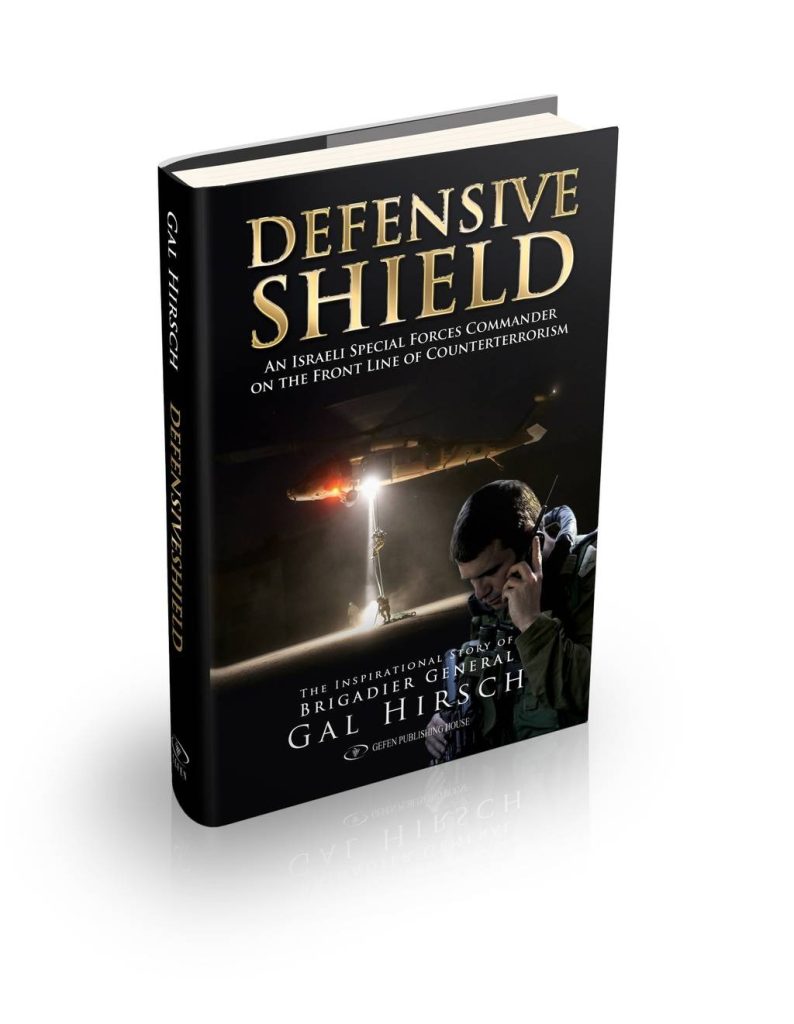
Gal Hirsch is a former military commander in the IDF who, as a brigadier general, commanded the 91st Division of the Israel Defense Forces during the 2006 Lebanon War.
Some time ago, over lunch in Monaco, he told me how, in his youth, terrorists had thrown a concrete block from a bridge onto his car. His right hand was shattered and he spent a year in therapy. Even today I can’t forget Gal’s words: “My only obsession after the bombing was that I wouldn’t be able to use my gun…”. I think he’s the right man in the right place.
At the same time, Israel is forced to do everything in its power to literally liquidate Hamas, otherwise the next time there will be an exponential massacre. Moreover, it is a sad but true fact that here in the Middle East, if you are perceived as weak and lenient, enemies like Hezbollah or Iran will attack you immediately and without hesitation, in a ‘kill or be killed’ approach. We have deluded ourselves into thinking that if we want peace and prosperity, so do our enemies. A colossal miscalculation.
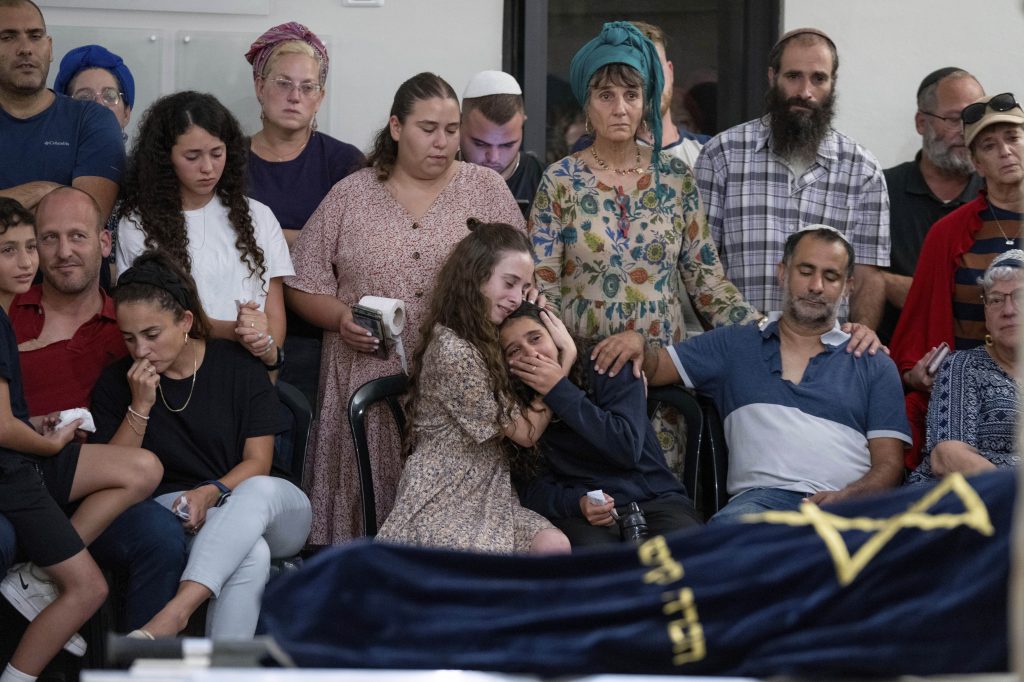
“They just cut off the children’s arms and legs. There are no words to describe such horrors. We found a mother and her child in a room at Kibbutz Be’eri. They were completely burnt. We had to collect their ashes with a spatula in order to bury what was once a mother and her child, of whom nothing was left.” – Israeli volunteer. Profimedia photo
We bury our dead, try to rescue the hostages and recalibrate the situation from the ground up, or else we are doomed.
Here in the Middle East, if you are perceived as weak and lenient, enemies like Hezbollah or Iran will attack you immediately and without hesitation!
There will be no quick fix. The Americans, for example, took 10 years to liquidate Bin Laden and one year to “clean up” Mosul. Solving this problem also depends enormously on whether other hotbeds of war are likely to emerge.
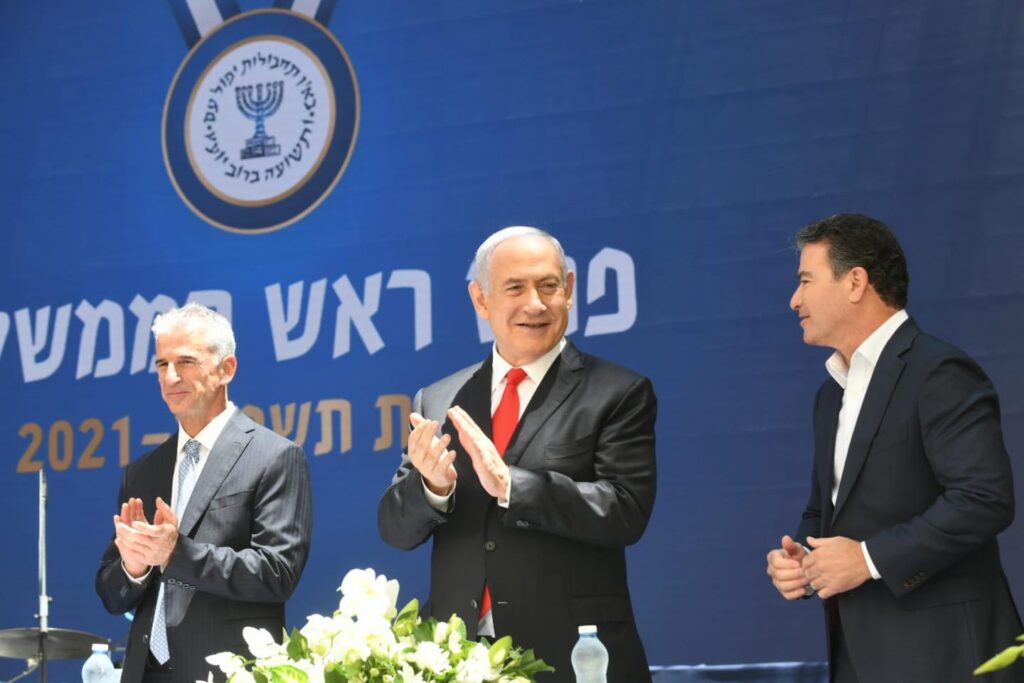
I recently heard former Mossad chief Yossi Cohen say that no one can predict Hezbollah’s intentions.
As for the “civilian” population in Gaza, it’s not black or white, i.e. terrorists or civilians.
The whole world has seen the footage of ‘civilians’ joining in the horrors with sticks, shovels and whatever else they could get their hands on. They too were raping, killing and destroying. In recorded conversations between attackers and their families in Gaza, they explicitly bragged about their actions, and family members applauded and encouraged them.
I am convinced that there are good people among the two million Palestinians in Gaza, and I am deeply sorry for the suffering they are enduring, caught in the middle of this war.
Unfortunately, knowing in depth the reality on the ground, I know that the number of good people is much smaller than we, with our incorrigible and optimistic Western views, can imagine.
Here’s some food for thought for pacifists: why is it that all the Arab countries that shout their love and support for Palestine, do not want or accept any Palestinian refugees?
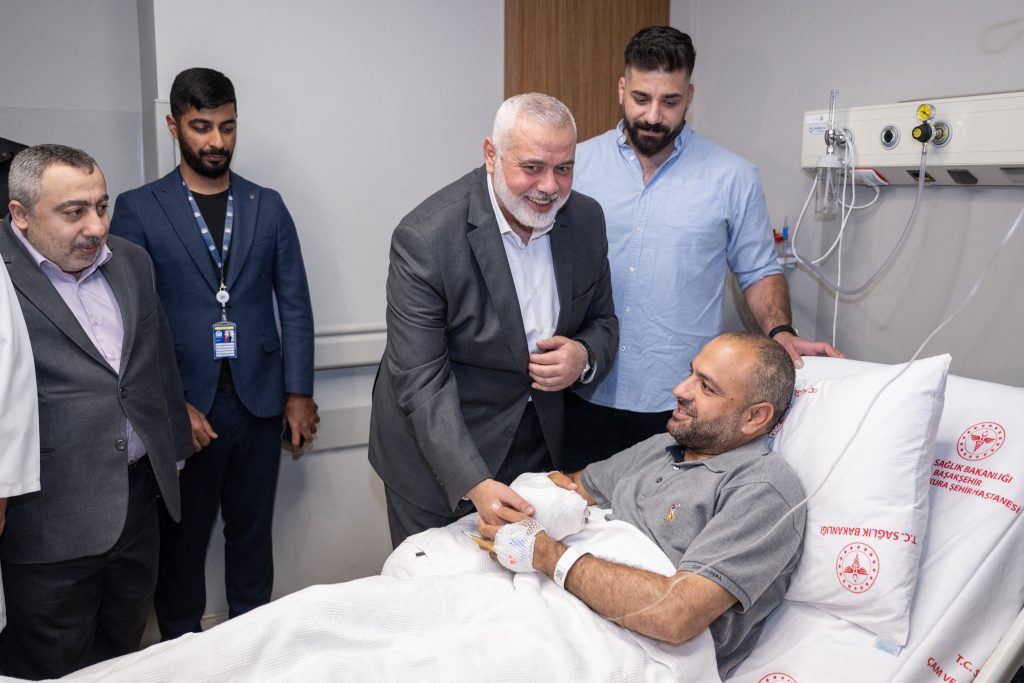
Chairman of the Hamas Political Bureau, Ismail Haniyeh pays a visit to Palestinian photojournalist Ashraf Amra, a freelancer for Turkiye’s premier news agency Anadolu who was severely injured on his hand by Israeli army fire while covering a protest demonstration, at the Basaksehir Cam and Sakura City Hospital in Istanbul, Turkiye on September 22, 2023. Profimedia Photo
HOW MUCH TRUTH IS THERE IN THE “OCCUPATION” AND FREE PALESTINE?
There has not been a single Jew/Israeli in Gaza for almost 20 years. The “occupation” is a legend and a perfect propaganda slogan among progressive (mostly European) activists who, when asked to give an answer off the top of their heads, have no idea where Gaza is on the map, or the realities of life here. They are prone to being misled by rhetoric like “Israel deliberately bombed a hospital killing 500 people” or “Old Christian church from 1600 destroyed by Israel”.
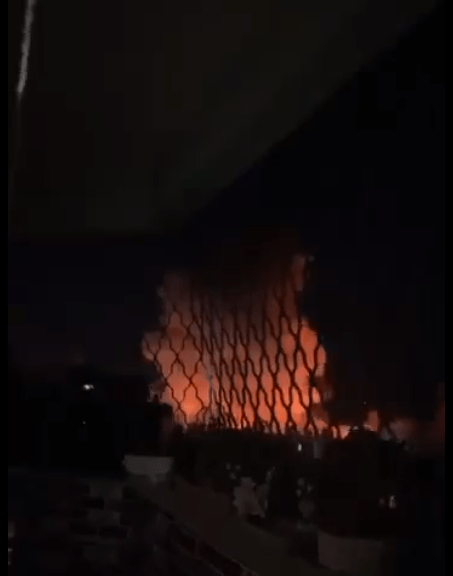
Later, faced with indisputable evidence, confirmed by military specialists from respected countries, we learn that Islamic Jihad and Hamas fired on the two targets, misdirecting rockets meant for Israel, and that the death toll was no more than 30, not 500.
This is deadly and dramatic. Statistically, one in five rockets fired by Hamas falls in Gaza, where, due to the lack of an Iron Dome shield and, above all, the density of the population, entire families are decimated and placed “under the responsibility of the Israeli occupation”. That’s why I advise moralists everywhere to check the information and document how many hospitals and civilians the Americans and the various NATO forces have hit in the last 20 years; as for the Russians, no comment. This is war, not a visit to a porcelain shop. Anyway, in the perverse madness typical of Hamas, they place launchers and rockets under hospitals, mosques, churches, schools, UN headquarters, and when they hit the wrong target, the explosions are all the more devastating because of the ammunition stored underground.
THE CURRENT BATTLE IS NOT BETWEEN ISRAEL AND HAMAS, BUT BETWEEN HUMANITY AND BARBARIANS
All those who regard Hamas as a “liberation movement” completely ignore these repeatedly and unequivocally documented facts. I’m waiting for a journalist to ask why, in 20 years and with unlimited funds, Hamas leaders have not built resorts like Hurghada or Sharm el Sheikh instead of tunnels and rocket launchers? It is Gaza, not Tel Aviv, that has the most beautiful and natural coastline.
Unfortunately, here too, Israel has got its strategy wrong, both in terms of PR and international communication. So I propose a new, slightly adjusted slogan: Free Palestine from Hamas! If not for Israel, then for the rest of the civilized world because, no doubt, the horrors here can quickly be exported anywhere.
But judging by our own Israeli inertia until three weeks ago, you probably don’t get it until you or your people are harmed.
The fanatical wing of Islam, such as Hamas, the Ayatollahs of Iran and others like them, have as their primary and declared target Christianity around the world, with Jews and Israel as secondary targets. They want to install Sharia law throughout the world, and those who oppose it are sentenced to death. And for those who have forgotten, Jesus was a Jew, which is why the current battle is not between Israel and Hamas, but between humanity and barbarians.
This is war, not a visit to a porcelain shop!
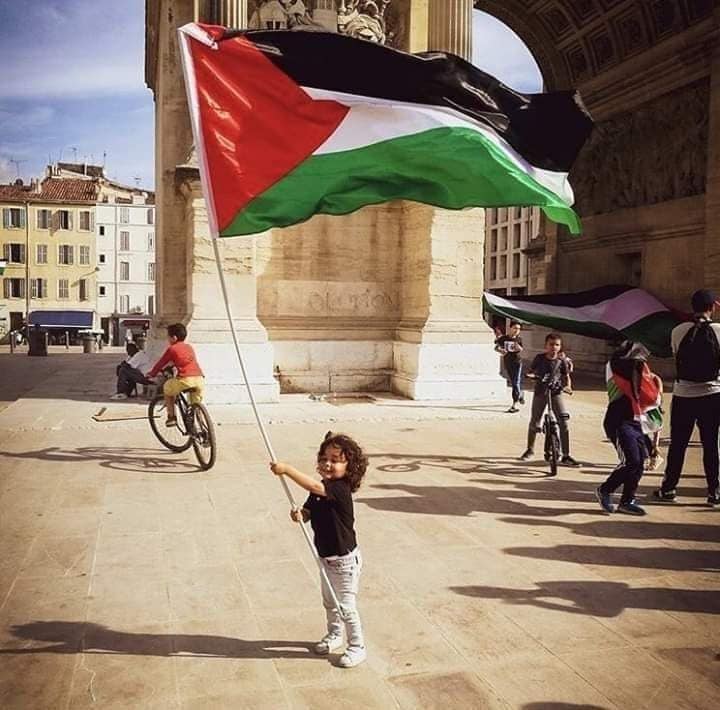
“We need the blood of the women, children and elders of Gaza to awaken our revolutionary spirit.” – Hamas leader Ismail Haniyeh
THE ARMY SHOULD BE APOLITICAL
Another misconception is that the previous six months of social unrest and mass demonstrations in Israel were a factor in this disaster. Sadly, we find that all the unfortunate elements I have described here would have been identical, with or without the demonstrations and activism. After years of the Supreme Court overturning multiple government or Knesset decisions, Netanyahu and the current coalition have decided to limit the judiciary’s interference in the legislature on a one-off basis. Obviously, two major sides emerged, for and against, and widespread demonstrations and televised debates ensued.
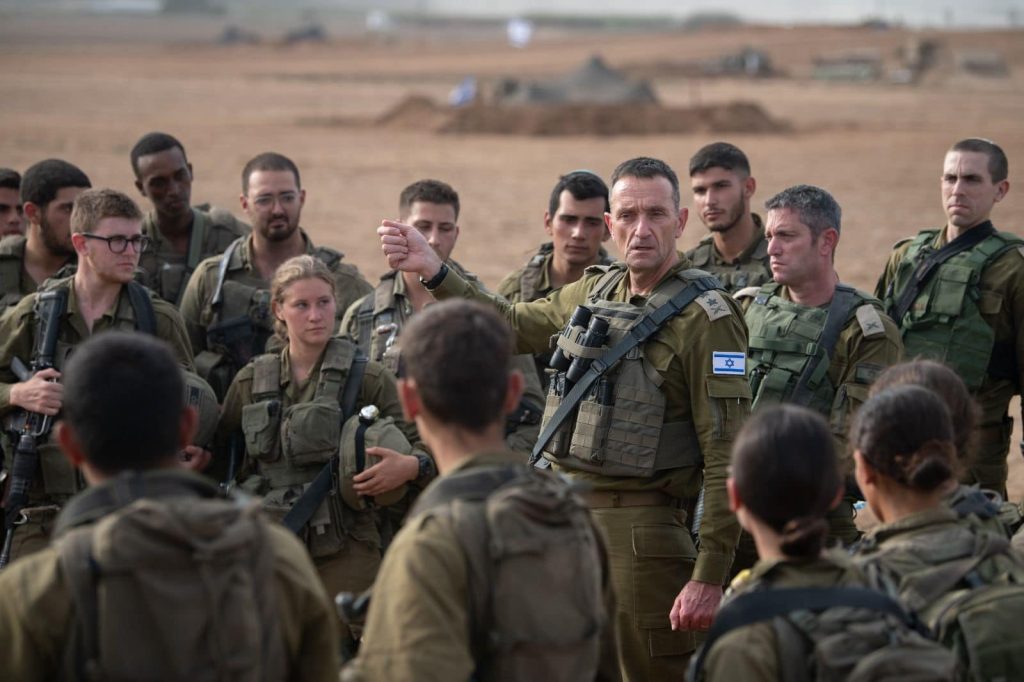
Many (former) commanders in the security and military establishment thought Bibi Netanyahu was wrong.
Personally, I believe and argue that THEY were fundamentally wrong on two points: in a democracy, the people vote, and elected officials make laws and implement the government’s program. So, dear current and former candidates, do what you want when and if you are elected! Until then, however, I am forced to note that some of you have been at the helm very recently (until “yesterday”), so you are directly responsible for this massacre. Yes, YOU personally, and although some of you are old acquaintances of mine, this is the absolute truth!
It is not the politicians or the demonstrators in the streets who “slept on the job”, it is you who should have known in advance what Hamas was doing and what it wanted, who should have guarded the border responsibly, who should have had several hundred soldiers armed and ready to go at all times, who should have been able to reach anywhere on Israeli territory by helicopter in less than 20 minutes in the event of an alarm. A few hundred soldiers and two helicopter gunships would have prevented this attack. That, by definition, was your job description, not “politics on TV shows” and public letters to members of the government.
I have told this directly to those I needed to tell, and to those I haven’t yet met, I will.
I have also read that there are Romanian commentators who claim that what happened to Bibi was the direct result of his not listening to the generals. A sort of nudge-nudge for Romanian politicians. I stand by my view that the Intelligence Service, regardless of its origin, must do its job – the specific assignments for which it is paid. After that, those who want to be in politics, let them run for office and be validated by the people!
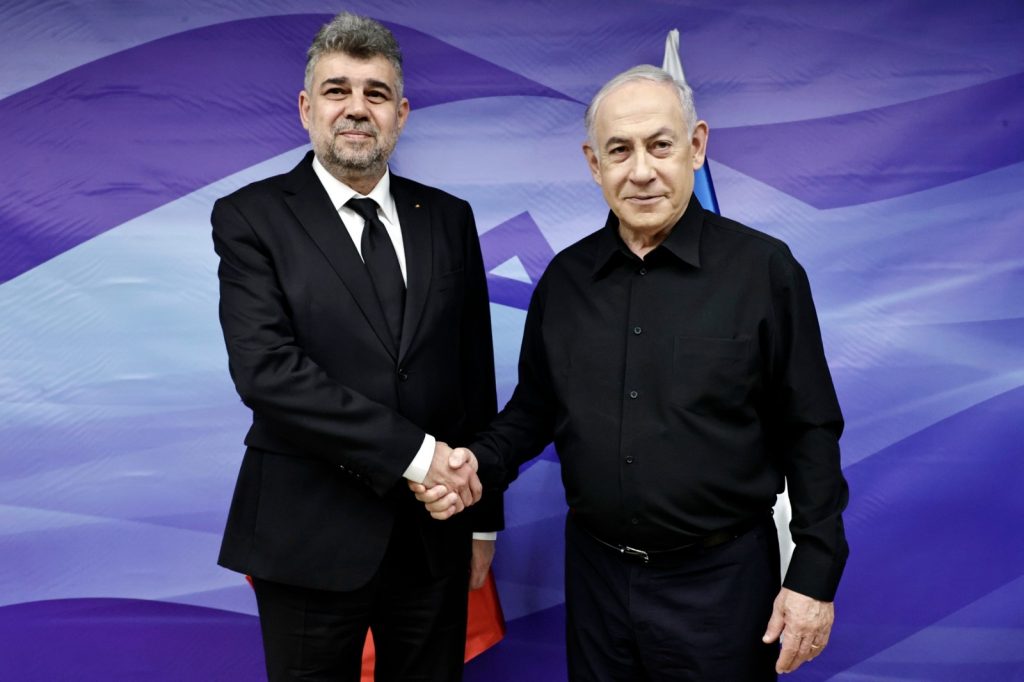
On another note, I was extremely proud and pleasantly impressed by Marcel Ciolacu‘s visit to Israel in the middle of the war. His very inspired positioning as an “equal among equals”, alongside great political leaders such as Biden, Macron, Sunak or Scholz, shows that he is a statesman who understands that the world does not end at the borders of his country. (I should mention that I don’t know Marcel Ciolacu personally, as he did not take part in the hunts organised by Marian Oprișan in Vrancea. He was probably not yet qualified at that time!).
I’ve heard that Klaus Iohannis would also like to visit Israel, but by the time he finishes his thinking and makes a decision, the war will probably be over…
Dozens of friends from Romania wrote to me and called me, worried and concerned about the situation in Israel. To those to whom I didn’t have the chance to reply, I thank you from the bottom of my heart. A kind word, a kind thought, means a lot to anyone at a turning point in their life, and let me tell you, the 7th of October was a disaster of biblical proportions for the whole of Israel.
I wrote this text in Tel Aviv, on Saturday 28 October, between the noon and the evening alarm!
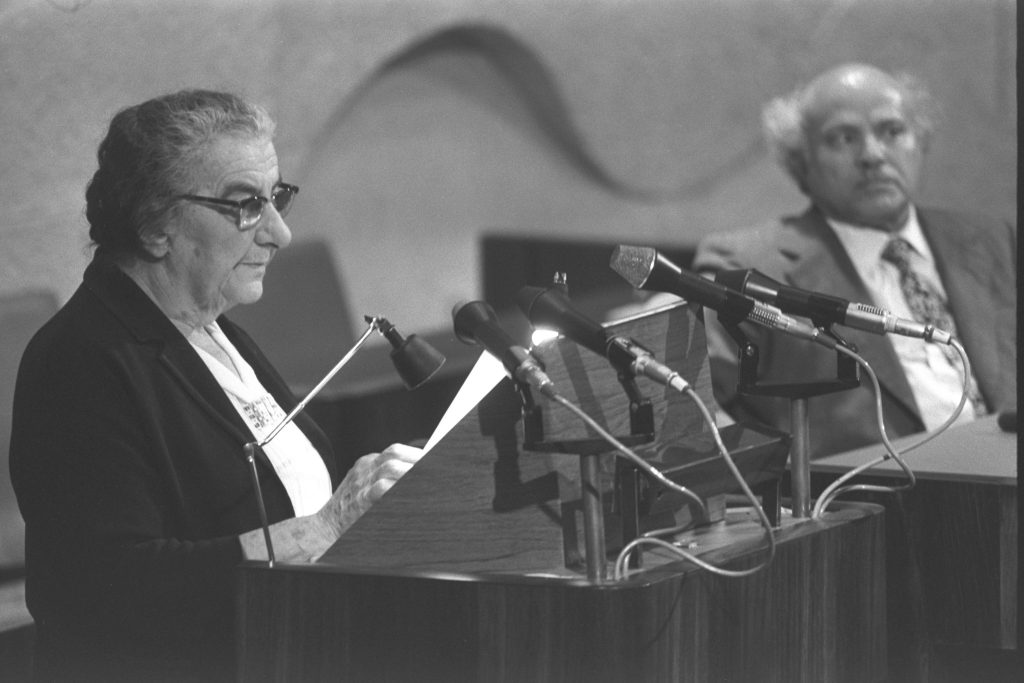
“When peace comes, we will probably forgive the Arabs for killing our children, but it will be hard to forgive them for forcing us to kill them instead!” said Golda Meir, Prime Minister of Israel 1969-1974
HISTORICAL FACTS
Situated on the trade route between Asia and Africa, Gaza has been inhabited and fought over for centuries by Egyptian Pharaohs, Babylonians, Philistines, Macedonian Greeks, Romans, Arabs, Mongols, Crusaders, Ottomans and even Napoleon. Alexander the Great conquered Gaza, killing men and taking women and children as slaves.
Christianity spread here in Roman times and still exists today in a small community.
Arab armies invaded the area 1,400 years ago and forced the inhabitants to convert to Islam.
Gaza was part of the Ottoman Empire from the 16th century until 1917, when it was taken over by British troops during the First World War.
Over the last century, Gaza has passed from the British to the Egyptians and then to the Israeli army.
It is now home to around 2.3 million Palestinians, mostly refugees.
1948. The British protectorate ends. Violence between Jews and Arabs escalates from 1940, culminating in the war that breaks out the day after the official declaration of the State of Israel in May 1948.
The Egyptian army invades a 40 km strip from Sinai to Ashkelon.
Hundreds of thousands of Palestinians seek refuge in southern Israel.
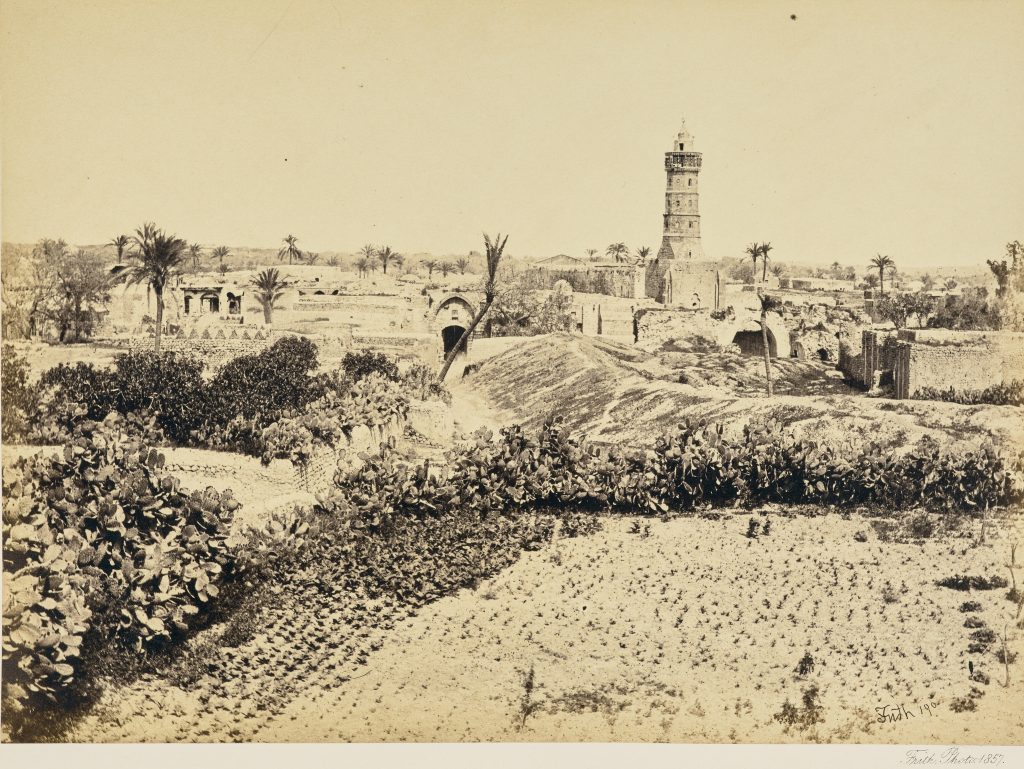
1950-1960. Egypt controlled Gaza for two decades, allowing Palestinians to study and work in Egypt. The Fedayeen, Palestinian militants, mount permanent attacks on Israel.
The United Nations establishes the agency for refugees, UNRWA, which today provides services and assistance to some 1.6 million registered Palestinian refugees in Gaza or in Jordan, Lebanon, Syria and the West Bank.
1967. After a war with Arab countries, Israel occupies the Gaza Strip.
As the Egyptians leave, many Gazan workers find work in agriculture, construction and industrial services in Israel, where they have easy access.
Israeli military forces administer Gaza and protect the Jewish settlements that have since been built there.
1987. Twenty years after the 1967 war, Hamas was founded and began a guerrilla war against the Jews. Called the Intifada, this struggle continues to this day.
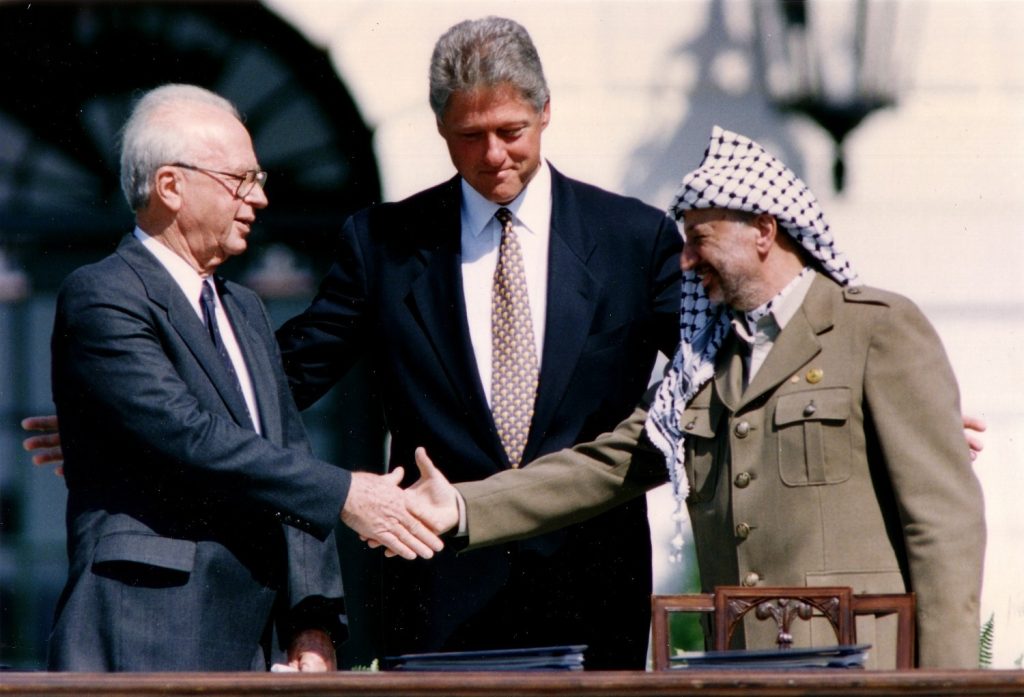
After the incredible handshake with Yasser Arafat, Yitzhak Rabin said in his speech at the White House: “We are destined to live together, on the same soil in the same land.
We the soldiers who have returned from the battle stained with blood, we who have seen our relatives and friends killed before our eyes… we who have fought against you, the Palestinians, we say to you today in a loud and clear voice: ‘Enough of blood and tears! Enough!”. In October 1994, Rabin and Yasser Arafat were both awarded the Nobel Peace Prize.1993. Oslo. Israel and Palestine sign a historic peace agreement leading to the creation of the Palestinian Authority. For the first time, Palestinians are given limited control over Gaza and Jericho in the West Bank, and Yasser Arafat returns from decades in exile.
The Oslo Accords allow the Palestinian Authority to establish relative autonomy and prepare for statehood in five years’ time, but not long after, Israel accuses the Palestinians of failing to abide by agreed security rules, while the Palestinians resent the continued building of countless Jewish settlements in their territories.
Hamas and another militant group, the Islamic Jihad, bomb various targets in Israel to jeopardise peace and the process of normalising relations. The Israelis react and impose new movement restrictions on Palestinians.
2000. The Second Intifada. Several Palestinian suicide attacks on Israeli territory escalate the conflict.
Israel destroys the radar at the Gaza International Airport, inaugurated in 1998, a symbol of the opening to and from Gaza.
Another casualty in the conflict is the fishing industry, extremely important for Gazans, which the Israelis severely restrict to prevent the transport of weapons via shipping routes.
2005. In an attempt to show that it wants peace, Israel evacuates all the Jewish settlements in the area, which is also controlled by Palestinians, causing enormous pain and hysteria among the conservative and ultra-religious Jewish population, who accuse the Israeli leadership of treason.
In August, Israel withdraws all its troops and lives the area completely free of occupation.
The Palestinians demolish all the infrastructure, and a veritable “tunnel economy” begins to develop in the place of settlements previously inhabited by Jews, housing an unimaginable military arsenal.
The few factories and farms that had been built here, providing employment for some Gazans, have also been destroyed.
2006. Isolation under Hamas. In 2006, Hamas wins a surprise victory in the Palestinian parliamentary elections and takes full control of the territory, forcing Mahmoud Abbas, a loyalist of Yasser Arafat, to cede power.
Much of the international community cuts off humanitarian aid to the Palestinians because Hamas is considered a terrorist organisation, and the Israelis block access to thousands of Palestinian workers, cutting off a vital source of income for Gazans.
Due to security concerns, Israel and Egypt jointly impose restrictions on the movement of goods and people in and out of the Gaza Strip. An air strike leaves Gaza without its only power plant.
Hamas’s ambition to turn Gaza’s economy eastwards and isolate it from Israel is ultimately condemning the territory to poverty and famine.
Egyptian leader Abdel Fattah al-Sisi closes Gaza border and blows up all tunnels into Egypt.
2014. One of the bloodiest battles takes place when Hamas fires several rockets at Israeli towns, and the response is an air strike that destroys many buildings in Gaza.
Over 2,100 Palestinians, 67 Israeli soldiers and 6 Jewish civilians are killed.

2023. At 6:00 a.m. on 7 October, several Hamas terrorists launched a surprise attack on several Israeli kibbutzim and villages, killing 1,400 Jews, mostly civilians, and taking 240 hostages. The crimes committed in this attack are despicable. Hamas terrorists murdered children in front of their parents, slashed open a pregnant woman’s belly, decapitated the foetus and then shot it too, raped women and burned alive Jews sleeping in their beds.
Israel has vowed to destroy Hamas and launched an unprecedented military operation that Hamas medical officials say has killed 8,300 people by 30 October.
However, these figures cannot be considered real, as in another case Hamas claimed that Israel had hit a Gaza hospital with a rocket killing 500 people, most of them patients or Palestinians sheltering from shelling. However, according to several independent sources, the attack was actually the result of a rocket fired by Hamas into Israeli territory that missed its target and fell on the hospital, and the number of victims was 30.