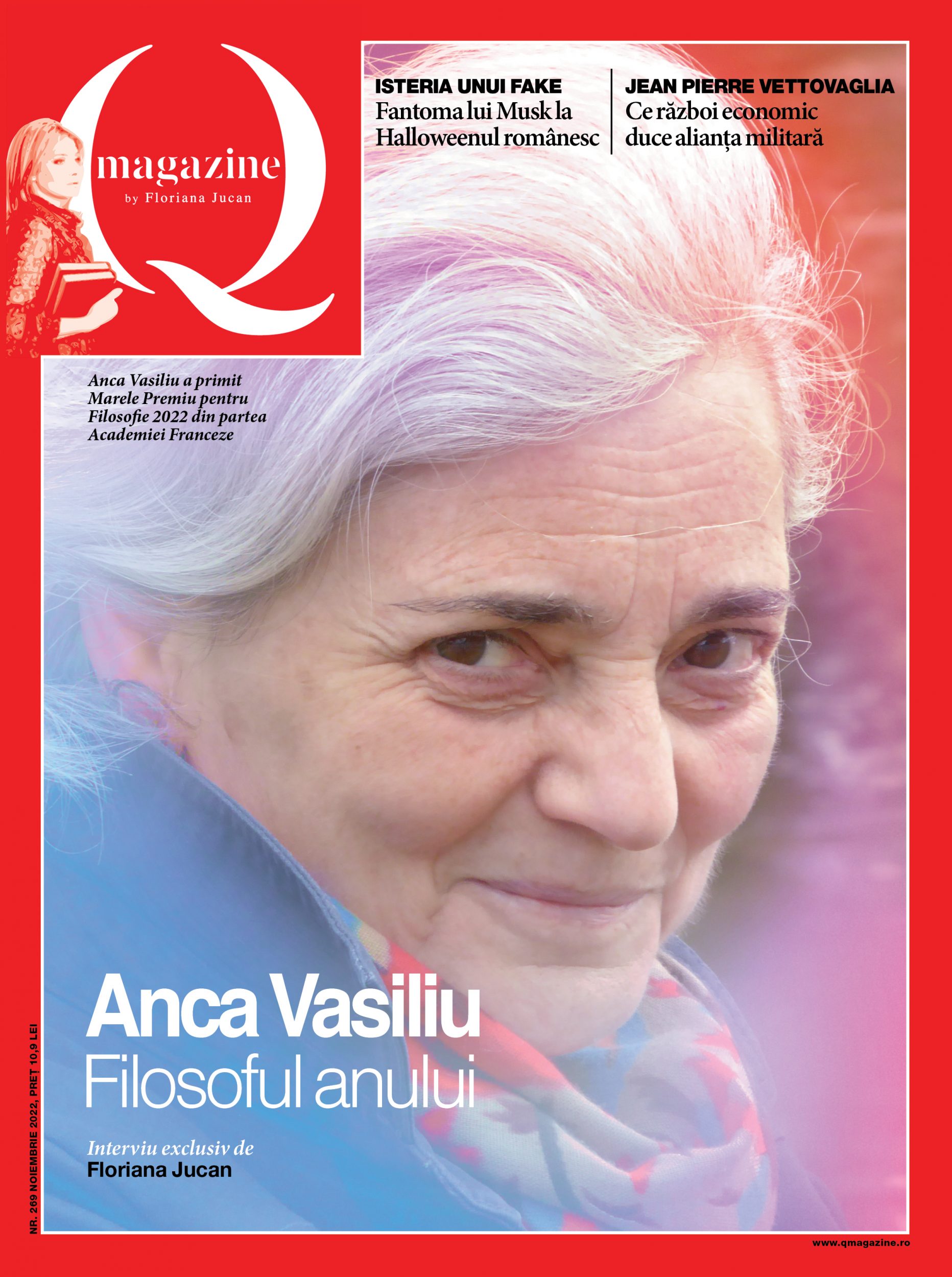

For the French Academy, Romanian scholar ANCA VASILIU is the philosopher of the year. You’ll understand why from this exclusive interview for Q Magazine.
- Nazare, la DNA în dosarul vaccinurilor anti-COVID
- Bilanțul „reformei Bolojan”: au crescut veniturile statului din impozite, taxe și TVA; au scăzut investițiile; au câștigat băncile
- Volodimir Zelenski, din ce în ce mai nerăbdător la porțile Europei
- Președinții Curților de Apel, îngrijorați de „atacurile fără precedent la integritatea şi stabilitatea statală a României”
- PSD l-ar putea accepta pe Eugen Tomac în funcția de premier
TRANSHUMANISM, THE CONSEQUENCE OF NIHILISM
Floriana Jucan: You were recently awarded the Grand Prize for Philosophy for 2022 by the French Academy for your research at the Léon Robin Centre for Research on Ancient Thought, a centre affiliated to the Faculty of Philosophy of the Sorbonne University and the National Centre for Scientific Research (CNRS). You are, in other words, a researcher focused on the traditional line of humanistic studies, that are based on broad philological and philosophical competencies. What relevance do humanistic studies rooted in the thought of Plato and Aristotle still have today, in an era of postmodernism, posthumanism or posthuman transhumanism?
Anca Vasiliu: The study of classical philosophy is a subject taught from high school in France and is one of the compulsory examinations for the high school degree. Why is that, since we are in an age of posthumanism? Because ancient philosophy provides education with the philological and conceptual tools needed to educate thought. How can we understand postmodernity if we do not know what modernity is, where it comes from and how we can assimilate it in order to be different from it and, if possible, beyond it and any other cleavage?
Classical philosophy is simply the education of the mind, of language, of actions. On the basis of it we relate to the world in which we live, and we can define ourselves as postmodern, that is to say more than modern, if we recover not only the immediate past, the paternal heritage, but also the cultural model that modernity itself wanted to overcome in its time.
Classical philosophy provides the framework and the tools to know who we are beyond generational contextual determination: modern, postmodern, traditionalist, etc. It allows us to understand humanism, not anthropologically, but culturally, in order to know ourselves, either from the perspective of knowing the properties of the human, or in the quest to get out of the human, claiming ourselves as ‘non-human’ or ‘trans-human’, in a relationship with robots, with artificial intelligence or with the universe populated by beings that are not human, but ‘trans-human’ and perhaps not even living beings, but illusions of a superpower without death, but also without life (sensitivity, feeling, judgment, dedication, creativity). This confrontation between old and new in terms of human/non-human is not an invention of postmodernism. In Greek mythology, the young gods (the ‘moderns’ endowed with intelligence) rebelled against the previous gods, the ‘giants’ (the blind elemental powers) and defeated them, taking their place. The story known as ‘gigantomachy’ has been used as a topos in classical philosophy to define the confrontation of cultural models and philosophical systems, but not necessarily as a confrontation between old and new, with an inherent determination of the new as superior, but as an attempt to get out of the binary mode of confrontation of oppositions by replacing it with another operative mode which was called dialectics. And dialectics, by introducing a dialogue between systems, also introduces a cultural positioning outside opposition, a sort of postmodernity avant la lettre.
Now, the situation of the transhuman is somewhat different, because the transhuman wants to be, not a blind power, but a power more intelligent than the intelligence of the educated man.
Indeed, except that this intelligence superior to intelligence is only the product of human intelligence, and the transhuman is only an overestimation of reality, a reality ‘augmented’ by an overestimation of the capacity to receive reality and create a new reality. To replace reality with surreal fictions we should first know what reality is. Does it reside in things, i.e. the immanent objectivity of the world? Or is it the result of our own imaginative and discursive capacity of projection on what is and what is not, without distinction between being, non-being, super-being? But these questions were already articulated by the Sophists in the 5th and 4th centuries BC. What lies beyond the meaning and power of words? Perhaps the transhuman, since it is not language and the knowledge of its reasons that define it, but the mathematical calculation from which it comes and which determines it. We speak then of what lies beyond the power of speech and thought, but do we speak with meaning, or do we translate dreams and string metaphors about what might be? I don’t mean to say that everything that concerns us today has already been addressed and that there is nothing new under the sun. But I am defending the absolute necessity of education that affords us the tools to continue to reflect effectively and positively on the world and to respond to the challenges we face.
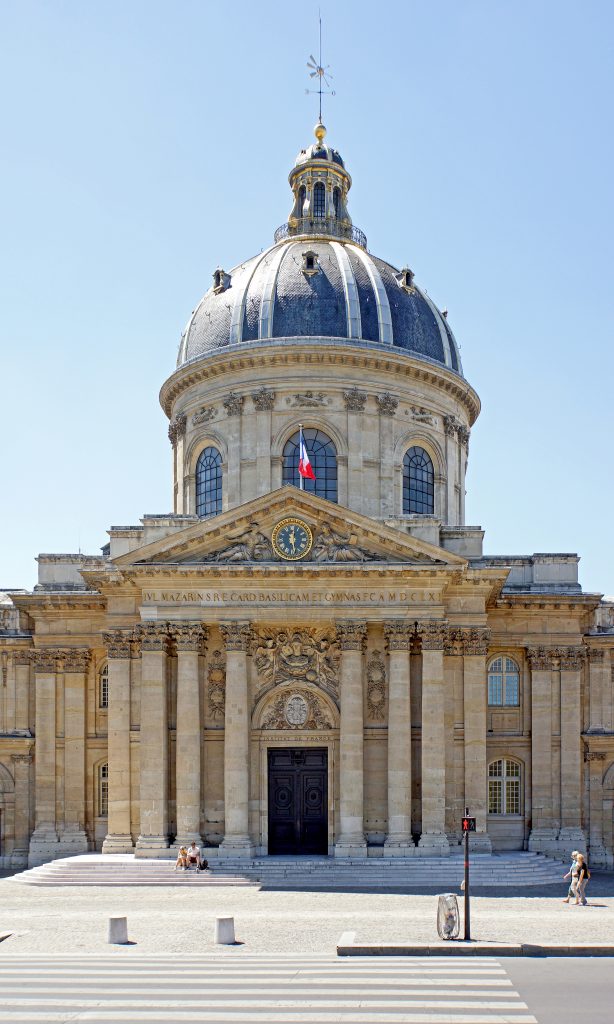
The French Academy
How would you define transhuman?
A desperate creation of the human, trying to cross the boundary of what is human, like a Luciferian creation.
We want absolute power and immortality. But the limit of the human is not death, it is senselessness, the loss of inner values, staples of the mind and heart.
Lack of education leads to loss of the limitlessness that is the appanage of human nature, it does not lead beyond it or outside it. Culturally speaking, transhumanism is a consequence of nihilism, rooted in a certain modernity, that of the 19th century, whose consequences caused the disasters of the 20th century and seem to be fuelling the disasters of the 21st century. But I believe that a slow process of settling down and emerging from nihilism has already begun. More or less spectacular disputes and reversals are short-lived, like any storm. The being remains unmoved in its depths, and nature spontaneously recovers its creative capacities and is reborn even from ashes. I am not an optimist, but a realist, that is, an observer of reality as far as possible.
WHAT WAS BEFORE MATTER
How do the studies in which you excel, and which speculate on ancient thought, that precedes the consolidated configuration of the idea of a trinitarian divinity, relate to the fundamental issue in philosophy regarded from the perspective of a pre-eminence in the spirit-matter relationship?
The issue of matter in ancient philosophy is extremely complex. Aristotle was the first to define it. But he did not invent it, nor was he the first to raise the question of the pre-eminence of matter over a formal, intelligible or purely elementary principle. I cannot present here the issue of matter in the ancient philosophies, but it must be pointed out that the material principle or cause of the world is something completely different from what we tritely refer to as ‘material life’, and that the opposition between material life and spiritual life pertains to another field than that of the constitution of the world.
The so-called ‘dualism’ that introduces a pre-eminence between material and spiritual ‘values’ is a modern invention. Ancient philosophers had a dialectical view of the relationship between matter and form or between active and passive. All ancient doctrines have a rather triadic view of fundamental principles, the triadic structure being composed of ‘single principle, totality, being’ or ‘being, becoming, receptacle’ or ‘intelligence, soul, body’ or ‘being, life, intelligence’ – depending on the chosen philosophical system. But these triadic structures cannot be sketched in a few sentences, and the ‘spirit-matter’ relationship is not theoretically pre-eminent over the trinitarian ‘divinity’, nor prior to it, like paganism to Christianity, but is a relationship subsumed to each of the three fundamental field of ancient philosophy: the divine, the cosmos and the soul.

Anca Vasiliu studied art history and theory at the Nicolae Grigorescu Institute of Fine Arts (1976-1980), obtained a DEA at the University of Poitiers, CESCM (1990-1991) and defended her PhD in philosophy at the University of Paris X Nanterre (1991-1996) with the thesis L’image et le diaphane: contribution à une phénoménologie de la lumière (a.n. The image and the diaphane: contribution to a phenomenology of light). She has been, in her turn, conducting PhDs since 2005 at the Sorbonne University in Paris. She was museographer at the Village Museum, then a researcher at the Institute of Art History in Bucharest. Since 1990, she relocated to Paris and became a researcher at the CNRS, Paris, then, since 2008, project leader at the Centre Léon Robin de recherches sur la pensée antique (translator’s note: The Léon Robin Centre for Research on Ancient Thought), affiliated to the Faculty of Philosophy of the Sorbonne University, and Associate Professor for philosophy at the University of Paris I Pantheon-Sorbonne. She initiated and edits the international journal of ancient and medieval philosophy Chôra, published by Polirom Iasi. She has written 10 books on ancient and medieval philosophy.
WE WOULDN’T HAVE A CHRISTIAN THEOLOGY WITHOUT GREEK PHILOSOPHY
Did Christianity put an end to Greek philosophy?
Absolutely not. Christianity, or more precisely the foundation of Christian thought, came about by immersing the Christian message and the entire biblical tradition in ancient Greek and Latin philosophy, drawing on all its knowledge, physics, ethics, psychology, rhetoric, dialectics, theology. All the concepts and the way of constituting a system or a doctrine are borrowed from the deeply known ancient philosophy, textually; let us not forget that the Church Fathers had access to many more texts than we have available today after the great libraries of the ancient world were burned.
Christian theologians opposed philosophers in certain situations, sometimes demonized them, but there is a lot of rhetoric behind the criticism.
In the beginning, Christianity was a system in competition with other systems or schools, such as Neoplatonism or Gnosticism. Criticism of philosophy is in good part a form of war against other religious models to strengthen the competing cultural position of the Church. But until very late in the Middle Ages, ancient philosophy was the foundation on which Christian theology was built. In the Latin world, Thomism, for example, is unthinkable without a rigorous knowledge of all of Aristotle’s treatises and their Greek and Arabic commentators. On the other hand, it was the Byzantines who copied, and thus saved, Plato’s Dialogues; it was still them who developed an early university education, the ‘palatine school’, in parallel with monastic schools, two or three centuries before the West.
There is so much to be said about the relationship between classical Greek philosophy and Christianity, but what is certain is that we would not have a Christian theology without Greek philosophy. Moreover, even before Christianity, Hellenistic exegetes of the Bible, such as Philo of Alexandria (1st century AD), based their interpretation of the biblical text on Greek, Platonic, Aristotelian and sometimes Stoic categories, concepts and definitions.

The School of Athens, detail from a fresco by Italian Renaissance artist Raphael Sanzio
Can the diaphanous (which you dealt with and which, simplifying Plato’s thesis in Timaios and Aristotle’s in the book On the Soul, would be transparency) be related to the theory of slits, that experiment in quantum physics in which light behaves either as a wave or as a particle depending on the observer?
No. The association with quantum physics experiments is speculative and unsubstantiated. Light is aporetic to ancient scientists. They have no theory about the phenomenon of light, so they consider light a ‘pure act’ or a permanent ‘active act’, without potentiality and without contrary. The invention of the diaphanous is a consequence of the impossibility of physically defining light. The diaphanous responds phenomenologically, being both a manifestation of light and a medium conducive to manifestation. Translating it as ‘transparency’ introduces a significant distortion of the original meaning, making the very reality of the visible and of colour as luminous manifestation disappear.
Is the icon-maker a wielder of the diaphanous in the sense that the icon is not an image, but a diaphanous medium through which, by trans appearances, we can glimpse the appearance of the divine?
The divine does not appear; it has neither face nor visibility. The icons we know in the Orthodox world have a certain diaphanousness because they are made with gold and colours, therefore brightness and shiny effects of coloured materials. But the ‘icon’ is a type of image that has taken on the name of the verisimilar image (eikôn) that imagination and language produce. The use of the term ‘icon’ in the religious sphere brings this image closer to what the ancient Greeks called agalma: the statue of the god in the temple, itself made of precious and luminous materials, gold, colours, fine stones, but considered an artefact image, so not the god himself but his effigy.
The icon is not a ‘medium’ that the believer can walk through. It is a boundary that ‘concerns’ him when he is in front of it. So to speak, it is the icon that ‘looks at me’ and that can also cross me in this way, if I, the beholder, am transparent before it.
WHAT IS PHILOSOPHY
If you had Diogenes’ lamp, who would be the Man you would find in ancient philosophy, and who would be the Man in modern philosophy?
‘Man’ in ancient philosophy is embodied by Socrates, but not for all ancient schools of philosophy. Posterity overcame the criticisms and made Socrates into the emblematic figure of ‘man’. In modern philosophy, ‘man’ is embodied by the search for the human or the denial of it. Moderns seek ‘man’ so as to glorify him, to see him embodied in dialogue with the other, or to simply destroy him.
Is philosophy the Path? From this follow, by way of consequence, the other two questions: Is philosophy Truth and Life?
No. The terms path, truth, life, as you quote them, are borrowed from the Gospels and belong to the language of religion and mystical initiation. There is a ‘way’ in philosophy: the term ‘method’, methodos, means the path that leads you to the accomplishment of something or the attainment of a cognitive result. And of course, the question of ‘truth’ in philosophy is posed and demonstrated either as purely semantic truth – a clear phrase necessarily states a truth – or as intelligible truth, a reference that goes beyond the accidental to recover the essential.
But in philosophy truth is not singular, unique and therefore written in capital letters.
That’s right. It is a problem of philosophy and has many faces and meanings. As for ‘life’, as in the case of truth, it is one of the important issues that philosophers discuss, for example, through the distinction between living (zôon) and biological life (bios), the former being related to the engine of cosmic and individual existence (the soul), the latter being subject to the corruptibility of the body. But philosophy is not the Way, Truth and Life. It is a discipline of thought that helps us understand and talk about truths, the meanings of life and the methodologies of knowledge.
BETTER TO HAVE NUMERICAL ASYMMETRY
In French philosophy, it was Jean d’Ormesson who welcomed to the Academy two of the most powerful female voices in the humanities: Marguerite Yourcenar and Simone Weil, two golden ladies of Western European culture. What does it mean to work in a predominantly male-dominated field that is philosophy, and what do you think about the small number of women in the Romanian Academy?
Jean d’Ormesson is not perceived as a philosopher, but as a man of culture and a particularly talented writer, with an appeal to a large cultured public. It is true that in certain academic circles, in the field of philosophy, women are in a minority compared to men, but I have no opinion on this subject. The explanations are different and depend on the context. I have never asked myself the question you ask. I sometimes noticed that there were fewer women than men at some academic events, colloquia, congresses, seminars, but without seeking explanations. On the other hand, the sometimes transparent idea that women are invited just to observe parity is much more upsetting than the numerical asymmetry. However, it is a question that should rather be addressed to sociologists and, of course, to Romanian academics in the case of the Romanian Academy.
Well then, I will address it to President Ioan Aurel Pop at the first opportunity. You conduct PhDs in philosophy. Is there innovation in this field, especially in a copy-paste world, crossed by crises of academic research ethics?
In the team in which I work and in the doctoral school to which I belong, there is an extremely demanding spirit of competition and work with doctoral students, where doctoral work is based on an exhaustive research of ancient texts from a philological, historical and philosophical point of view, starting from a hermeneutical hypothesis, a ‘thesis’ of the thesis, and from the selection of a theme and of texts and authors for which the existing bibliography proves to be incomplete or erroneous. So, the first step is to draw up an overview of the existing bibliography on the chosen subject and to outline a thesis that is innovative in terms of interpretation, or perhaps fills a ‘gap’ in historical knowledge, or highlights a less studied aspect, a relationship between ‘schools’ and authors, or proposes a critical retranslation of a text or an unpublished translation of a text that has not yet been translated, perhaps not even critically edited. It is rare for plagiarism issues to occur under these demanding conditions, but sometimes they do, and are often eradicated before the doctoral candidate defends his or her thesis. The doctoral jury does not meet unless the preliminary reports have verified the quality and originality of the work. The competition is so fierce and the demands relatively severe that it is rare for a young person to spend around 4 years to produce a copy-paste thesis that will turn against them and bar any attempt to get a teaching or research position afterwards. Demand and intransigence mainly solve the ethics crisis, but sometimes accidents happen. I have known, in our academic environment too, some embarrassing situations of this kind that ended with radical exclusion from teaching and research.
READINGS of BALANCE
In particular, your interest in Plato’s philosophy led to a successful book, Dire et voir. La parole visible du Sophiste (translator’s note: Speaking and Seeing. The Sophist’s Visible Word) (Vrin, Paris, 2008), which was awarded the Philosophy Prize of the Society of Greek Studies (founded in Paris in 1867). I’m not going to ask you what your novel reading of Plato’s philosophy is, but rather what difference philosophy can still make, in terms of critical thinking and increasing the rationality of the public sphere, in a society seized by those who have their own profitable industry: trainers, coaches and, more recently, happiness experts?
It is obvious that a good knowledge of the philosophical disciplines (logic, dialectics and rhetoric) allows for the exercise of the critical spirit, just as a good knowledge of categories allows a clear distinction between what is real and what is false (this is one of the themes of the Sophist). Also, a good education in the history of philosophical doctrines concerning the body-soul relationship and, respectively, the faculties of the soul from perception and passion to the faculties of the intellect, imagination, memory, intellectual knowledge (Plato considered the intellect as the superior faculty of the soul, as opposed to the Aristotelian and Neoplatonic tradition in which the intellect is separated from the soul and considered impassive) leads to an unapologetic critical distancing from the various proposals and suggestions for achieving happiness and success through ‘initiatory’ techniques and miracle ‘pills’.

A good reading of the Sophist and the Phaidros, to quote two of Plato’s essential dialogues (other than the Republic or the Apology of Socrates or the Phaidon, which everyone should have read) or a careful reading of Aristotle’s Treatise on the Soul or Epictetus’ Manual – to give other examples from ancient philosophy – can produce a balanced state in the face of the daily challenges of the world we live in. But they are demanding readings that require patience and concentration. Their beneficial effect is not achieved by reading a paragraph or a summary on-the-go.
Thank you for this list of recommendations! Some of them even make sense to return to, if we’ve ever been through them! If you had the power to bring about change, what would be the first steps you would take to increase philosophy education in Romania and respect for it? This is, notably, a country that has only one Faculty left strictly for philosophy, the Faculty of Bucharest, and which, unlike France, has not made philosophy a compulsory subject in the high school degree examination!
I would mention one measure that would have a huge impact. Compliance with international and especially European university conventions, which are intended for the training of young specialists in the history of philosophy, and not only, through co-tutorship, often on the stipends of Western universities. On their return to Romania, these young people encounter enormous difficulties in having their diplomas recognised, even when they left with a co-tutorship contract signed by the Romanian university. And once they have gone through all the formalities and their diploma is finally officially recognised, these young people cannot find a place at the university. In short, in the vast majority of cases, young people with excellent qualifications have to choose between leaving Romania or retraining in order to make a living.
A counter-example: I have supervised the PhDs of several young Brazilians who came with Brazilian stipends and a contract that obliged them to return by offering them a temporary work contract at the university until the next selection process when they could take up a permanent assistant or lecturer position. In the meantime, they are obliged to invite their former professor from Paris or other universities to teach a module of doctoral courses to students who were unable to train in Europe. I have seen the result with my own eyes: the level of some universities in Sao Paolo or Belo Horizonte is excellent in philosophy and attractive to the entire Latin America. This system was set up under the Lula regime and destroyed under the next regime, which does not favour culture.
To conclude, in order to have quality university education, the European exchange system to which Romania has adhered, but which does not work at local government level, must be observed. I could give recent examples, but this is not the place for that.
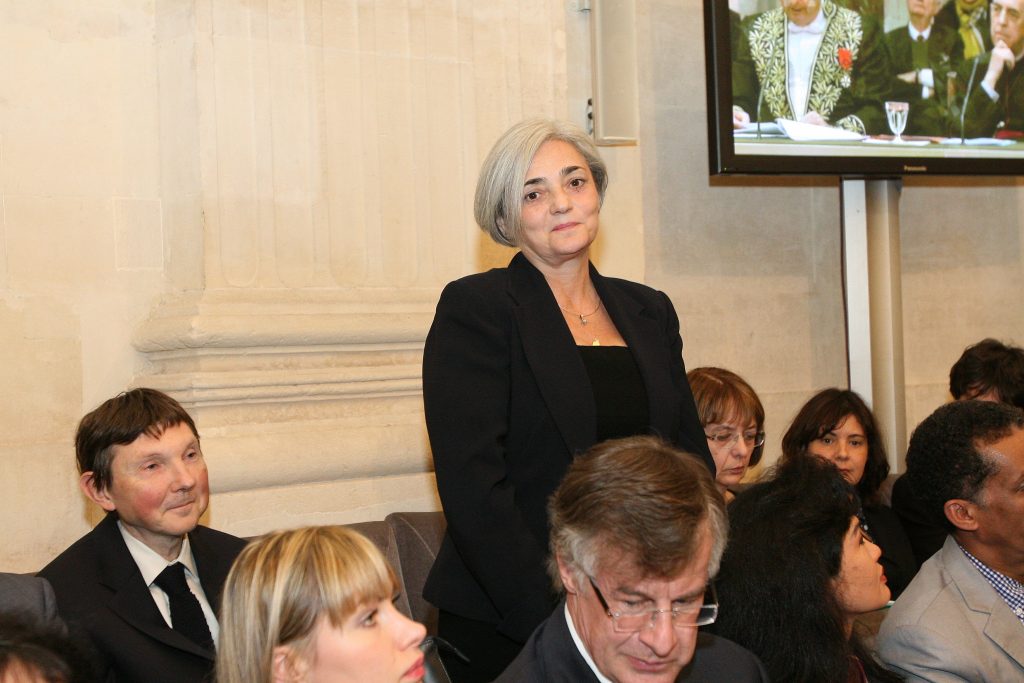
Anca Vasiliu, born in Romania, who became a senior researcher at the CNRS and Professor of ancient philosophy at the University of Paris I Panthéon-Sorbonne, has been awarded the French Academy’s Grand Prize for Philosophy for 2022. Photo: Michel Monsay, Académie Française
Why ancient philosophy? Why didn’t you choose an area of modern or contemporary philosophy?
My first university training was in Byzantine art and culture. It was natural to turn to ancient culture and to the period that seemed to me to be the most fruitful for the encounter between ancient culture and Christian modernity, namely late antiquity and the early medieval period, before scholasticism and the first Western universities.
Also, the interpretation of ancient texts is in some way inevitably related to modern and contemporary philosophy. We are not contemporaries of Plato and Aristotle, however familiar their texts become to us; we are contemporaries of our world, and so we read and study ancient texts from that perspective.
NO ONE CAME LOOKING FOR ME
The European Vocabulary of Philosophies, which you coordinated in the Romanian edition with Alexander Baumgarten, won the Romanian Writers’ Union Prize. How did you receive this recognition and what is the role of such an encyclopaedic tool today? Do philosophers have a common vocabulary in a world where philosophy is increasingly seeking, for the sake of absorbing research funds, to professionalise itself?

What surprised me was the fact that the Romanian Writers’ Union awarded this prize to the Romanian edition of the Vocabulary, but did not contact me in any way, neither to inform me nor to send me the award diploma. I was only contacted by my colleague and friend Alexander Baumgarten who informed me and sent me the diploma with both of our names. I had no contact with the Writers’ Union and this made me sad because I didn’t understand the reason for occultation. But, outside this anecdotal detail, it is good that philosophy was the focus of the Writers’ Union.
This Vocabulary is not only an encyclopaedic tool, but also an extremely useful tool for knowing the origin of concepts and their migration from one language to another. It is a book with both a philosophical and a political ‘thesis’: philosophical concepts are created in a specific language and translate a specific issue that the language in which they were conceived shaped. Transposition into another language, through adaptation or translation, means an implicit reshaping of the problematic and a linguistic and cultural recontextualisation of the concept in question.
The thesis of the almost organic relationship between concept and language means that philosophy is primarily a discipline of language in relation to thought; it also signals that there is no hierarchy of more or less ‘philosophical’ languages, but that each language has its own philosophical potentiality and thus the capacity to assimilate and reshape the concepts it needs according to its own linguistic rules. It is a demonstration of the dialectical relationship between the universal and the particular.
The Vocabulary has a European opening, showing the migration of ‘untranslatables’ (concepts) in almost all European languages, from Greek and Latin to French, German, English, Italian, Spanish, Portuguese, etc. Romanian is also present. One term appears in the French edition.
Which one?
Dor. ( Translator’s note: ‘Dor’is a Romanian word with no exact equivalent in other languages. The closest English translation would be ‘longing’.) However, the Romanian edition contains numerous other terms, analysed linguistically, historically and philosophically, and also includes two background articles on Romanian philosophical vocabulary and the Romanian language.
I don’t see how this book can be used in the preparation of applications for European funds, but it is of major importance, I believe, in the work of translating philosophical works into Romanian, a translation that is also a strengthening and refining of the Romanian philosophical lexicon. The Vocabulary presents a number of translators of philosophy into Romanian, from the 18th century to the mid-20th century, because these translators, some of them renowned, such as Dimitrie Cantemir, Samuil Micu, Ion Heliade Rădulescu or Titu Maiorescu, others less known, such as Eufrosin Poteca, Eftimie Murgu, Treboniu Laurian or Ion Zalomit, were the ones who fixed the Romanian philosophical vocabulary and founded, in their own way, a modern Romanian philosophical school that deserves, perhaps, a closer study.
These translators’ lists are a novelty in the Romanian edition compared to the original edition and to the translations of the Vocabulary into other languages, English, Portuguese, Ukrainian, Arabic, Spanish, etc.
I heard that you had been co-opted at some point in the ICR Paris relaunch team. But the ICR is a dead institution. What will this mean in the future for the promotion of Romanian culture in the West? Whose fault is it for the collapse of the ICR?
I have never been co-opted by the ICR. I don’t know if anyone specifically is to blame for the collapse or if it’s a systemic issue of organisation, staff selection, projects. I have not perceived a concerted policy to promote Romanian culture in the West. It would be worth making an intelligent effort in this direction and allocating well-targeted resources, based on a thorough knowledge of Western worlds.
Especially as other countries have a diplomatic and political ally in culture! Thank you for this philosophical dialogue, in which I am the one who has been the lesser philosopher… naturally!
Anca Vasiliu studied art history and theory at the Nicolae Grigorescu Institute of Fine Arts (1976-1980), obtained a DEA at the University of Poitiers, CESCM (1990-1991) and defended her PhD in philosophy at the University of Paris X Nanterre (1991-1996) with the thesis L’image et le diaphane: contribution à une phénoménologie de la lumière (a.n. The image and the diaphane: contribution to a phenomenology of light).
She has been, in her turn, conducting PhDs since 2005 at the Sorbonne University in Paris.
She was museographer at the Village Museum, then a researcher at the Institute of Art History in Bucharest.
Since 1990, she relocated to Paris and became a researcher at the CNRS, Paris, then, since 2008, project leader at the Centre Léon Robin de recherches sur la pensée antique (translator’s note: The Léon Robin Centre for Research on Ancient Thought), affiliated to the Faculty of Philosophy of the Sorbonne University, and Associate Professor for philosophy at the University of Paris I Pantheon-Sorbonne.
She initiated and edits the international journal of ancient and medieval philosophy Chôra, published by Polirom Iasi.
She has written 10 books on ancient and medieval philosophy.
Readings of Plato’s dialogues such as the Sophist and Phaidros, in addition to the Republic, Socrates’ Apology and Phaidon, Aristotle’s Treatise on the Soul or Epictetus’ Manual can produce a balanced state in the face of the daily challenges of the world we live in.